art, books, interview, poetry

Interview: Jennifer Gurney, author of “Indelible Ink: Postcard Poems and Paintings from the 2025 Postcard Poetry Fest”

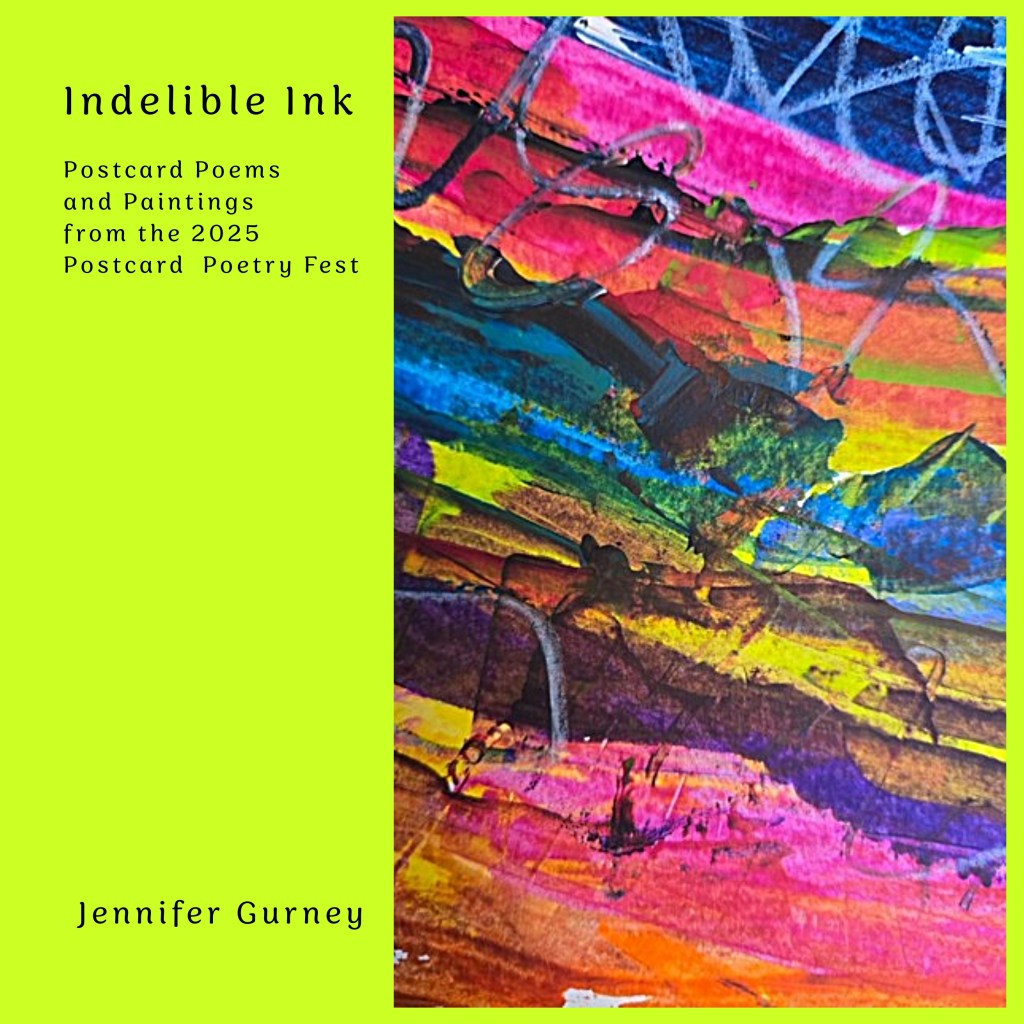
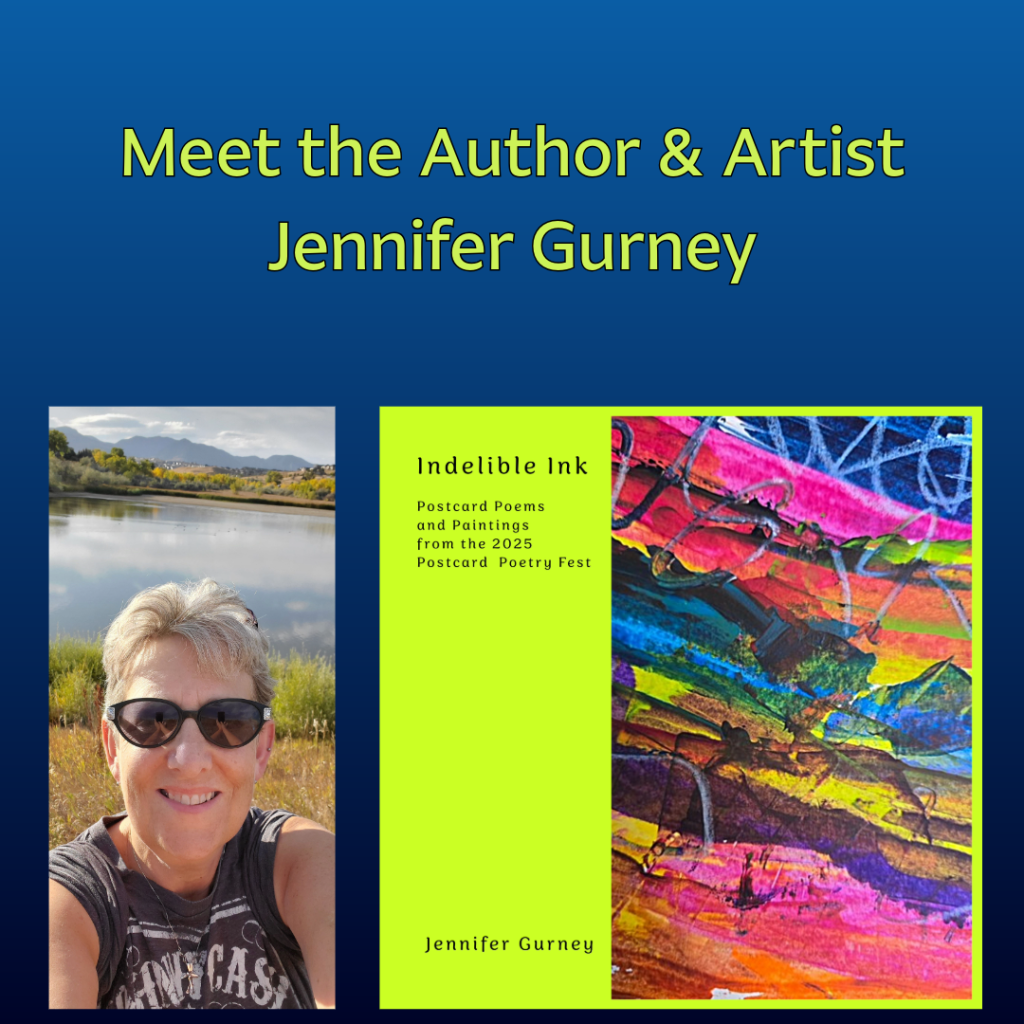
A selfie of Jennifer Gurney by a lake surrounded by trees and mountains, next to the cover of her book 'Indelible Ink' featuring colorful abstract art.

I recently interviewed Jennifer Gurney, author of Indelible Ink: Postcard Poems and Paintings from the 2025 Postcard Poetry Fest. Let’s have a fun read!

The Fest and the Process

1. For readers who’ve never heard of it, what is the Postcard Poetry Fest, and how did you first get involved?

  The Postcard Poetry Fest is an annual experience. Writers from around the world register for it and we each receive 31 names and addresses. During the month of August, we write a poem on the back of a postcard and mail it to a person on our list. In return, we receive poems and postcards from our group. As a writer and painter, both, I enjoy painting my postcards as well as writing the poems. It is a joy to connect with others from around the country, and in some cases, the world. Occasionally, we write a second or third postcard to someone we connect with. I stumbled upon this incredible opportunity on Facebook one summer and am hooked. I cannot imagine an August without it.    

2. You painted all thirty postcards in one day and wrote all thirty poems the next. Why do it that way instead of one card a day?

Sometimes I set a challenge for myself to see what happens. This year I loved the flow of painting the cards on the same day and then writing the poems the next day. Last summer I completed a 24-hour poetry marathon that I loved. Sometimes less is more. And sometimes more is more. This was one of those times. Getting into the flow of painting and writing can sometimes take some doing. Once there, there is a beauty to the state of creativity. I love the shimmery feeling of hanging in the balance between real life and creativity.  

3. What does a day of painting thirty postcards actually look like? Music, snacks, a mess on the table?

What a great question. I have a home studio where I typically paint. It is a spare room on the second floor. But for this excursion, I set up on my kitchen table where I could look outside to the patio, be near my Bose for great tunes and close to the kitchen for snacks and coffee. My cat was curious as to what the heck I was up to and hung close that day, keeping me company.  

4. When you sat down to write, did the painting lead the poem, or did you sometimes ignore the image entirely?

I tend to look at the name of the person I´m writing to (and for) and their address. Sometimes their name gives me a spark and other times knowing where they live is the inspiration. When those fail, I look at the image on the postcard to see what floats to the surface. Other times, something comes to my mind entirely unrelated. And I go with it.  

5. Every poem in this book is a true first draft. Was it hard to let them go out into the world unrevised?

That is a very astute question. As a Virgo, I tend to want things to be in order. Tidy. Accurate. But as a creative type, I am getting better at going with the flow. I am also half German and half Irish, several generations ago. I truly think they form the voices in my head. The German side says get to work. The Irish side says take a break. I laugh when I hear them dickering. So the creative and Irish side of my brain had to take over with the whole first-draft-letting-go business. Luckily it worked. I was tempted several times to fix things, but in the end first draft-ness prevailed.  

6. Was there a card you wanted back the moment it hit the mailbox? Why?

Wow, I had never thought about that. Honestly, no. When I write and paint for others, it is truly theirs from the get-go. Reminds me of a powerful experience a few years ago. Our part of Colorado experienced a horrible fire called the Marshall Fire. Over 1,000 families lost their homes. The elementary school where I teach was hit hardest. Fifty-five families lost their homes. After searching for a way to help, I landed on a project I headed called Art Heals. I pulled paintings I had made together, collected art supplies to donate and hosted 10 events for people to come get free supplies, art and make art there. After I ran out of my own paintings, I painted daily, voraciously, for the Marshall Fire Families. In about six months I gave out 800 paintings to help cover the walls of temporary housing these families were then living in. Hearing their stories at the events, painting beside the children and giving away my art was one of the most poignant experiences of my life.  

The Art

7. Your paintings are bold, layered abstracts. How do you decide when a piece that small is finished?

My sense of completion is changing and evolving over time. The past eight months, I have been working on a series of pieces called Pushing the Limits. I asked myself: what would happen if I keep going after when I normally would have stopped? The results have been transformative. I couldn´t love a painting of my own any more than this series. And I never would have produced these paintings if I hadn´t asked the question. I am finding a new normal of when to stop and when to proceed. It is a fascinating process. I´m nowhere near finished with answering this question.  

8. Tell us about the cover painting. Why did that one get to be the face of the book?

The vibrancy and fluidity of the cover painting stood out to me. I especially love certain color combinations, and this piece had several of them. But to be completely honest, it is my favorite painting in this collection. So it gets the prized position of cover. Don´t we all put our favorite in the best spot available?  

9. You’ve painted the covers for all your poetry books. How do painting and writing feed each other for you?

There is a different kind of energy required for me to paint. I paint nearly every day, some days longer than others. Painting is a way to express my feelings and thoughts in a wordless format. There is a deep, physical element of painting for me. I love to paint big, sometimes 3×4 feet on stretched canvas, sometimes larger on flat canvas. I use music to help create the flow and I try not to look at a clock or my phone when painting so I can stay in that suspended state of flow.   When I am adding layers to a former painting, or sitting to work on small studies, it takes less energy. But still takes energy.   When I am writing, it is a way to communicate what is on my head, heart and soul in word form. I often write haiku-ish poems, which are only three lines. I also write prose poems which can be pages in length. There is less physical energy required for me to write, but still mental and emotional energy that is needed. I write almost every day. Sometimes to a prompt and other times whatever is on my heart. One of my favorite places to write is in nature, on the shore of my favorite lake. I also write on the back of envelopes at a red light. Poems come at all times of day and night and in every place imaginable. When I have something to capture them, they stay.   I love having time to paint and write. What I love more than that is having the time to paint and write while I also have the energy to do so. Since I teach elementary school full-time and am very involved with other pursuits, the time does not always coincide with the energy. When they do, it is bliss.  

The Poems

10. Reviewers have called this a book of summer: watermelon, fireflies, thunderstorms. Did you set out to write about the season, or did it just show up?

I think I write mostly about the life that I am living while I am living it. So it makes sense that during the summer, the poems would come out watermelon, fireflies and thunderstorms.  

11. One poem pleads, “Summer, slow down.” What were you hoping to hold on to?

As a teacher, the summer goes all too quickly. When the calendar turns to August, I tend to get nostalgic that summer is nearly over. Don´t get me wrong. I love teaching and I love my students. But summer is my absolute favorite summer of all. So that one was just noticing that I was not done summering yet. (I´m still not and it´s October!)  

12. Is there a poem in the collection that surprised you when you reread it later?

I think it has surprised me the most to hear what others have to say about my poems. This is the first time I have had others review my book. It has been delightful to hear what they find enjoyable. I also shared a few poems with my fourth-grade class on the day my advance copy arrived. Hearing their giggles and questions added a nice depth to how I view the poems. (They loved the ¨boyfriend¨ one!)  

The Community

13. What was it like to open your mailbox every day and find postcards from strangers?

It was so cool! Every summer when the first one arrives, it is a sharp intake-of-breath moment.  

14. Do you remember a card you received that stuck with you? Tell us about it, please.

My first card that referenced my poem I had sent them felt like connection.  

15. Postcard poetry is very much a gift economy. What does it give you that publishing in journals doesn’t?

The fact that someone else wrote a poem just for me, and I just for them, is unique. In a world that values AI, plastic surgery and one-up-manship, this festival is the epitome of authenticity and generosity. It lifts my soul.  

The Bigger Picture

16. With nearly 3,500 poems published, how does a project built on speed and no revision fit into your practice?

It is a once-a-year experience that I look forward to. To send my poems into the world and find poems in my mailbox is a gift.  

17. What would you say to a reader who wants to try the Fest but is scared of sharing first drafts?

There is nothing to be afraid of. You have a poem on your heart right now. Just write it down on the back of a postcard. And add a stamp and mail it. Then do it again each day for a month. And you will find your voice in setting your poems free.  

18. Why turn this exchange into a book? What did you want readers to take away from it?

I love this collection of short poems and small paintings. And I love this Postcard Poetry Fest. Pulling them together into a book is a way of honoring this community of poets and bringing a taste of summer into the world in book form.  

19. Where can readers find you and Indelible Ink online?

I am hoping to have a website at some point in the future. For now, you can find Indelible Ink and my other books on Amazon and Barnes and Noble. If you search ¨Jennifer Gurney poetry¨ or ¨Jennifer Gurney art¨ you can find other examples. I have a small Etsy site that is Jennifer Gurney Art. And my Insta is @pelican6527.  

Lightning Round

20. Favorite color to paint with?

lime green

21. Best place to write a poem?

shore of my lake

22. Watermelon or fireflies?

fireflies

23. One word for your 2025 Fest?

fulfilling
Cover of the book 'Indelible Ink' featuring vibrant abstract artwork with bold colors, including pink, blue, green, and yellow, alongside text that includes the subtitle 'Postcard Poems and Paintings from the 2025 Postcard Poetry Fest' and the author's name 'Jennifer Gurney'.

Get your copy of Indelible Ink and learn more!

Book Announcements, books, children's books, Children's Books, nature

Meet Mr. Krippet: How Two Toddlers and One Mysterious Sound Inspired a Children’s Book

Every story starts somewhere. For Mr. Krippet, the illustrated children’s book by veteran educator Emma L. Sembly, it started on an autumn stroller ride through the park, when a twenty-two-month-old asked a simple question. Here, in Emma’s own words, is how Mr. Krippet came to be.

In Emma’s words

“Aunt Emma!

Do you hear it?

I hear a krippet.”

It was my turn to take my twenty-two-month-old fraternal great-nieces on their daily stroller ride through the park near their grandmother’s house. It was a balmy autumn day, and I had been looking forward to taking them on an “adventure” in the park. I could never predict what new perspective they would bring into my consciousness. Children have a way of doing that, don’t they? Some minor thing that we adults take for granted appears magical and mysterious to them, and their wonderment often reminds grownups not to take the ordinary miracles of living for granted.

The girls, being twins, were just learning how to enunciate words so that others could easily understand them. But their private twin language had not prevented them from exploring and expressing to everyone their discoveries of the world around them.

So, when Sierra questioned if I had heard what she identified as a krippet, she was very intentional about confirming a particular sound, among all the other sounds that we had identified as we explored the surroundings. We had parked their stroller, and the toddlers had freely moved about. They pointed to and commented on the leaves, weeds, flowers, and grass, honking geese, various twittering birds, rocks, dirt, pebbles, and the stream nearby. Therefore, as peaceful as it was that afternoon, the air was full of the sounds produced by the collective natural community.

Sierra had distinguished a sound that she attributed to a krippet. I never saw the source of the sound, but she was resolute. Her sister, Sienna, absolutely agreed. I had my suspicions, of course. (You, too?) But his true identity remains one of life’s great mysteries, and that, Dear Reader, is a very good thing.

From the park to the page

That afternoon’s mystery became Mr. Krippet, the most industrious, well-mannered, and well-respected member of the meadow. Known for his magnificent tenor voice and his skill as a shoemaker for the ants, he spends the warm months singing, working, and making friends. But winter is coming, and Mr. Krippet has nowhere to live and nothing stored away to eat. Will he make the baker’s acquaintance, and earn a place by the fire, before the first snow falls?

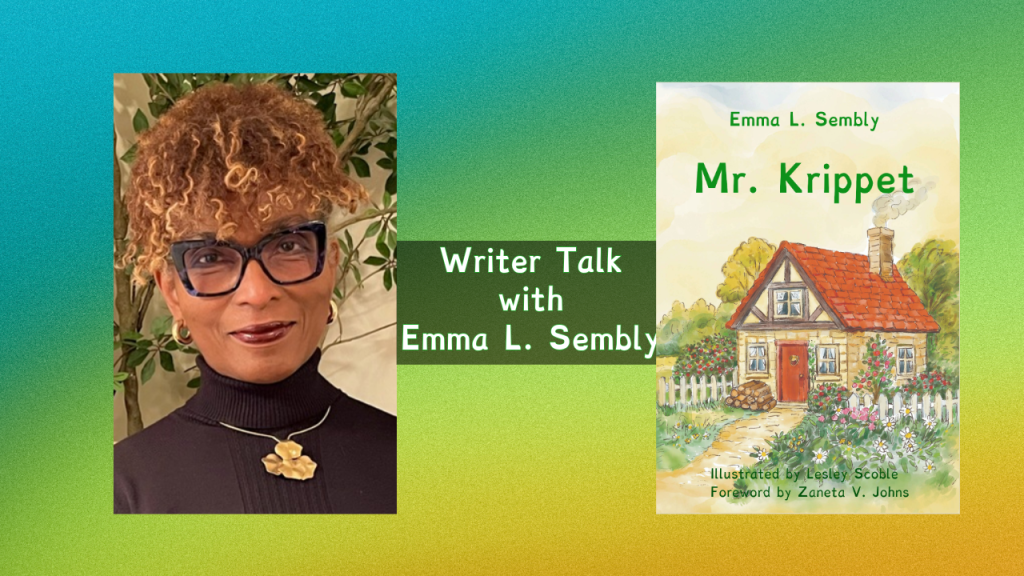
Brought to life by Lesley Scoble’s charming illustrations, with a foreword by poet Zaneta V. Johns, Mr. Krippet is a gentle read-aloud about kindness, hard work, planning ahead, and good manners. Its enriched vocabulary and rhythmic voice make it a favorite for bedtime, classrooms, and libraries.

What readers are saying

“I am enchanted by this simple and beautiful tale. With lush descriptions of the meadow and lovely portrayals of those who inhabit it, Emma L. Sembly takes us on a loving journey to a warm and cozy finale.” — Marjorie A. Schenk, Voice Artist

“Educationally, I liked how Ms. Sembly very gently pushes an enriched vocabulary through descriptions of characters and settings… Mr. Krippet is a great book for the elementary library as well as for a child’s personal library.” — Kirk P. Mullen, Retired School Psychologist and Reading Teacher

Watch the Book Trailer

Emma L. Sembly Get your copy today!

Meet Emma Sembly

Announcements, Book Announcements, book launch, books, poetry, Poets & Events

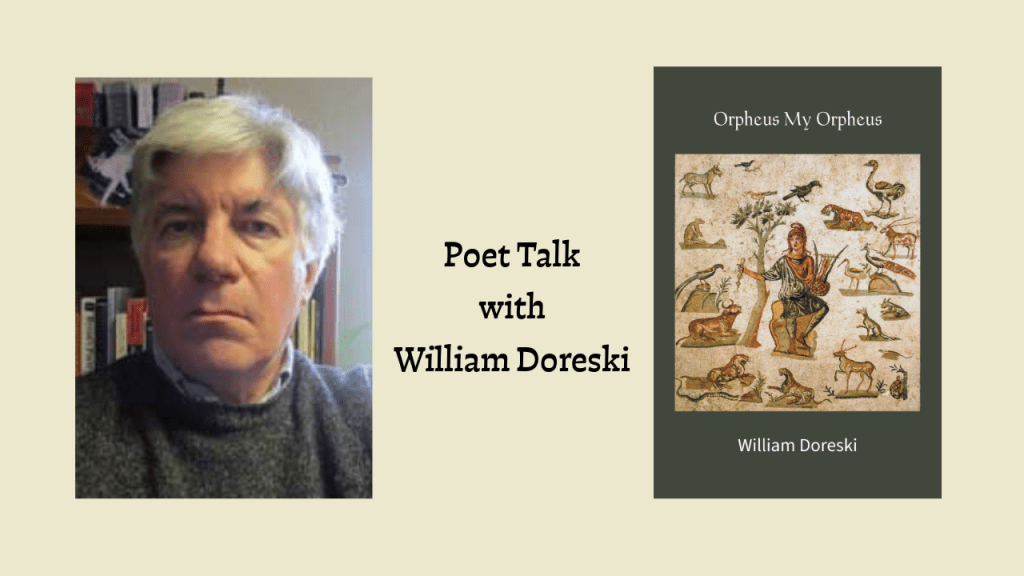
William Doreski on “Orpheus My Orpheus,” Myth, and a Life Devoted to Verse

When New Hampshire poet William Doreski sat down with Lisa Tomey-Zonneveld of Prolific Pulse Press to talk about his new collection, Orpheus My Orpheus, the conversation ranged from a stubborn high school argument about E.E. Cummings to an early morning writing routine, and from Robert Lowell to a poem about RadioShack laptops that write their own deranged love poetry. It’s a wide-ranging, generous conversation — and it offers a rare window into how a poet’s voice gets built over a lifetime.

A poet almost by accident

Doreski’s origin story starts with resistance, not inspiration. As a high schooler in Connecticut, he was assigned some E.E. Cummings poems by a teacher barely older than his students — and he wasn’t impressed. “This doesn’t seem like poetry to me,” he told his teacher. “Anybody could write this stuff.” His teacher’s response became a turning point: go home and try it yourself.

“I spent several frustrating hours,” Doreski recalls, “learning what Mr. Cummings was doing was held a lot better than I could do.” Cummings never became a favorite, but the exercise cracked something open. From there, Doreski found his way to Wallace Stevens — drawn in partly because Stevens was, like him, a Connecticut poet — and then to Hart Crane, whose Collected Poems was handed to him by a working poet he met in a Springfield, Massachusetts bookstore. Reading about Crane’s death by suicide at 32 was, in Doreski’s words, horrifying — but Crane became an essential influence all the same. Rounding out his early education was Allen Tate, whose Pulitzer- and National Book Award–winning debut left Doreski impressed by a voice he found “very hard to imitate” — a lesson that would shape his own search for a distinctive style.

A career, and a well-timed exit

Doreski went on to teach for 34 years at Keene State College in New Hampshire, with a decade before that as an adjunct at several Boston-area universities, including Boston University, where he studied under the influential critic Helen Vendler. He’s candid about why he chose to retire when he did, at 70: “There comes a point where you may know a lot more than the students, but… their culture has become so different, so far from mine, that I’m really not the right person to be teaching them anymore.” He’d seen colleagues stay too long and become, in his words, “objects of ridicule among the students” — and he wanted to leave on his own terms.

It turned out to be well-timed. Just a few years after Doreski retired, Keene State laid off several tenured English faculty amid enrollment declines tied to New Hampshire’s shifting demographics. “I probably, with my seniority and higher salary, probably would have been a ripe candidate,” he notes.

The discipline of retirement

Retirement didn’t slow Doreski’s writing down — if anything, it gave it more shape. He describes waking early in the morning simply to have quiet, uninterrupted time to read and, some mornings, to write. “It gets sets the right kind of pace for your day,” he says. The flexibility of retirement means he can step away from gardening or painting the house to return to a poem started that morning — “a luxury,” as he puts it, “to be able to pick and choose your time.”

Inside the poems

During the conversation, Doreski reads two poems from the new collection. The title poem, “Orpheus My Orpheus,” restages the Greek myth as a piece of avant-garde 1960s-style theater — complete with a fiberglass fish tank stage, a disembodied singing head placed in a cooler by EMTs, maenads in “fright wigs,” and a narrator accepting a Pulitzer for drama before retreating, Eurydice in hand, toward the underworld. Doreski traces some of its spirit back to a book he’d been reading about the New York avant-garde scene of the 1960s — happenings, underground film, and the kind of theatrical strangeness he was, in his words, “too young to really fully appreciate” at the time.

The second poem he reads, “Computers Go Crazy,” imagines RadioShack display computers spontaneously generating and publishing deranged lyric fragments — and refusing to stop even after being unplugged and smashed on the floor. It’s a playful premise, but it illustrates something Doreski returns to throughout the interview: his belief in verse as a shaped thing, distinct from “broken prose.” Years ago, he says, he stopped writing free verse entirely, worried he was just writing sentences with line breaks. Returning to Wallace Stevens’s example — deceptively simple, but unmistakably verse — helped him find his way back to line, rhythm, and form as meaning-making tools in their own right.

On reading poems aloud — and the people who shaped him

Doreski credits Helen Vendler with instilling in him the practice of reading poems aloud, even alone — a habit he says has taught him more about a poem than silent reading ever could. “A lot of poetry… does not read aloud very well at all,” he observes, even work published in respected magazines.

The conversation also touches on the poets and friends who shaped him — including Robert Lowell, whom Doreski knew personally but has deliberately never written about, wary of adding to the “gush of memoir” that followed Lowell’s death. Of Helen Vendler, he jokes that her ghost would “tell me off” if he tried. It’s a glimpse of how seriously Doreski takes the boundary between friendship and material — a poem, he says, quoting T.S. Eliot’s idea of the “objective correlative,” has to become its own thing, not a sermon or a memoir.

A candid note on where poetry stands today

Later in the conversation, Doreski reflects frankly on the state of the literary world — the shrinking audience for poetry, bookstores where used poetry collections outsell new ones simply because they’re cheaper, and a broader cultural shift away from reading. It’s a wistful, clear-eyed assessment from someone who has spent a lifetime inside that world, delivered without bitterness — just honest observation, and an unmistakable commitment to keep writing anyway.

About the book

Orpheus My Orpheus is a slim, restless collection of seventeen poems in which art is never mere decoration — it’s a disruptive force that exposes the hidden dimensions of experience, and poetry itself becomes a form of survival even when the body fails. Written in fast-swerving accentual verse, the collection moves from the domestic to the mythic to the grotesque with startling emotional agility, echoing poets like Mark Strand and Stephen Dobyns.

Order Orpheus My Orpheus and learn more about William Doreski here 🎥 Watch the full interview on YouTube.

Announcements, Book Announcements, books, Children's Books, illustrator, interview, kindness, Poets & Events, writing

Writer Talk with Emma L. Sembly – With her Debut Children’s Book “Mr. Krippet”

From Classroom to Children’s Books — An Interview with Emma L. Sembly

For Emma L. Sembly, every story teaches a lesson, and every life is a story.

Emma is a life-long storyteller and lover of stories. As a child, Emma loved telling fantastical tales, starting with a captive audience consisting of her little sister. After she grew up, Emma continued to create stories that her students loved.

With a bachelor’s degree in psychology from Elmhurst College and a master’s degree in reading from Johns Hopkins University, Emma set out on a thirty-seven-year journey as an educator in the Baltimore City Public School System, where she taught children with different abilities on both elementary and high school levels. During that time, she also created stories for her own daughter and niece, then for her grandchildren and great nieces.

Now, Emma creates stories for children of all ages, especially the young at heart.

Emma also has a podcast, Just Folks: Conversations with Emma, in which she provides a platform where regular, everyday humans can share their own stories with listeners of all persuasions. Life lessons shared.

Drawing and writing poetry are among Emma’s favorite things to do. She also enjoys planting red flowers around her home. And when she’s not chatting it up with her kitty of thirteen years, she’s having a blast with both of her Favorite Number One Grandchildren.

“What I have learned as a writer and podcaster, is that our stories, our bedtime stories, our fables, are the gateways to life’s lessons,” Emma says, “and we all have a story to tell.”

https://emmaleesembly.com/
https://www.prolificpulse.com/emmalsembly

In a meadow full of chirping, squawking, climbing, crawling creatures, Mr. Krippet is the most industrious, well-mannered, and well-respected of them all. Known for his magnificent tenor voice and his skill as a shoemaker for the ants, he’s spent all summer singing, working, and making friends. But winter is coming — and Mr. Krippet has nowhere to live and nothing stored away to eat. Will he make the baker’s acquaintance — and earn a place by the fire — before the first snow falls? Written by veteran educator Emma L. Sembly and illustrated by Lesley Scoble, with a foreword by celebrated poet Zaneta V. Johns, Mr. Krippet is a gentle, richly imagined tale about dedication, preparation, and friendship. It’s a natural companion to classic fable-and-fall stories about industriousness and community — perfect for bedtime, classroom read-alouds, and quiet corner adventures. Author: Emma L. Sembly – Illustrator: Lesley Scoble – Foreword: Zaneta V. Johns

Get the book: https://www.prolificpulse.com/emmalsembly #MrKrippet #ChildrensBooks #ReadAloud #BedtimeStory #KidsBooks

Announcements, Book Announcements, book launch, books, poetry, Poetry Forms, Poets & Events

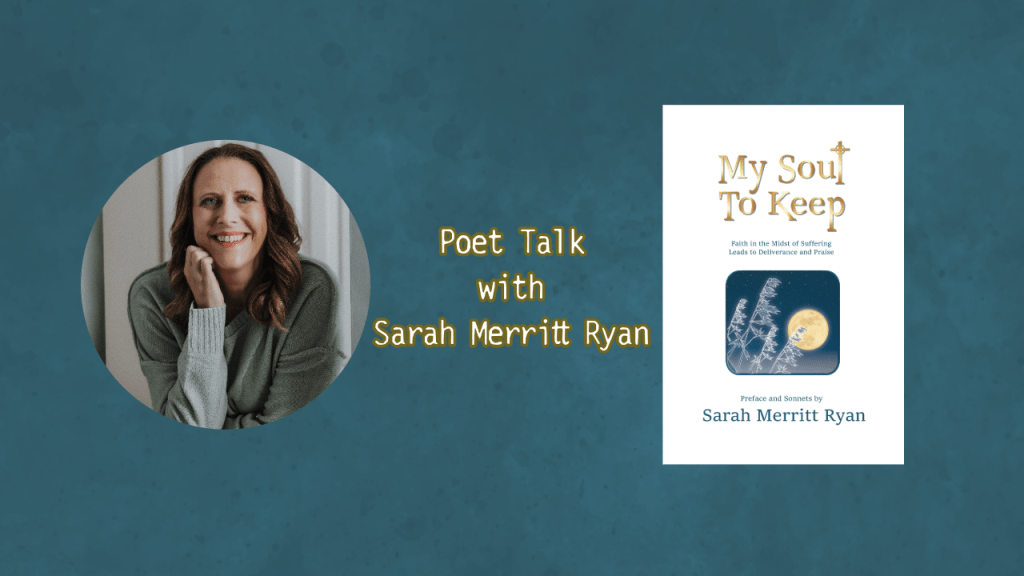
Poet Talk: My Soul to Keep by Sarah Merritt Ryan

I met with Sarah Merritt Ryan recently to discuss her upcoming book My Soul to Keep.

Have a listen or watch and listen.

Podcast

About the Book

My Soul to Keep is a deeply personal and spiritually resonant collection of sonnets that explores what it truly means to walk with God through the darkest seasons of life. Written primarily from a Christian perspective, these poems offer an intimate portrait of faith — not as a smooth and effortless journey, but as a living, breathing relationship that is tested, stretched, and ultimately strengthened through suffering.

At the heart of this collection is a profound truth: hardship does not have to destroy us. Long-suffering, when carried in faith, becomes a crucible that deepens our connection to God and shapes us into something more resilient, more compassionate, and more whole. Faith here is not static — it ebbs and flows, wavers and steadies — and that honest portrayal makes these sonnets feel achingly real.

Many of these poems are written from a woman’s perspective, and several speak with quiet courage to the wounds left by broken relationships and the pain inflicted by others. Yet even these most tender and difficult places are held within a larger story of survival and grace.

What ultimately distinguishes this collection is its vision of the final destination of enduring trial — not merely survival, but praise. To give thanks to God in the aftermath of suffering is portrayed here as both an act of healing and an act of liberation. Praise cleanses the heart of bitterness, loosens the grip of the past, and opens the soul to receive what God has always intended: wholeness, peace, and renewed purpose.

My Soul to Keep is for anyone who has ever wrestled with God and refused to let go.

Get your copy: https://www.prolificpulse.com/sarahmerrittryan

About the Author

Sarah Merritt Ryan is a North Carolina native who writes from a Christian perspective on faith and suffering, and this collection of sonnets is her first book. She is a member of the United Church of Christ. Her faith has helped her survive many trials, including her battle with schizophrenia.

     Through patience, a refusal to give up, and believing there could be a bigger picture for her life, even when she could not see it, she persisted and did make a full recovery, going on to get married, become a mother, and rebuild her career. She has been symptom-free for 14 years while on medication for life, after having three psychotic breaks in two years.

     Through a desire to help others have a better emotional experience than she did, she is now also a writer, speaker, and advocate for emotional recovery from psychotic disorders. Her writings on mental health include poetry, blogging, memoir, fiction, and academic publications.

     She has a blog on Psychology Today called Healing Mind: My journey to cognitive and emotional recovery, which is used as training material for resident psychiatrists at the University of North Carolina at Chapel Hill (UNC-CH) Schizophrenia Treatment and Evaluation (STEP) Program and is republished on the UNC School of Medicine website. She is a Certified Peer Support Specialist who works for the UNC Center for Community Excellence in Mental Health.

     She also blogs for Nami.org and Life Effects, a blog by Teva Pharmaceuticals. She has been published twice in Writer’s Digest on topics related to mental illness. She has been published twice in the academic journal, Schizophrenia Bulletin Open. She has a full-length memoir in the works.

     She is also a public speaker and NAMI volunteer who was named Hometown Hero in 2024 by the North Carolina Women’s Courage Professional Soccer Team, Lenovo, and NAMI Wake County for her mental health advocacy work in the Raleigh-Durham area. She is also the Parent Advocate for the Wake County Public School System, representing parents living with mental illness.

     She has a degree in Journalism from UNC-Chapel Hill and a Master of Science degree in Communication from NCSU.

​Her website is sarahmerrittryan.com

Book Launch

If you are in the Raleigh, North Carolina area, you are welcome to join the Book Launch. Registration