
Announcements, Book Announcements, book launch, books, poetry, Poets & Events

William Doreski on “Orpheus My Orpheus,” Myth, and a Life Devoted to Verse

When New Hampshire poet William Doreski sat down with Lisa Tomey-Zonneveld of Prolific Pulse Press to talk about his new collection, Orpheus My Orpheus, the conversation ranged from a stubborn high school argument about E.E. Cummings to an early morning writing routine, and from Robert Lowell to a poem about RadioShack laptops that write their own deranged love poetry. It’s a wide-ranging, generous conversation — and it offers a rare window into how a poet’s voice gets built over a lifetime.

A poet almost by accident

Doreski’s origin story starts with resistance, not inspiration. As a high schooler in Connecticut, he was assigned some E.E. Cummings poems by a teacher barely older than his students — and he wasn’t impressed. “This doesn’t seem like poetry to me,” he told his teacher. “Anybody could write this stuff.” His teacher’s response became a turning point: go home and try it yourself.

“I spent several frustrating hours,” Doreski recalls, “learning what Mr. Cummings was doing was held a lot better than I could do.” Cummings never became a favorite, but the exercise cracked something open. From there, Doreski found his way to Wallace Stevens — drawn in partly because Stevens was, like him, a Connecticut poet — and then to Hart Crane, whose Collected Poems was handed to him by a working poet he met in a Springfield, Massachusetts bookstore. Reading about Crane’s death by suicide at 32 was, in Doreski’s words, horrifying — but Crane became an essential influence all the same. Rounding out his early education was Allen Tate, whose Pulitzer- and National Book Award–winning debut left Doreski impressed by a voice he found “very hard to imitate” — a lesson that would shape his own search for a distinctive style.

A career, and a well-timed exit

Doreski went on to teach for 34 years at Keene State College in New Hampshire, with a decade before that as an adjunct at several Boston-area universities, including Boston University, where he studied under the influential critic Helen Vendler. He’s candid about why he chose to retire when he did, at 70: “There comes a point where you may know a lot more than the students, but… their culture has become so different, so far from mine, that I’m really not the right person to be teaching them anymore.” He’d seen colleagues stay too long and become, in his words, “objects of ridicule among the students” — and he wanted to leave on his own terms.

It turned out to be well-timed. Just a few years after Doreski retired, Keene State laid off several tenured English faculty amid enrollment declines tied to New Hampshire’s shifting demographics. “I probably, with my seniority and higher salary, probably would have been a ripe candidate,” he notes.

The discipline of retirement

Retirement didn’t slow Doreski’s writing down — if anything, it gave it more shape. He describes waking early in the morning simply to have quiet, uninterrupted time to read and, some mornings, to write. “It gets sets the right kind of pace for your day,” he says. The flexibility of retirement means he can step away from gardening or painting the house to return to a poem started that morning — “a luxury,” as he puts it, “to be able to pick and choose your time.”

Inside the poems

During the conversation, Doreski reads two poems from the new collection. The title poem, “Orpheus My Orpheus,” restages the Greek myth as a piece of avant-garde 1960s-style theater — complete with a fiberglass fish tank stage, a disembodied singing head placed in a cooler by EMTs, maenads in “fright wigs,” and a narrator accepting a Pulitzer for drama before retreating, Eurydice in hand, toward the underworld. Doreski traces some of its spirit back to a book he’d been reading about the New York avant-garde scene of the 1960s — happenings, underground film, and the kind of theatrical strangeness he was, in his words, “too young to really fully appreciate” at the time.

The second poem he reads, “Computers Go Crazy,” imagines RadioShack display computers spontaneously generating and publishing deranged lyric fragments — and refusing to stop even after being unplugged and smashed on the floor. It’s a playful premise, but it illustrates something Doreski returns to throughout the interview: his belief in verse as a shaped thing, distinct from “broken prose.” Years ago, he says, he stopped writing free verse entirely, worried he was just writing sentences with line breaks. Returning to Wallace Stevens’s example — deceptively simple, but unmistakably verse — helped him find his way back to line, rhythm, and form as meaning-making tools in their own right.

On reading poems aloud — and the people who shaped him

Doreski credits Helen Vendler with instilling in him the practice of reading poems aloud, even alone — a habit he says has taught him more about a poem than silent reading ever could. “A lot of poetry… does not read aloud very well at all,” he observes, even work published in respected magazines.

The conversation also touches on the poets and friends who shaped him — including Robert Lowell, whom Doreski knew personally but has deliberately never written about, wary of adding to the “gush of memoir” that followed Lowell’s death. Of Helen Vendler, he jokes that her ghost would “tell me off” if he tried. It’s a glimpse of how seriously Doreski takes the boundary between friendship and material — a poem, he says, quoting T.S. Eliot’s idea of the “objective correlative,” has to become its own thing, not a sermon or a memoir.

A candid note on where poetry stands today

Later in the conversation, Doreski reflects frankly on the state of the literary world — the shrinking audience for poetry, bookstores where used poetry collections outsell new ones simply because they’re cheaper, and a broader cultural shift away from reading. It’s a wistful, clear-eyed assessment from someone who has spent a lifetime inside that world, delivered without bitterness — just honest observation, and an unmistakable commitment to keep writing anyway.

About the book

Orpheus My Orpheus is a slim, restless collection of seventeen poems in which art is never mere decoration — it’s a disruptive force that exposes the hidden dimensions of experience, and poetry itself becomes a form of survival even when the body fails. Written in fast-swerving accentual verse, the collection moves from the domestic to the mythic to the grotesque with startling emotional agility, echoing poets like Mark Strand and Stephen Dobyns.

Order Orpheus My Orpheus and learn more about William Doreski here 🎥 Watch the full interview on YouTube.

Book Announcements, poetry

New Release! “Man Afield” by Jim Krosschell

We are pleased to announce the New Release of Man Afield by Jim Krosschell.

Jim Krosschell has published poems and essays in some 85 journals, plus two essay collections: One Man’s Maine, which won a Maine Literary Award, and Owls Head Revisited. He lives in Deer Isle, ME and Newton, MA, and volunteers on Boards for Coastal Mountains Land Trust and the Maine Writers & Publishers Alliance.

His poetry collection, Man Afield is a lyrical journey through the living world, guided by a backyard naturalist attuned to both wonder and warning. These poems chronicle spiritual and physical excursions into landscapes larger than any one mind or body — places where awe, joy, disorientation, and reckoning intertwine.

Organized in six evocative sections, the collection:

I. bears witness from a seaside deck;

II. wanders through yard and neighboring woods;

III. explores the shifting shoreline;

IV. imagines the vast and restless ocean;

V. surveys the scars of environmental damage;

VI. honors home in its many meanings.

Throughout, the poems dwell in the charged space where humans and the natural world meet. They examine our peculiar paradox: we are the only species that knowingly fouls its own nest — and the only one capable of choosing restraint. With clear-eyed honesty, Man Afield mourns the grinding erosion of precious places while celebrating the stubborn beauty that persists despite us — and sometimes because of us.

From deck to forest trail, from tidal pull to smoke-streaked sky, these poems trace one person’s evolving relationship with plants, animals, weather, memory, and spirit. Intimate yet expansive, they invite readers to travel outward into the wild and inward toward belonging.​

Man Afield is at once a field journal, a meditation, and a love song — to earth, to home, and to the fragile bond between them./


What reviewers have to say:

A “backyard naturalist,” Jim Krosschell writes about human relationships with the natural world. His previous books include One Man’s Maine and Owls Head Revisited. He has been Board President for Coastal Mountains Land Trust and the Maine Writers & Publishers Alliance and continues to volunteer in conservation and publishing communities. Before retirement, he worked in science publishing in Boston and now lives in Deer Isle, Maine and Newton, Massachusetts.

I read Man Afield in one sitting, delighted as the speaker in these poems trains his roving eyes and ears on his surroundings and the wonders of the natural world, searching for any “wildly beating heart.” There is no high or low in the cataloguing and noticing that happens here—gnats, ants, many kinds of birds and trees, rivers, oceans, the delicious names of plants all receive attention and care. These poems are clear-eyed, not romantic—they take in the “miles of Walmart, Ford, and Shell” and Land Cruisers “junked on the veldt” and know well how precarious our world is. Krosschell still chooses, again and again, to draw his careful attention to, say, three loons on “this stretch of shore / on the coast of Maine…” and to allow himself, and us, to be mesmerized.

Gibson Fay-LeBlanc, Author of Deke Dangle Dive


What a satisfying and uplifting ride it is to join Krosschell’s journey from young man, “with his dreams of rivers” to old man with his “permanent perch on a hermit’s wild ledge,” overlooking the forest and coast of Maine, mindful of carbon’s engulfing demise, delighting in the “manna of joy administered only in crumbs.” From Man Afield’s opening flight of poems that expose what’s small and barely perceptible, to its closing epics and late-life gatherings, these are poems of a specific earned grace brought to beauty by Krosschell’s firm roots in the natural world. There is lament here for irreparable loss but also humor and social commentary (“Turkeys,” “White Man’s Footstep”), a retort to Frost (“Whose Woods These Are”), and a brilliant ode of reflection to Thoreau, “March Into April” and its haunting question, “will spring still come to the window and wake me?” Man Afield’s poems are grounded in the terra firma of New England, but their reach is universal, and they reward fully with the music of observation.

Bruce Willard, Author of In Light of Stars


In graceful, accessible language, Jim Krosschell’s poems create a glass pane through which to view and ponder the wonders of the natural world and the fraught relationship of humankind to it. Often clear and bright, sometimes dark, and always reflective, these poems reveal a man alive to the world he observes precisely and lovingly, and to which he longs to connect his self and the transcendent. Something we all, in our own way, seek in our lives. Man Afield is a collection that invites us in to learn from one man’s journey to our benefit.

Brian Schulz, Poet

Get your copy at ProlificPulse.com

Book Reviews, poetry

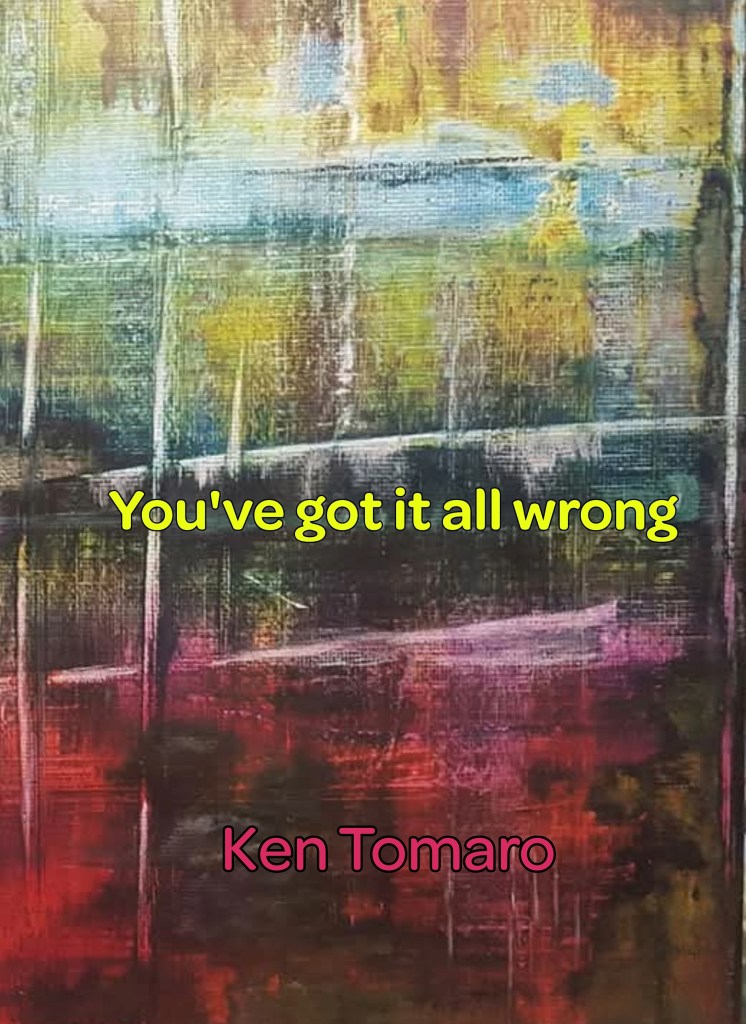
The House of Representatives: a review by Peter Mladinic of “You’ve got it all wrong” by Ken Tomaro

Thank you to Peter Mladinic for this excellent review of Ken Tomaro's latest collection. [Sensitive Content Warning]

The House of Representatives: a review of You’ve got it all wrong, by Ken Tomaro. Prolific Pulse Press. Raleigh, NC. 2025. $12.95 paper.

Reviewed by Peter Mladinic

Just as there are representatives in politics, poetry too has its representatives, one difference being: there’s no party line to the imagination. Ken Tomaro, in the state of Ohio, is reminiscent of two poets in the neighboring state of Pennsylvania, John Yamrus and Dan Flore III. Like them, he eschews capitalization and standard punctuation, and like them, his comments are blunt, succinct, and direct. Yet all there are distinct voices. Ken Tomaro, like the hero in Frank Capra’s film Mr. Smith Goes to Washington, speaks for all of us. Three things worth noting in Tomaro’s poems are his imagery: his syntax, particularly his interpolated interjections, and his use of the first-person plural we.

Tomaro’s images are exacting, “on the mark, in that they are essential to the whole poem. In “I remember the distinct aroma” as the title indicates, the olfactory takes precedence. The speaker, in a coffee shop smelled an aroma reminiscent of “Polish donuts…from childhood.” The coffee shop workers “couldn’t tell me which pastry it was because I couldn’t describe it.” At the end, his question “but it goes deeper than that, doesn’t it?” is like the donut image at the start, absolutely essential to an appreciation of this imagist poem about memory. “Make it stop” relies on a tactile image. The speaker is irked or annoyed by people violating his personal space.

they were standing 3 feet from my desk
talking about their kids,
comparing all the sports they were in
all the after-school activities
which coach does his job, which one needs to retire
blocking the isle so I couldn’t escape if I wanted to

This tactile image leads to a comment on society that is both poignant and funny. His pain is his readers’ pleasure as he says, “death is 5 feet away from me in the living room every night.” "Cash,” paper money, in “I can’t give you that” is what the speaker wants for Christmas. It leads him to say, “I can’t give her her old life back / I can’t give her a new set of legs / I can’t give her a million dollars.” This poem is similar to, yet opposite from “Playing God.” In that poem he looks out a window, “down on the traffic / speeding down the highways.” Rather than the person painfully aware of his limitations in “I can’t give you that,” here, in “Playing God” he pretends the cars are little race cars, “toys / running on an electric track / and I am …deciding how fast or slow they go.” The interpolated interjection is an element of syntax Tomaro uses to achieve compactness in his poems. It is particularly effective in “Summer of ‘89, where he puts one complete comment inside another.

the cement blocks we walked along were perfect squares
but now, after years of Lake Erie slapping against them
made them worn down and smooth
there were little pockets along the surface

“Lake Erie slapping against them made them warm and smooth” the complete comment within the other complete comment “The cement blocks …were perfect squares / but now …there were little pockets along the surface “layers the texture of those blocks, adds to these things readers can touch. In “Chickens,” the speaker, running errands, sees something out of the ordinary, “two chickens pecking away at a pile of leaves …in suburbia.” He says, “I laugh for a moment at the absurdity of what I’ve seen / this is truly absurd; I can’t be the only one who thinks so.”

The comment within the comment— “this is truly absurd” accents his surprise at seeing “chickens where chickens shouldn’t be.” Other poems in which interpolated interjections play a vital part are “Reminiscence” and “Bad genes. In “A glittering shitshow of smash-faced adults” the interpolated interjection acts as a bridge of time linking adulthood to childhood:

I’m sitting in the office
listening to John Prine
pining for that good old country life
feeling all weepy and shit
he knew the deal
he knew how it was
and there I was
a 14-year-old boy
with a half-assed mustache
surrounded by a town full of smashed-faced kids

The interjections “he knew the deal / he knew how it was” are followed by “I was,” and a memory of childhood.

Like the hero in Frank Capra’s Mr. Smith Goes to Washington, Ken Tomaro speaks for we, the people. One of his talents is that his deeply personal voice speaks for all of us. Like us, the speaker is an imperfect person living in an imperfect world. If he could he’d tell God that “this masterpiece he created / is just a pile of mud and sticks / slapped together haphazardly.” The title of the book comes from the first line of “We all carry anger.” With his direct address, the speaker conveys empathy. “I think you’ve got it all wrong / but I can see your grief from losing something.” Farther along, “I know you had a plan / and maybe it didn’t go as planned.” And finally, (profoundly), “you continue to do all these things / you say you can’t do /without even realizing you’re doing them.” This book does not lack for humor. “The big God damned bang” gives a unique spin to Adam and Eve’s fall from grace:

This is for you and only you. Go forth and explore, take in all the beauty and the glory. Go wherever you want, do whatever you want. Think and feel however you want. Just don’t touch that fucking apple, is all I’m saying. Give me a fucking break, man. Don’t invite me into your house for a party and tell me eat, drink, be merry, just don’t sit on the couch in the family room. It’s an antique, my grandmother’s, in pristine condition…

This irreverently funny passage conveys an exasperation people must feel at one time or another when thinking about Adam and Eve’s being cast out of paradise, to toil and sweat and grow old and die.

This passage of satire depicts the human condition of transience and mortality. Ken Tomaro’s topic is the human condition. The quotable passages in his poems are many. He is poignant, funny, irreverent, inquisitive, and contemplative. With an attentively attuned ear and a sharp eye for beauty, he makes the subjective objective, the local universal. He says things his way, as he simultaneously instructs and entertains. At the end of the book, he addresses his readers. “Here’s wishing you well and safe travels.” He means it. And his book is deserving of many readers.
...
Peter Mladinic was born and raised in New Jersey. He graduated from the University of Minnesota in 1973 and earned an MFA in Creative Writing at the University of Arkansas in 1985. Professor emeritus at New Mexico Junior College, where he was a member of the English faculty for thirty years. During that time, he was a board member of the Lea County Museum and president of the Lea County Humane Society. He is the author of seven books of poems; his most recent book, Maiden Rock, is available from Uncollected Press (2024). An animal rights advocate, he lives in Hobbs, New Mexico, USA.

You've Got it All Wrong, Prolific Pulse Press LLC (2025) is available at online stores.
Announcements, Book Announcements, poetry

ANNOUNCEMENT! “You’ve got it all wrong” is available for pre-order

https://youtube.com/shorts/QUO6tn0MFw4?feature=share

Check out the latest web update for Ken Tomaro’s latest Poetry Collection,

“You’ve got it all wrong.” https://www.prolificpulse.com/

Hear what Ken Tomaro has to say: “We don’t all get a fair shake in life, which will become clearer to you after reading this collection of poetry. Life is, among other things, a series of memories, good and bad, of death and grief. Hate and happiness. Kindness and compassion. Sometimes it’s just plain ridiculous and all we can do is laugh or shake our heads in disbelief. But, everything in this life is very real as are these poems. My hope is simply that anyone reading this book finds them relatable and that they evoke some kind of emotion whether it’s joy or discomfort.”

Reviewers have great praise for Tomaro’s work:

The voice in Ken Tomaro’s new chapbook, You’ve got it all wrong is at times despairing, often celebratory, and always restless, hungry for truth, not one absolute, but the many truths beneath the surface of every day. He finds the extraordinary in his life and in the lives of others, and puts it into sharp, elegant lines of poems written by a human being in a beautifully complicated, troubled, imperfect world. His poems raise questions, offer no easy answers, and go straight to the heart. They are particular but also universal. Readers can see themselves and be thankful for the significant fact of being alive. Mostly, these poems take you in, and delight. In “Well, hello,” the chapbook’s final poem, Ken Tomaro says, “wellness is in the eye of the beholder / it’s in a good cup of coffee / a good hand in poker or / laughing out loud when you haven’t in a while.”

Peter Mladinic, author of The Whitestone Bridge and Maiden Rock

Give me a nice day, some really good tequila and a book by Ken Tomaro and I’m good to go.

John Yamrus, author of Don’t Shoot the Messenger: Just Give Him a Good Place to Hide

Ken’s work speaks from the base of his heart directly to the base of yours, leaving the mind to eavesdrop. His words evoke moments, feelings, memories so strongly that the conscious mind can only hang on for the ride and this collection has you nodding in agreement before you can even process what was said. This gift, this curse of his, is neatly packaged up for us to experience in this collection

Jason Artis

Pre-Order your copy for the October 17 release! https://www.prolificpulse.com/

Announcements, Book Announcements, Book Reviews, Celebrations, poetry

ANNOUNCEMENT! “Writing Between the Lines” by Nolcha Fox is Now Released!

https://www.prolificpulse.com/nolchafox

We are pleased to announce the new release of Nolcha Fox’s Poetry Collection, Writing Between the Lines”

Each natural jewel has its own unique brilliance. Catch the fire in a diamond and it’s like no other. As Nolcha catches the fire from other’s poems, these reflections create a whole new light show. As you read through the poems, you may find remnants of life’s experience weaving through. Like the light streams through stained glass windows, there are illuminations, sun dogs of brilliance, fractures melded into brilliant streams of color, of light.
~~~

Nolcha Fox is fearless. She walks the literary tightrope between success and failure with grace and elegance and she never ever disappoints. For my money, she’s simply one of the most remarkable writers to come along in years.

John Yamrus, author of Don’t Shoot the Messenger: Just Give Him a Good Place to Hide

***
Nolcha Fox’s new poetry book, Writing Between the Lines, is a keen collection of poems that begin and end with two lines from another poet’s poem. Although two lines are credited to another poet, the reader is taken into a new story and resolution decorated with vivid imagery and metaphors.

Barbara Leonhard, author of Three-Penny Memories: A Poetic Memoir

***

“Writing Between the Lines” by Nolcha Fox is a collection that surprises at every turn. Written as part of a 30-poems-in-30-days challenge, each piece begins and ends with borrowed lines from other poets, yet what happens in between is unmistakably Fox’s own voice.

The poems move effortlessly between humour and heartbreak. In “Drunk,” night, sleep, and dawn stumble together like a merry band of revellers, while “My Father’s Death” cuts deeply with raw grief and memory. “Dog Days” transforms the sun into a mischievous dog splashing through a creek, while “Keep Things Simple” delivers biting dark wit.

Nolcha Fox excels at capturing the contradictions of human experience, sorrow and absurdity, longing and laughter. Her imagery is sharp, her tone daring, and her honesty uncompromising.

Munmun Samanta, author of Yellow Chrysanthemum

Get your copy today! Click here for the best choices for this prolific collection.