call for submissions, Celebrations, garden of neuro, napowrimo, national poetry month, poetry, prompts, short story, workshop, writing

What now?

Photo by ANTONI SHKRABA production on Pexels.com

First of all, CONGRATULATIONS! If you participated in any way for National Poetry Month, BRAVO to you!

Do you have a stack of poetry to read, edit, scratch your head over? Where do you go from here?

There nothing quite like a critique group to help you sort this out. Do you have such a group? They are out there. Check with other poets to find out where they go. In this area of North Carolina there is an excellent group via Living Poetry. Here’s a link to check it out! https://www.meetup.com/living-poetry/events/305658373/?utm_medium=referral&utm_campaign=share-btn_savedevents_share_modal&utm_source=link

Poets and Writers AKA PW.org has a variety of groups, including online critique groups. You can check them out here: https://groups.pw.org/browse-all-groups

There are others, I have no doubts. Just ask around and I bet you find a group. Anything I have worked on via a critique group has been published and rather quickly.

Poetry Editors can also be helpful. You will have the advantage of 1:1 feedback. It takes a bit of time to find that right match. This is often a paid service unless you work out a mutual feedback relationship.

Meet others in common at Poetry Workshops. Chances are that if you put it out there that you would like a writing partner, you will find someone or a group to work with. I participate in a weekly prompt workshop. In this it’s up to you to be prompt centric or to veer off. I tend to veer off. It’s a PW.org group called The Time is Now. It only last about 30-45 minutes and it helps to interact with others.

Photo by Markus Winkler on Pexels.com

You have polished your work and now is the time to publish. There are multiple journals accepting submissions. Where do you find them? I use Duotrope. because I like the feedback feature in which you can determine if the publisher is a good match. There is also a tracking feature for all your submissions. As one who runs a Facebook group, I share when I find what sound like good matches. I especially focus on paying publications, preferably ones who don’t charge.

Submittable is another option for finding a variety of places to submit.

As an editor for FineLines.org I recommend this journal, which has been around for 35 years, for submissions of poetry, art, essays, short stories, and photography.

There are also several calls for submissions from poets and writers of which I regularly have contact. Here they are:
Feed the Holy

Chewers by Masticadores

Masticadores USA

Latinos USA

Photo by Pixabay on Pexels.com

Have you found that National Poetry Month has helped you with all the prompts? Check out the options for regular prompts.

Living Poetry has regular prompts and you can even share your work on their blog.

Metaphor Dice are fun for creating metaphors. You can make a game of these.

Garden of Neuro Institute has frequent poetry prompts and events in their Poetry Group. There are also regular workshops and open mics.

Wordsmith Weekly is a Saturday group in which attendees work with prompts and share.

If you are interested in a special Call for Submissions with a specific theme, you might want to check out this one: https://www.gardenofneuropublishing.com/

I hope this is helpful. There is a lot more information out there, but I thought I would open up the discussion.

Happy Writing!

Photo by Lisa from Pexels on Pexels.com

If you have a completed manuscript, feel free to submit to ProlificPulse.com We are reviewing submissions for 2026.
Book Reviews, poetry

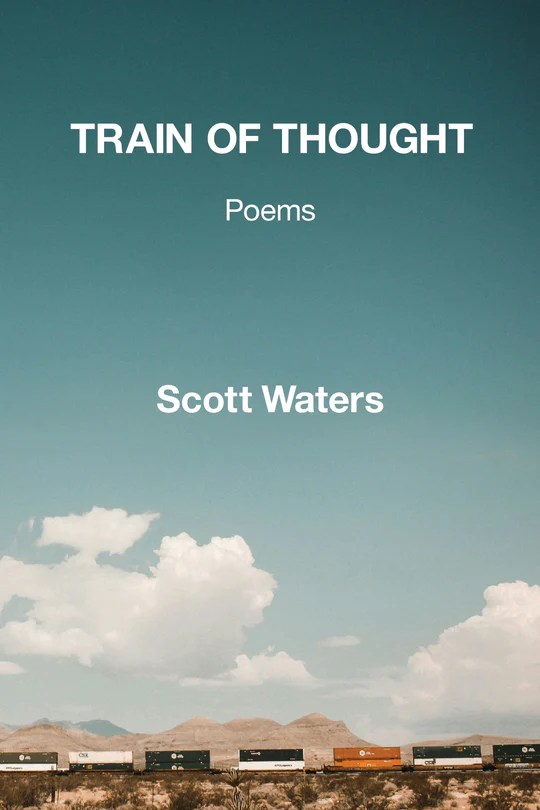
So the Day Doesn’t Escape Too Soon, a review of “Train of Thought” by Scott Waters; Reviewed by Peter Mladinic

Book Link

So the Day Doesn’t Escape Too Soon, a review of Train of Thought by Scott Waters. Kelsay Books. American Fork, Utah. 2025. $17.00 paper

In a documentary film on the great director Yasajiro Ozu, Wim Wenders has some wonderful commentary on trains in Ozu’s films.  Trains in Ozu are symbols of passage, and a similar symbolism is going on in the poems of Scott Waters. As in Ozu, Waters’ trains are often commuter trains, taking people from their homes to work or to business in a city. Trains appear in various contexts in most of these poems, that concern themselves, and their readers with, like a train, going forward, and the persistence of nature, art, and humanity.

Nature thrives among the ruins. The vital coexists with the decadent. In “When I Took This Job,” the book’s opening poem, “the lulling rumble / of the train car” is juxtaposed with “three ducks shot like arrows / over a Cabernet pond.”  The lulling rhythm varies with the quick, smooth flight, as seen from a window. In another poem, hills are likened to horses. In “Small,” “the morning news” is enveloped by a finch’s descent “through the bright pond of air” and “a spray of white petals / against your windshield.” In “Awakening on the 5:05,” the democracy of “a lavender stream in the woods” is accented, how it is there for all, to sustain animal life and evoke tranquility in humans, regardless of their socio-economic strata. It is there for all, as are the “oak, hickory, dogwood” trees in “Parallel Tracks,” the “mountain stream” in “Leaving the Cove,” and the “blackbirds” that rise “from marshes” in “I Took a Train to Fresno.”  The human, the machine, and nature converge in “Shredding the Clouds,” a poem about ascent. 

Three seagulls

circle above 

a commuter train 

parking lot

This passage is followed by an image of a raven’s descent onto a parking lot, perhaps to pick up a scrap of food left there.  And then, another ascent “a small white plane,” in appearance like a gull, “chops through a / grey scarf of clouds.”

What is art? Perhaps, anything the artist can get away with. The idea that the subject chooses the artist is alive and well in “About the Floor,” with its tone of wry humor. The commuting speaker contemplates nature “cumulus piled /  on western hills,” and human-made “beams as thick / as battering rams,” and ends up writing (memorably) about “the filthy / train / floor.” In “Body of Work” he describes in an array of arresting images a painting that has a quilt-like collage. “God’s Diorama” is three-dimensional, like a Joseph Cornell box. Beauty in art underlies “Puffs,” “glory / is an / English train.” The train, like a work of art, “startles you / when it arrives.” The role of the imagination in art underlies “Waking the Phoenix” as a train moves through hills, the “hills roll on,” the sun, like a new-born bird, “learns to fly” and finally is “soaring now,” a metaphor for humans being alive enough to imagine. Art mirrors life. In “Switch,” the speaker says “I …

pull out a pen 

and the train, the mole,

the hills, the clouds,

the fog

are all at once embraced 

by arms

of light.

The poet Philip Larkin said “What will survive of us is love.” In Train of Thought the best of humanity is exemplified in the care people give to places, things, and each other. Their “best” is continual, starting from “the / loved one / at / the door” in “Castaway Mind,” and ending with the “dark forces” in “Let Us Now Praise Breakfast in the Sun,” a poem that, despite those dark forces, is celebratory. Life is precious because people are mortal, the speaker suggests: “I am 57 / beard more grey/ than it was last week.”  With a grey beard and a cognizance of death he says of his company’s CEO, a man who “died in his sleep … He will never face/ another Monday.” In “One Thing” a scent of perfume triggers a romantic memory, and in “A Bit of Flannel” the image of a shirt on a clothesline triggers a memory of familial love. In “Better Home and Garden” the speaker’s empathy for whoever lives in a “Tent by the railroad tracks” abides.  A man rummages (“among the flung garbage/ of his campsite”)

as she hangs laundry

among the overgrown weeds

of a yard that belongs 

to an unsent postcard 

of a home.

Any review of Train of Thought would be remiss without the mention of “Mumbly Old Men.” With its precise showing and telling, it contrasts reality and virtual reality, accenting differences between then and now. One of the best in this collection of very good poems, it deserves to be in an anthology of the best of contemporary poetry. It engages all the five senses, and in a few words says a whole lot, not only about the speaker but about anyone living within the touch of a keypad. Fortunately, for readers, other poems in this book have the import of “Mumbly Old Men,” a poem with something to say that readers are unlikely to forget.

About Peter Mladinic

Peter Mladinic lives in Hobbs, New Mexico. He was born and raised in New Jersey and has lived in the Midwest and in the South. He enlisted in the United States Navy and served for four years. He received an MFA in Creative Writing from the University of Arkansas in 1985, and taught English for thirty years at New Mexico Junior College in Hobbs. He has edited two books: Love, Death, and the Plains; and Ethnic Lea: Southeast New Mexico Stories, which are available from the Lea County Museum Press, as are three volumes of poetry: Lost in Lea, Dressed for Winter, and Falling Awake in Lovington. His most recent book, Knives on a Table was published by Better Than Starbucks Publications in 2021. He is a past board member of the Lea County Museum and a former president of the Lea County Humane Society. An animal advocate, he supports numerous animal rescue groups. Two of his main concerns are to bring an end to the euthanizing of animals in shelters and to help get animals in shelters adopted into caring homes.

GoodReads

Announcements, art, Book Announcements, poetry

Announcing: End of Earth – Kindle Exclusive!

Poet Nolcha Fox and Artist Mike Armstrong have known each other for over 30 years. It is only natural that this would result in an amazing collaboration. “End of Earth – A Collaboration of Poetry and Painting” is the result. The rich, colorful, expression of art by Armstrong encouraged Fox’s poetic muse to create these thought-provoking poems. Such a collaboration is like no other and, well, you must see this for yourself. It is a little book with a big WOW factor. This would make a lovely gift for art and poetry lovers.

What do others have to say?

End of Earth, a Collaboration of Poetry and Painting, by Nolcha Fox and Mike Armstrong is ekphrastic art at its finest, a seamless coming together of vibrant brushstrokes and memorable lines in poem after poem. From “They circle” we have “Ah, they are money vampires. / They tell me they can hook me up, / no, cook me up in style.” The wit, music, and metaphors that comprise Nolcha Fox’s style are alive and well in End of Earth; it contains some of her best recent work. She is our contemporary Emily Dickinson, but also an original, fulfilling the potential of her poetic self in this new book.

Peter Mladinic, author of House Sitting, and The Homesick Mortician


Without a doubt, Nolcha Fox is the most interesting, inventive writer of poetry on the scene today.

John Yamrus, author of Present Tense

And now, January 25-31 there’s a .99 Kindle Exclusive Deal! https://a.co/d/i1Fpf50

Irony won’t be wasted! As January 25 is National Florida Day, let’s honor Mike Armstrong, the Artist of this team. He is in Sunny Florida!

art, books, poetry

Where Poetry Meets Art

Have you picked up your copy of End of Earth? We love to hear what you think. Reviews are always welcome and appreciated. End of Earth

Here are some reviews that have been posted:

Peter Mladinic

5.0 out of 5 stars The Stars Will Remember

Reviewed in the United States on November 30, 2024

Perhaps in a future ions away, the stars will remember life on earth, the life of planets, animals, and humans, which is precisely what Nolcha Fox is writing about in End of Earth, a document of that life in poetic lines about people, places, and things in her past and present. Her poems, each of them, are complimented by Mike Armstrong’s paintings,
that are vivid, abstract, and evoke impressions suited to the particular mood of each poem. In her point of view, sensibilities, and brevity, Fox is our contemporary Emily Dickinson, and very much herself, her own person.


B. Leonhard

5.0 out of 5 stars a stunning collaboration of art and poetry

Reviewed in the United States on November 26, 2024

I thoroughly enjoyed this book. The free verse poems speak of grief and loss. The abstract art is just as soulful. I highly recommend the book!


G. Magrini

5.0 out of 5 stars An Exemplar on Collaboration That Includes Beauty and Poetry

Reviewed in the United States on November 25, 2024

Nolcha Fox has always been a sharp and intuitive writer, using serrated incisions of the word to establish truth, humor, and other weapons of choice to create her perfect reality, or to showcase the diseased realities we prefer not to see. Her collaboration with Mike Armstrong is a stroke of genius, as his images perfectly enhance Nolcha’ s poetry, or is it the other way around? It is this dissonance which I am thrilled to experience through End of Earth!


Munmun Samanta

5.0 out of 5 stars Stellar fusion of art and poetry

Reviewed in India on 12 December 2024

In this eclectic collection “End of Earth” by Nolcha Fox and Mike Armstrong, you will enjoy the ceremony of words and images in perfect harmony. Nolcha Fox’s pen matches perfectly with Mike Armstrong’s brush strokes to explore the nuanced landscape of human emotions. I like to recommend this book to all the book lovers specifically to those who love to relish the vibrancy of life most poetically. Though one can read the book in a single sitting, each poem demands engagement, reflection, and the courage to face the brutal truth. These free verses celebrate variegated emotions and interplay of imagery. Cynicism catches the image of vultures waiting to feast on the carcasses. At the backdrop of a citrus sunset, someone preserves the warmth of love in sharing an orange, half. Sun emerges like a bulky woman kissing the mountains. Unrequited love is represented by a red poppy flower aimed as a bullet to the soulless shell that bounces it off. Fox’s poetry is like fragments of images, poignant glimpses of human existence, uncomfortable yet honest. If you are ready to assemble those fragments of expression and fill the silence between what is said and left unsaid, then this book is for you. Read this book as a challenge, as a puzzle, as a brazen explosion of human vulnerability.


Photo by Ann H on Pexels.com
Book Announcements, Podcasts

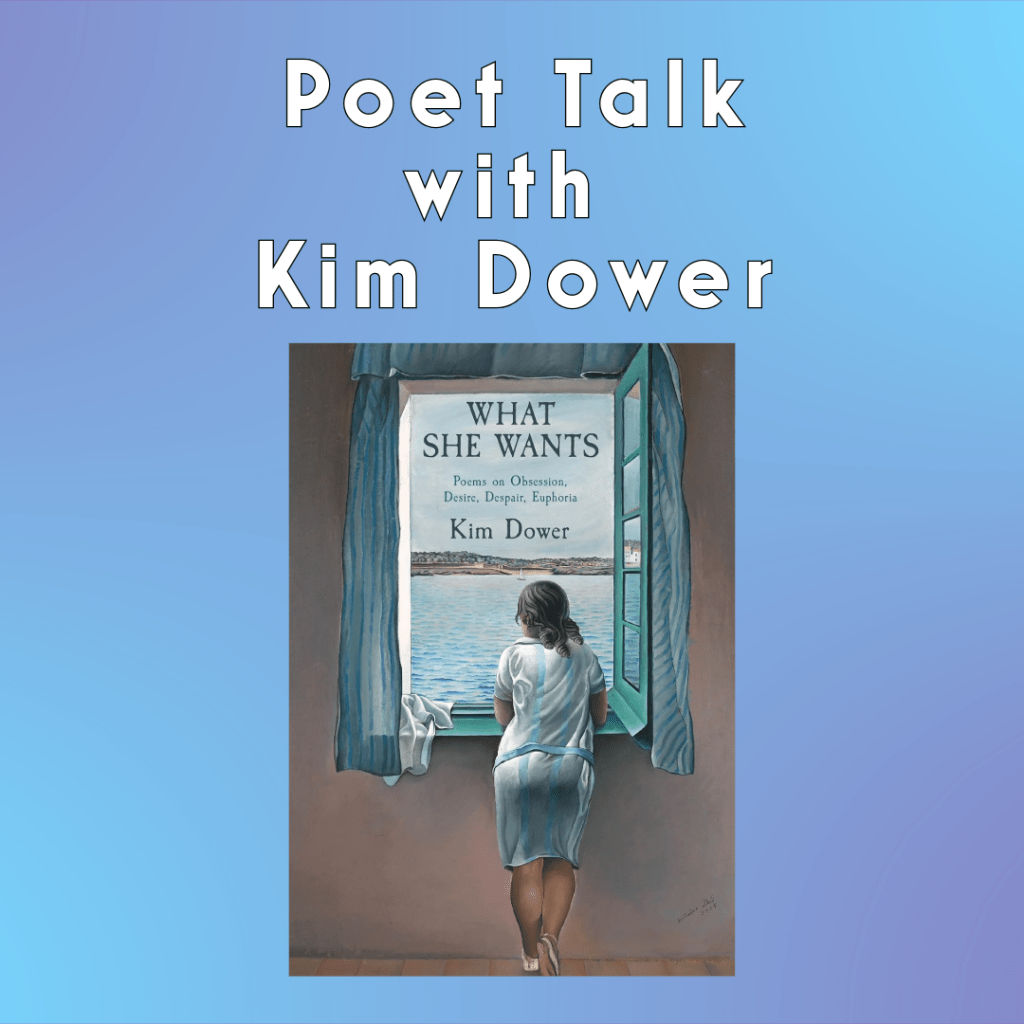
Poet Talk with Kim Dower

It was such a pleasure to meet with Kim Dower and discuss her upcoming release: “What She Wants: Poems on Obsession, Desire, Despair, Euphoria” Now Available! “Obsessive love has never been so much fun! What She Wants: Poems on Obsession, Desire, Despair, Euphoria is a powerful tribute to the intensity of obsessive love, told through the trademark humor and heartbreak of bestselling poet Kim Dower.” “Following the commercial and literary success of her bestselling poetry collection, I Wore This Dress Today for You, Mom: Poems on Motherhood, Kim Dower delivers What She Wants: Poems on Obsession, Desire, Despair, Euphoria—turning her keen eye, vibrant imagination, trademark insight, and humor to the intensity of obsessive love. These steamy and provocative poems, combining humor and heartache, run through the four phases of Limerence, the state of being infatuated or obsessed with another person: Infatuation, Crystallization, Deterioration, and Ecstatic Release. From the opening poem, “She’ll do anything for food,” to the sexy title poem, “What She Wants,” the painfully funny, “His Other Girlfriend,” to the longing in “Visiting Baudelaire,” and the sad, sweet final poem, “Fish’s Lament,” Kim Dower captures the essence of what it means to be stuck on someone—even on a squirrel! Her eclectic, growing readership will savor these poems that can be read in one sitting, like a story with an arc, or separately, each one recalling the moment of falling in or out of love, the moment our hearts skipped a beat.” ⁠https://redhen.org/book_author/kim-dower/

SPOTIFY