

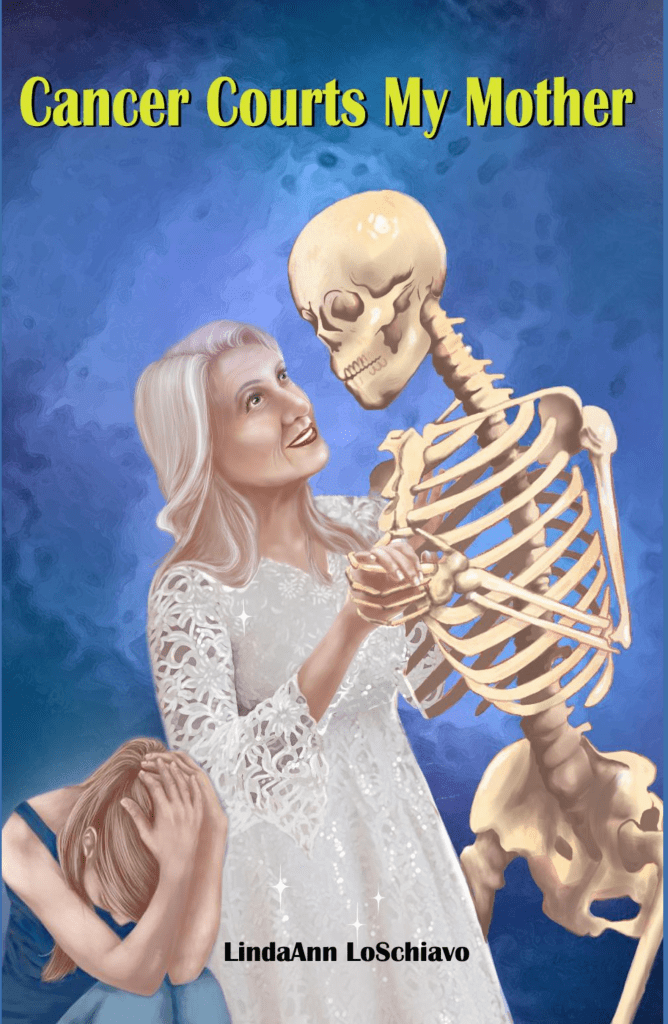
Home Remedies: a review of Cancer Courts My Mother by LindaAnn LoSchiavo. Prolific Pulse Press. Raleigh, NC. November 2025
It would be hard to find a person whose life, directly or indirectly, has not been touched by cancer. Just as cancer takes many forms, people’s mental, emotional, and physical responses vary. LindaAnn LoSchiavo’s response is this book. Out of ugliness, the frightful fact cancer kills, she has wrought beauty, this sequence of poems. A reader’s appreciation of them may be heightened by taking a look at their metaphorical resonance and their distinction between honesty and artifice; and, ultimately, by considering the voice of the poet, a daughter speaking about her parents.
The book’s title Cancer Courts My Mother suggests an extended metaphor. The tenor, cancer, is a suitor. A suitor is defined as a man who courts a woman. Although the title suggests otherwise, the woman the suitor courts is the daughter, the poet. In “Arrival” she says, “I know he’s made himself at home, the dark prince …conveying her into his sunless realm.” Yes, death is conveying the mother but it’s daughter who knows. And she is the one being courted, the one who hears the dark prince’s seductive whispers, the one for whom “terminal illness / twirls out of the speech of men.” At the end of “Tick Tick” she says, “Cancer, biding his time, taunts me.” In “Early Visit from the Grim Reaper,” “His baritone commanded me to GO!” In the “Bartering with Cancer,” the octave begins with “When medicine has nothing more to give / There’s only daughters and morphine…” And in the turn, the second half, she says, “I’m stunned.” In “Jaundice,” she says, “my mother wound up with him —Cancer —,” but in the realm of life, cancer courts the daughter, the maker of these poems.
They are interesting for their distinction between fact and fiction, honesty and artifice. Interesting, compelling, haunting. “Diagnosis” begins the sequence. Its abrupt enjambments signal an urgency that inclines the speaker towards artifice.
Transformation’s required, starting with your voice,
Hemorrhaging with euphemisms, lies. You could
Be an actor fed fake dialogue, words almost
A well-rehearsed performance. You could be-
Come an acrobat, clutching the girders of hope. A
Safety net’s missing. The laughter is a ghost’s.
The abiding artifice is the poems.
Even imagination threatened to betray
me, failing to make good on the fancies I’d hope to invent.
But pen and paper became the dependable parents I’d
always longed for. With them, I sketched realities I could
eventually escape to.
That passage is the conclusion of “Mother Magnified,” which is an honest account of the friction between the speaker and her mother, one aspect of this mother and daughter relationship. Yet another realm of reality, that not only counters the artifice “an actor fed fake dialogue” but also the wooing of “the dark prince” is the life of plants. In “Green Nursemaid” the daughter tends her mother’s plants, “suturing new healthiness into the exhausted potting mixture.” While other flourishes of artifice appear in the forms of mythic “mermaids” and the “prayer candles” of religious ritual, the plants symbolize continual life, and, in “Living through the Dying,” which begins with the imperative “Resuscitate the wilted,” their tenacity and the poet’s.
To consider the voice in the poems is to consider the speaker, a poet facing the grim reality that many of her reading audience have faced or will face: cancer kills. The poet’s mother’s suffering is terminal; then there’s her father’s suffering and her own. Her voice, what is said, and how, reflects the human heart in conflict with itself. Signs that say Fuck Cancer are brandished by people who hate the thing that is killing their love ones. I love, I hate —they suggest, conveying that conflict. The poet’s “realities” she “could escape to” suggests her speaking, and putting pen to paper is cathartic. She is also defiant. In “Early Visit …” the reaper says, “GO! She says “No!”
Cancer Courts My Mother consists of poems in free verse and in tradition forms. While its rhymes resolve, there is no closure; the poet’s turmoil remains. Cancer took her mother. A mother’s suffering and eventual absence, left a daughter and a spouse/ father to grieve. The poet’s grief is poignantly conveyed throughout this sequence. Towards the end she says, “When my mother died, she took home along with her.”
Order “Cancer Courts My Mother”
Peter Mladinic was born and raised in New Jersey. He graduated from the University of Minnesota in 1973 and earned an MFA in Creative Writing at the University of Arkansas in 1985. Professor emeritus at New Mexico Junior College, where he was a member of the English faculty for thirty years. During that time, he was a board member of the Lea County Museum and president of the Lea County Humane Society. He is the author of several poetry collections.


 Prolific Pulse Blog