mental health, Personal Essay, social justice

World Mental Health Day 2026: Questions and Activities for “Lived Experiences Heard”

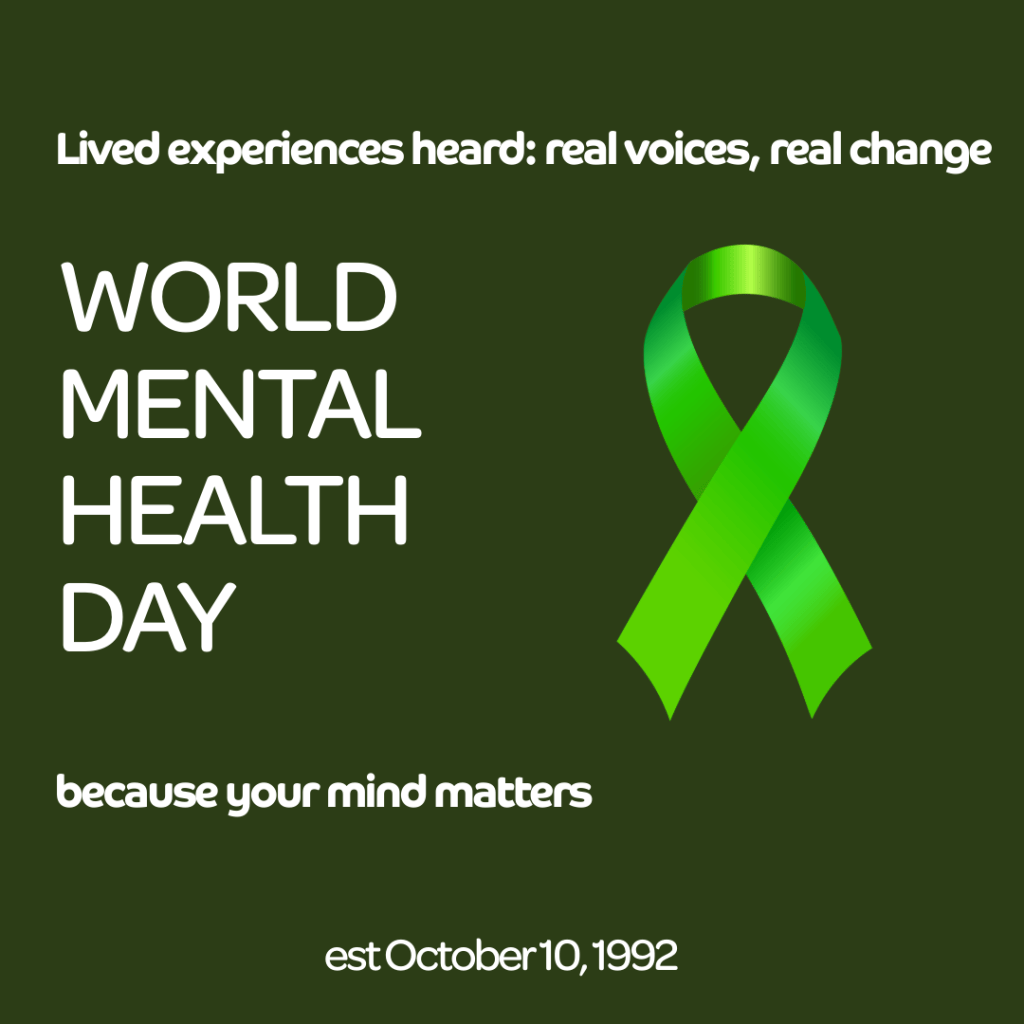
Today, October 10, 2026, is World Mental Health Day, and this year’s theme is “Lived Experiences Heard: Real Voices, Real Change.” Below are some questions to reflect on and simple activities to help families, friends and groups listen to one another.

What Is World Mental Health Day?

World Mental Health Day was first observed in 1992 at the initiative of Richard Hunter, then Deputy Secretary General of the World Federation for Mental Health. It is marked every year on October 10, with a new theme each year to focus attention on a different part of mental health.

The 2026 Theme: “Lived Experiences Heard: Real Voices, Real Change”

How does this year’s theme affect you and me? I believe it is about all of us, and our personal need to stay mentally healthy or to find the path to get there. People who have lived through mental health challenges know things that no textbook can teach, and when their voices are truly heard, real change follows.

Mental health is a personal and a long-lasting concern with people I have cared for and about for much of my life. As a social worker and advocate for mental health I believe that lack of services, accessibility to services, and the stigma associated with mental health are major factors. If we don’t address these, we risk more distancing leading to poor care.

5 Questions to Reflect On

1. Do you recall a time when you felt truly understood? What did the other person do that fostered this feeling? Often it is simple things, like listening without interrupting or not rushing to fix the problem.

2. What unique insights do clinicians, researchers and people with lived experience each hold that others might miss? Each group sees mental health from a different angle, and the best care brings all three together.

3. How has openness from public figures shifted attitudes about mental health? Think of social influencers, celebrities, athletes and others in all areas of life who have spoken honestly about their struggles.

4. What risks do people take when they share their stories, and how can we protect them? For example, workplace environments and attitudes, stigma about mental health, and the pain of reliving difficult experiences.

5. What changes have you seen that made a real difference? If you have heard stories from others or experienced improvements yourself, such as legal changes, funding or better access to services, what made those changes possible? What factors played into them?

Activities for Putting Mental Health into Practice

1. The two-minute listening circle

In a family, circle of friends, church group, or simply around a table over nachos, each person has two uninterrupted minutes to share. Listeners respond to what they heard before anyone offers ideas or advice.

2. Redesign a local service

Pick a real service, such as a school counseling program, and redesign one feature with people who have experienced or observed its gaps. Perhaps there are accessibility issues in your community that the group can help resolve. Factors to consider include stigma, language barriers and cost.

3. Rethink everyday language

Recognize slang terms related to mental health and discuss how they shape perceptions of people with lived experience. What are some better expressions to use instead?

4. Share one helpful habit

Have each person name one thing that helps when talking with someone who has lived experience, such as asking open questions, being patient with silence, or simply saying “thank you for telling me.”

Frequently Asked Questions

When is World Mental Health Day?

World Mental Health Day is observed every year on October 10.

What is the World Mental Health Day 2026 theme?

The 2026 theme is “Lived Experiences Heard: Real Voices, Real Change,” announced by the World Federation for Mental Health.

Who started World Mental Health Day?

World Mental Health Day was started in 1992 by the World Federation for Mental Health, at the initiative of its Deputy Secretary General, Richard Hunter.

Where to Find Help

Always and forever, please know that there is help.

Lisa Tomey-Zonneveld is a never-retired social worker who is currently an artist, writer, and publisher in Raleigh, North Caroline.

caregiving

Caregiver Appreciation Day

Photo by Kampus Production on Pexels.com

Caregiver Appreciation Day is March 3, 2026. This day honors those who selflessly care for others’ welfare. This follows National Caregivers Day in February, affiliated with Home | The National Alliance for Caregiving With a similar focus, it makes sense that there be more than one day in the year to recognize the most important caregivers of life and life preservation. There is also Caregiver’s Month is November. Caregiver Action Network (CAN) is the nation’s leading family caregiver organization. Caregiver Action Network: Resources for Family Caregivers

I’ve been a caregiver many times, finding no role more meaningful, at least for me. When I say this, I am talking about many aspects of caregiving, whether it be working together with a team, working in a compact unit such as family caregiving, or caregiving as an individual unit. And there are other types of caregiving. Certain caregivers get compensated; others do not. The greatest pay is the satisfaction of feeling confident in knowing that others get the care they truly need.

Share your journey as a caregiver. What support was available to help you in this role? I put together a section in my book, Caring for Souls: “Stress Management for the Caregiver”

Caregivers and receivers alike are vulnerable to stress. Stress affects health and personal relationships. If your resources to handle situations are low or depleted, there is more vulnerability to becoming ill or to have much confusion.

Having experienced caregiving roles and intermediary positions, I understand the necessity of evaluating effective and ineffective methods. These are simply suggestions. You, of course, do what works for you.

Ideally, one of the best ways to manage stress is to build an arsenal of awareness which is stocked daily. Some items that may help:

· Assertiveness. Develop the skill to decline activities that destabilize your energy and time.

· Feelings Checks. Communicate how you feel. This clears the air and helps you recognize the value of feelings. How often have we held onto certain feelings and discovered that once we communicate them, we heal?

· Have fun! Don’t let life pass by without savoring its joys. Take the time to play games, read, work on creative projects, play music, go to movies, stay in for movies, go out to eat or order in, and do whatever you truly enjoy.

· Exercise. You needn’t run marathon distances. Enjoy the outdoors, walk through your neighborhood, or visit local shops or fitness centers. Senior centers offer many options for exercise and fun. Some even have adult day programs for your person.

· Journal. Keep a journal for yourself, along with encouraging the family to do the same. This provides release, insight, problem-solving, and personal documentation. They also come in handy when going to medical appointments.

· Flexibility. Sometimes it seems like a day is full of compromises. When caring for others, you often have to change plans to meet their needs. Accepting that each day has surprising moments makes it easier to handle whatever comes your way.

· Nutritional meals. Feed your internal arsenal to build stamina and energy stores. Treat yourself to foods you like and make meals a featured event. If able, it can be a fun activity to prepare meals with your person. Maybe they can prepare the table, wash produce, do other meaningful work, or simply stay with you as you prepare.

· Medication and supplements. Sustained use of prescribed medication is essential. Supplement the diet with necessary vitamins and minerals.

· Engagement. Involve your family member who has medical needs in activities you enjoy. Of course, safety first. This helps to build strong, healthy relationships. Getting others involved in activities also helps with socialization.

· Respite. If workable, please steal moments from your family. Other family members or friends could provide respite care. If this is not possible, then check into respite care programs in the community. Note: for end-of-life care, such as in-home hospice, it is more difficult to manage. Even a step outside is supreme relief.

· Reality Checking. Expect some frustrating days. Accepting that there are going to be these days will help you release stress. Be good to yourself. On unpleasant days, try your best to adapt.

LindaAnn LoSchiavo, a caregiver for her mother, who had terminal cancer, expressed her story well in her chapbook Cancer Courts My Mother.” She put together this video, and I believe it illustrates what people can relate to as a caregiver and helps to increase awareness.

Caregivers will derive comfort and solace from the poems in LindaAnn LoSchiavo’s award-winning book “Cancer Courts My Mother” AND in this special horoscope she has created for all the volunteer caregivers out there. 

Sample of Cancer Courts My Mother https://buy.bookfunnel.com/db5iql4jef

non-fiction, Personal Essay, poetry, Senior Health

World Cancer Day – February 4, 2026

Photo by Tara Winstead on Pexels.com

As we enter World Cancer Day, how I wish this were a topic that we could just sweep under the carpet. Unfortunately, when faced with cancer, it’s unavoidable. It will not bring out a Pollyanna in me. It has had too strong an effect on my family and friends.

Therefore, pausing for thought for one full day becomes significant. What has cancer done to change our lives? What losses have we experienced? Is there any year that passes without your considering cancer as a potential cause for an ill feeling?

Cancer is sneaky. It worms its way into the body without invitation. I mean, last time I checked, I don’t recall asking it to visit my family members, yet here it came and did not want to leave. My sister had lung cancer. She had not smoked for years, realizing it was not serving her a purpose more important than life. Hearing she possessed this was unexpected.

Yes, it responded to treatment, including partial lung removal, chemotherapy, and radiation therapy. Despite all she went through, she had a positive demeanor, believing in believing. Technically, the treatment cured her. Her doctor told her it would be something else that would take her, not cancer. She could travel to Alaska from our home in North Carolina and spend time with her daughter, son-in-law, and grandchildren. For this, I am grateful. And I cherish the time we had together before she moved to Alaska. She ended up with a few short years before she passed away. Her heart had spent enough time on earth.

Has cancer affected you? What is your story?

As a caregiver for more than one cancer patient, I wrote this poem, based on personal experience.

Hearts to Hands

As you lay in the hospital bed I was lost.

You were jaundiced, dying, and needing care.

You looked into my eyes:

“my feet are cold”

Gently placing my hands on your feet,

feeling the thin parchment like skin,

and observing the golden glow of jaundice.

Mixing Vaseline with hospital lotion,

then warming the mixture in my hands.

Massaging your soles, arches,

and rounding to the dorsum

such warm flows, energy exchanges.

Stretching each toe, kneading the pads, some pop.

Our smiling eyes connect as softness pervades.

Warming your fuzzy slippers on the heater,

scrunching and easing them on your warm, softened feet.

Just standing with hands on your covered feet,

having a private moment,

energy pouring from my hands and exchanging hearts.

How I wish that moment would heal you.

Even if a new day meant another treatment.

Each day is the chance to show you how much I love you.

I do and you love me too.

Words did not have to be said.

I knew it when you looked at me and said,

“my feet are cold.”

Previously published in Fine Lines Literary Journal

The Cardinal is a sign of hope and love from beyond. This picture was drawn by Kayla Wygal and included in the coloring pages of Caring for Souls.

As depicted in this video, cancer is life “the thief in the night.” I would encourage you to view this and reflect.

TTOT

Ten Things of Thankful-March 30, 2024

Photo by Kat Smith on Pexels.com

Happy TTOT time! And March, in this neck of the woods, has turned into a gentle lamb. We are looking at 77 degrees today, daughter is in shorts (I have a sweater on), and the weekend looks to be gorgeous. How many thankfuls did you count?

It’s that time of year when I am lucky to see my sweetheart by 9 p.m. Yes…tax season is strong and healthy. The good news is that his office is feeding him supper. He shared the menu with me, and I started plotting how I could go help at the office. We have worked for the same firm before, but that’s not happening this time. He’s the only CPA with whom I would work alongside. I will listen to feedback about which dishes he liked, so I can make them for him later on. I learned from this last year that he found shrimp and grits to be delicious. Well, I did not know this, and I know how to make that dish. He’s had it a few times since-from my kitchen. I loved learning he liked them, also because that is one of my favorite dishes.

It’s been a super busy time in the publishing scene. We bumped up two books, by special request. My norm is one book per month. I am grateful to see the other side of this very soon. We’ve had great book launches and I was honored to do one for my favorite SistersRoc’N’Rhyme duo. We even did one with a mixed venue of live, on site while the rest of the participants were virtual. It went well.

This upcoming week is National Poetry Month and that changes our focus. You may be seeing more posts and poetry. The poster for this year is amazing.

Source

Daughter is doing well with her Aloha Ambassador program. She’s oriented new members to the program and it’s gone well. She has arthroscopic knee surgery soon. The date is not set, but should be set up next week., We pray she finds relief after they rework her knee. It worked for me when I was in my twenties. Back then, you stayed in bed with a cast because they did long incisions. Then you lugged the cast around for a bit. So, I am grateful for much less invasive surgeries.

I think that there are at least ten things highlighted up there. And I am confident there will be more to come. May you know these blessings as well.

Photo by George Dolgikh on Pexels.com

You are invited to the Inlinkz link party!

Click here to enter
https://fresh.inlinkz.com/js/widget/load.js?id=c0efdbe6b4add43dd7ef
poetry, Senior Health, six sentence story

The Signs of a Stroke

Photo by Karolina Grabowska on Pexels.com

How ironic that I saw the prompt of “Stroke” for the Six Sentence Story, especially since on June 17 I received word that a beloved family member had mini strokes. Thankfully-they are home and on the mend. It only seems appropriate to list the signs of a stroke and since there are six letters, you know what that means…

Signs of a Stroke

Severe headaches could happen, so pay attention when this does.

Trouble talking or understanding, take a breath and signal for help.

Refocusing due to trouble with vision or even loss could mean there’s something going on.

Ordinary feelings go numb and you may feel weak one or both, help you must seek.

Keep checking numbness, indicate where it is, ask for someone to watchfully note.

Equilibrium feels off with dizzies or loss of balance or ever a fall, for which 911 you want to call.

…..

There’s more to learn every day and here’s a link to help: Stroke Signs and Symptoms