Announcements, Book Announcements, Celebrations, poetry

Bro ken Rengay – Unruly Poetry

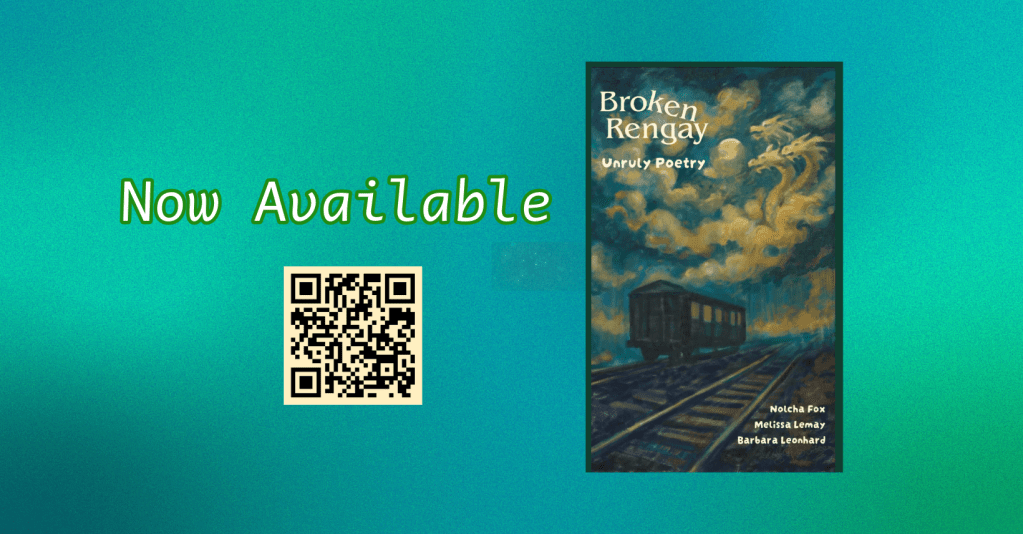
We are excited to announce the release of this fun and thoughtful collaboration known a “Bro ken Rengay – Unruly Poetry” written by the magnificent trio of Nolcha Fox, Melissa Lemay, and Barbara Leonhard.

Get your copy here!

Prolific Pulse Press LLC is pleased to welcome to new authors to our group. Melissa and Barbara are no strangers to writing, but this is their first full length publication with us.

Please join us with the hearty welcome! Nolcha is a returning author, and she has more under the secret dome of poetry. It won’t be much longer for you to find out what it is.

Get to know these women through their author pages on ProlificPulse.com

Nolcha Fox

Melissa Lemay

Barbara Leonhard

But…Wait! We have more!

Recently, we completed an interview with these three women. It’s time to share and let you in on their thoughts and efforts to honor the beauty of poetry.

We would like to welcome the authors of Bro ken Rengay: Unruly Poems, Nolcha Fox, Melissa Lemay, and Barbara Leonhard.

Congratulations on your collaboration resulting in Bro ken Rengay: Unruly Poems

With this big release, I know you must feel much anticipation and excitement.

Tell us about Bro ken Rengay. So, what’s “rengay” anyway?”

NF: Other than alternating 3-line/2-line stanzas and a startling lack of punctuation, I’ve written them several ways. I’ve written a rengay with me and my multiple personalities. I’ve written rule-breaking rengays with Melissa and Barb. I recently wrote a rengay with David Bogomolny, in which the 3-line/2-line structure was different from what I’d done previously. It’s a form best written with coffee or wine, and a weird sense of humor.

ML: I like coffee. I think I have an explanation of rengay memorized at this point.😅It’s a form of linked verse invented by Garry Gay, whom I’ve had the pleasure of “meeting” at an international rengay gathering via Zoom. He created it as an alternative to the Japanese forms renga or renku. He named it “rengay” because of his last name. Initially, Garry created the form with two poets in mind. In a two-person rengay, the structure follows a 3-2-3-3-2-3 line count, with each 3-line stanza having a syllable count of 5-7-5, and each 2-line stanza having a syllable count 7-7. Or in Nolcha’s, Barbara’s, and my case, whatever-syllable-count-we-want (though I am the one who sticks most closely to the original form).🙃

If you’re confused, it’s okay. I still get confused with what I’m doing in rengay poetry, since I write them with different sets and numbers of people. Here is an example of a two-person rengay I wrote with Nancy Brady:

Totality

NB:

moonlight…

the violinist plays

a nocturne

ML:

shadows    pirouette

across the sidewalk

NB:

the morning’s red sky–

we fear we’re in

for bad weather

ML:

sunlight

through the clouds

a robin’s song

NB:

eclipse totality

the birds go quiet

ML:

covered in

golden glow of twilight

the violinist plays

Here is an example of a three-person rengay (never-before-seen!) that I wrote with Barb and Nolcha:

Noteworthy Duel

ML:

tinkling piano keys

I blast classical music

to drown out the neighbor’s bass

NF:

bass is an earthquake

shaking my bones

BL:

I rock them with Rachmaninov

I would give them the keys to good living—

if they would listen

ML:

or perhaps hypnotize them

‘you will find a new apartment’

NF:

one of us has to

move or turn down the noise

it won’t be me

BL:

the discord is noteworthy

time to change the tunes

You can see the way the number of people alters the lines of each stanza. It is also common for writers to create solo rengay. Another variation is the six-person rengay, in which the line count follows that of the two-person rengay. I also modified the form to accommodate four writers. You may see an example of that here: https://skepticskaddish.com/2024/07/31/reflections-or-a-rengay/

BL: I believe Nolcha and Melissa have said it best.  I don’t have anything to add except that it was fun learning about this form.

How did you each gain knowledge of this writing style?

NF: Melissa introduced the form to us, and suggested Barb and I write a rengay with her. Melissa is great with forms. Barb’s a real trooper, and I’m allergic to them. Melissa carefully described the form. Up until we submitted the manuscript, we still screwed up the number of lines we were each supposed to write.

ML: If I’m remembering correctly, I believe it was Nancy Brady who introduced me to the form. I enjoy collaborating on poetry with anyone and everyone, and I reached out to her and asked about writing together. I think I suggested renga, and she wasn’t very familiar. So, she suggested rengay. She also introduced me to Sherry and Zoe Grant, the creators of Raining Rengay. They hold international rengay gatherings (I believe twice a year) that are usually attended by Garry Gay and Michael Dylan Welch, one of the very first to write rengay.

BL: I had never written a rengay poem until Melissa invited Nolcha and me to collaborate. It was an interesting and enjoyable experience. Because the three of us were writing each poem, I sometimes forgot which stanzas would be mine. How all our voices came together was magical. Collaborations are becoming more popular these days because people can learn about new poetic forms and bond during the creation process.

Where have you published poetry of this style?

NF: We published in Raining Rengay (thanks, Melissa), Medusa’s Kitchen, Collaborature, MasticadoresCanada, Chewers by Masticadores, and LatinosUSA.

BL: I believe you’re right, Nolcha. Nolcha records our publications on a spreadsheet. She’s our historian.

ML: You’re welcome, Nolcha.🫶🏻I think they’ve covered most of the places we’ve published. I also have written rengay that have been published on The Skeptic’s Kaddish, as well as those that I’ve published on my personal blog.

How did you decide to create what must have been a somewhat challenging collection?

NF: It was in the back of our minds when we started writing the second rengay. The more we wrote together, the better we understood each other’s styles, the closer we became to each other, and the easier it was to collaborate. The rengays kept rolling out, and suddenly we had enough for a book.

BL: Yes, the process was organic. We didn’t set out to write a book. We just wanted to have fun. We even collaborated on record-keeping (Nolcha), the submission process (me), and editing (Melissa). 

ML: Girls just wanna have fu-un.🎶 I don’t remember who suggested the idea of a collection. Maybe Nolcha? I’m glad it was suggested. As she mentioned, we wrote many of them, and so had the collection to begin with. We discussed putting together a manuscript and submitting it to you, Lisa. I curated the collection in the order that it appears in the book. I like it a lot. It has been a great experience from start to finish.

What challenges come with writing rengay?

NF: The biggest challenge was that we all had lives that sometimes interfered with collaborating. Very occasionally, we forgot to finish a rengay, and we had to remember who wrote the previous-to-last stanza.

BL: To add to what Nolcha said, like I said earlier, I sometimes lost track of which stanzas I wrote, especially if some time passed since the last share. Sometimes, based on what others wrote, I revised my lines for the sake of unity. I suppose the lack of unity would be good for a collection of broken poems.

ML: Part of the challenge for me has been letting go of expectation. It’s challenging in a good way. Let’s say I write the first stanza, or even any subsequent stanza, and pass it along to whoever is next. After that, it’s out of my hands. Wherever it goes is up to whoever comes next. Yet we still work together to bring into form something cohesive that unifies as a whole. Rengay are meant to be thematic or have a linking thread. They aren’t separated stanzas that have no context without each other.

I’ve learned through writing with people with different levels of experience writing rengay. I was taught to follow “link and shift.” In other words, I write the first stanza, then the next person writes their stanza so that it links back to mine and shifts away at the same time. That’s another one of the “rules” we broke. The rengay in this collection are more connected than some, in which each stanza can technically stand alone, yet links together with the others through a common thread.

The bottom line is that this is still a fairly new form. As Nolcha has said, I do like forms. Or she said I’m good with them. Something like that. I take a lot from learning how to write different poetry forms and write them well. However, I don’t like to be a stickler for rules, and I love to bend them and mold them so that I’m happy with what I create.

I would like to recognize Lesley Scoble, the amazing cover artist. Wow! Did she ever create a beautifully perfect cover!

Writing a unique poetry form has clearly been a challenge that you each have surpassed. Now, you have an amazing collection. Where do you go from here? What other forms would you like to try?

NF: We tried writing alternating haiku, and I thought we were successful. Or we just might continue with rengay. We haven’t had any serious conversations about what’s next.

BL: I vaguely recall the haiku, Nolcha. It would be fun to revisit that form and explore others, such as garland tanka or garland haibun. There are many possible forms to collaborate on.

ML: I second the vaguery.🤭I think I remember that. I’m always open to writing just about anything. In addition to rengay, I’ve written collaborative acrostic, tapestry, sestina, haiku sequences, and there might be more I’m not mentioning. As for the three of us together, I think we will write some more rengay poems, and whatever else we get up to. Garland tanka and haibun sound great!

Please share about each of your publications. It’s my understanding that poets and writers can share their work through your blogs and journals.

NF: I’m the editor of Chewers by Masticadores (https://chewersmasticadores.wordpress.com/). I publish a wide variety of writing, artwork, and photography from contributors all over the world. One of my contributors mentioned he could send me recipes from some fancy restaurants, but I’m not convinced it’s a great idea.

Barb and I are co-editors of a new section on LatinosUSA (https://latinosenglishedition.wordpress.com/) called Bookshelf. We use the section to promote books, reviews, and interviews.

BL: I’ve been editor for MasticadoresUSA since November 2022.  https://masticadoresusa.wordpress.com/.  In November 2024, I created a journal FEED THE HOLY on Blogger. I’m the sole editor and staff. https://feedthehol.blogspot.com/. Because I founded this journal, it holds a special place in my heart. And Nolcha and I enjoy co-editing Bookshelf on LatinosUSA. On my own WordPress blog, Extraordinary Sunshine Weaver, I record my publications and repost blurbs and reviews I’ve written under Barb’s Wordy Blurbs. https://extraordinarysunshineweaver.blog/. Now that I co-edit Bookshelf, I may post my reviews there instead. Although editing three journals takes time, I really enjoy it. Editing is a form of collaboration. I’ve found that in all my editing ventures, I am helping to build community. Supporting authors is fulfilling. 

ML: Around the same time Barbara started FEED THE HOLY, I began Collaborature. It is a labor of love, as are most literary journals, I think. Collaborature is a forum dedicated to poetry and short fiction written collaboratively by two or more authors. To not pigeonhole anyone, I’ve allowed for a pretty wide interpretation of what this means. Submissions may include (but are not limited to) poems written by multiple authors, ekphrastic pieces, cento poetry, rengay written collectively… the sky really is the limit. There are as many ways to collaborate in writing as there are people to write with. Get out there and collaborate! Then send in your submissions. Find out more at https://collaborature.blogspot.com

I also host challenges (monthly) at both Tanka Tuesday and dVerse Poets Pub. Check out either or both of those for more collaborative writing opportunities!

Thank you for your time. Others are certain to value what you achieved, as well as your future direction.

ML: Thanks for having us, Lisa!

BL: I’m excited that Prolific Pulse Press believes in our collaborative Rengay collection. Thank you for your support, Lisa!

NF: Thanks, Lisa, for herding us cats! 
Announcements, Book Announcements, books, poetry, Poets & Events, writing

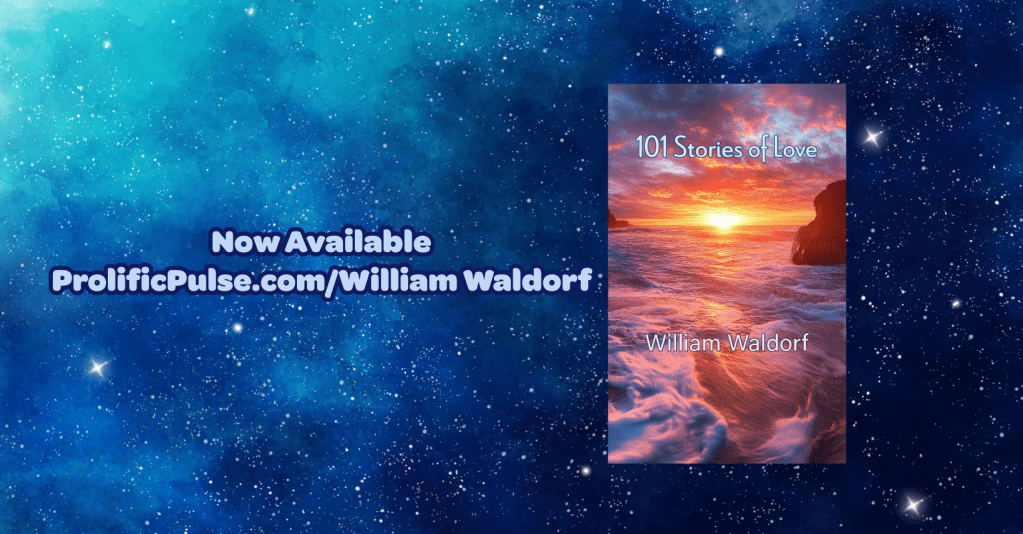
ANNOUNCEMENT! “101 Stories of Love” by William Waldorf is Now Available!

A resonating and richly crafted collection of poems

Ready?

Then brace yourself for the symphonic rollercoaster through the landscapes of affection, loss, desire, and redemption with William Waldorf’s 101 Stories of Love. In his collection, Waldorf invites his readers to explore myriad forms of love- from whispered intimacy to the poignant ache of absence, from shared laughter in a café to the serene desolation of widowhood. The poet has juggled with varied poetic forms like sonnets, villanelles, and free verse transforming the ordinary experiences into luminous reflections, crafting verses that resonate deeply with readers of all ages. This collection is a celebration of life, memory, and enduring connections, serving as a testament to the indelible impact of love in our souls.

Thank you to Munmun Samanta for her beautiful write up for this outstanding poetry collection. Congratulations to William Waldorf!

https://www.prolificpulse.com/williamwaldorf

Stay tuned for information about the Virtual Book Launch on

Sunday, September 7 at 1 p.m. EST

Announcements, Book Announcements, Celebrations, poetry

Seesaw: Quirky Poems by Ken Tomaro & Nolcha Fox

This Poetry Collection is available for purchase through online stores. Born from a shared love of dark humor and playful wordplay, Seesaw is a delightful balancing act of wit, whimsy, and poetic mischief. Ken Tomaro and Nolcha Fox first crossed creative paths in the Thursday Night Poets group, where their mutual knack for quirky, offbeat humor sparked an unexpected collaboration. What began as playful exchanges-plucking words and phrases from each other’s poems to craft something new-quickly evolved into a collection that swings between the light and the dark, the serious and the absurd. Seesaw is poetry at its most spontaneous and fun, a reminder that even in life’s heavier moments, there’s always room to laugh, twist the narrative, and dance on the edge of meaning. Dive into this collection and let the playful push and pull of their voices keep you balanced right in the middle of the seesaw.

About the Authors

Ken Tomaro Never until recently did he consider writing poetry. Not when he slid from the womb. Not when he felt the first tingle of teen hormones. Not after he got married, divorced, moved to another city, lost a couple jobs, moved back. It just sort of happened. Ken Tomaro, self-proclaimed poet laureate of the Cleveland sewer system, has been writing poetry for a few short years. He’s not famous, rich, recognized or read in schools across America. He has been published in several literary journals, done a couple podcasts, started the YouTube channel, Screaming Down the Poetic Highway KenTomaro.com

Nolcha Fox’s poems have been curated in print and online journals. Her poetry books are available on Amazon and Dancing Girl Press. Nominee for 2023, 2024, and 2025 Best of The Net. Nominee for 2023 and 2024 Pushcart Prize. Editor of Chewers by Masticadores. Co-Poetry Editor of LatinosUSA. Websites: https://bit.ly/3bT9tYu and https://nolchafox2.wixsite.com/nolcha… Facebook:   / nolcha.fox  

ProlificPuise.com (links)

Celebrations, poetry

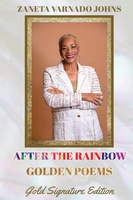
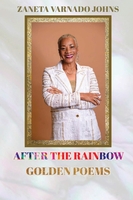
Happy Bookiversary to Zaneta V Johns for After the Rainbow – Golden Poems

Would you believe that it’s been three years since this book was published? This means I have known Zan for over three years. And what a celebration this is!

What is After the Rainbow about?

Throughout the storms of the pandemic and other challenges, #1 bestselling poet Zaneta Varnado Johns wrote to capture her rainbow of intense emotions. In After the Rainbow, maturity oozes throughout the golden lyrics penned in her highly anticipated second book of poetry. The collection captures her transition to a woman in full pursuit of her passion, loving aloud through reflection. As she expresses deep feelings, appreciation for nature, and life’s simple pleasures, this book covers more than a steppingstone path, but a deep dive into the realities of life. From these depths, the eagle soars as we get to experience transitions and triumphs, all a grand, escorted travel through faith and hope.

Prepare to be amazed at the levels this author is willing to share. As a prolific force with her dedications, Johns has expressed her admiration for souls before her, luminaries among us, and precious ones we have lost. Be inspired by the senior citizen with spunk, Ms. Maggie. Wipe a tear at the photo of the author’s granddaughter as she reads Amanda Gorman’s poetry. Sandwiched between generations of inspiration, Johns beautifully celebrates the people who touch her life. You will be introduced to two esteemed poets from the United Kingdom, Sarfraz Ahmed and Pratibha Savani. Each poet collaborated with Johns on poems, including the award-winning poem, “New Wonderland,” co-authored with Savani.

After the Rainbow will captivate the reader with full on experiences, relatedness to life in life’s terms, and ultimately these golden expressions of poetry. We get to see inside the humor of this creative author as she shares about bubble baths, morning sounds, and a glimpse of her closet’s contents. Travel with her in the poem, “Casa Magdalena,” a cozy adobe spot in Santa Fe, New Mexico that captured her heart. Before we dip into the waters of this journey, Johns’ husband, James J. Johns II, offers a beautiful foreword and his own heartfelt poem. With this grand send off, this is a book which will be revisited time and time again.

We couldn’t let three years go by without a bonus for dedicated poetry lovers. Here’s what we have:

An exclusive discounted offer for each version of this beautiful poetry collection.

After the Rainbow Golden Poems Gold Signature Edition for 14.95 US until February 28, 2025

After the Rainbow: Golden Poems
Johns, Zaneta, Varnado

After the Rainbow Golden Poems for 10.95 US

After the Rainbow: Golden Poems
Johns, Zaneta, Varnado

art, interview, poetry, Poets & Events

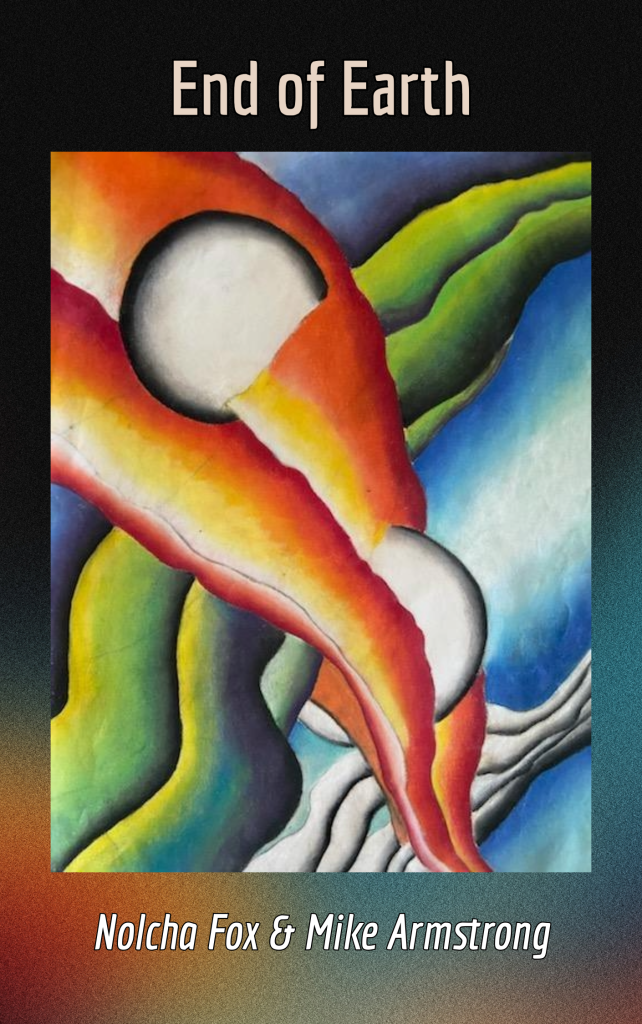
Feature Interview of Nolcha Fox – the Poetic Half of “End of Earth”

You’ve already learned of the new release of “End of Earth” but in case you missed it… it’s right HERE

This is the first of Two interviews. This first interview is with Nolcha Fox, the Poetry Contributor of the poetry and art collection by Nolcha Fox and Mike Armstrong.

Let’s learn about Nolcha Fox:

   – Please tell us a bit about yourself and your journey as a poet and writer,

I started writing as a toddler, using poop on the walls. I also tried to write on myself using my mother’s red lipstick. She told me it took a little while before the red tint disappeared from my face and hair.

When I was a little older, I returned to walls with crayons. I must have been potty-trained.

I expanded my writing to the margins of pages, a little embarrassing to my father, who borrowed the book. That may have been when I fell in love with reading, too.

In school, I expanded my skills through writing assignments. I had a wonderful teacher who encouraged us to write in the style of different authors. I wrote in the style of Charles Dickens for a bit. Poor Dickens.

I journaled in my early 20s and 30s. My journals included some awful poetry. So awful, I eventually tossed a small library of journals into a dumpster and never looked back.

My poetry was awful because I didn’t write like myself. I didn’t trust my intuition to guide me.

Plus, the angst in my poems was over the top. Hormones will do that.

Finally, I stumbled into technical writing. What an education in learning how to write! Much of my career was a black hole that squashed my creative writing. After 8+ hours working at a computer, my eyes were too tired to stare at another screen.

I didn’t seriously write until I retired. I had to wait for my hormones to move to a tropical island before I could truly write instead of emote.

   – What inspired you to start writing poetry?

A dear poet friend of mine suggested poetry when the pain of daily migraines made it next to impossible for me to write any short fiction.

My first poem was published, and I thought, hey, I can do this!

   – How would you describe your writing style and the themes you often explore in your poetry?

I write about whatever comes to mind. When I start a poem, I have no idea where it will end. I went through a period of writing about grief after my mother died last year. Otherwise, my themes are all over the place.

Most of my poetry is short (10 lines or less), unless I’m working with a form, such as a pantoum.

   – Congratulations on your latest poetry book! Can you give us an overview of what readers can expect from it?

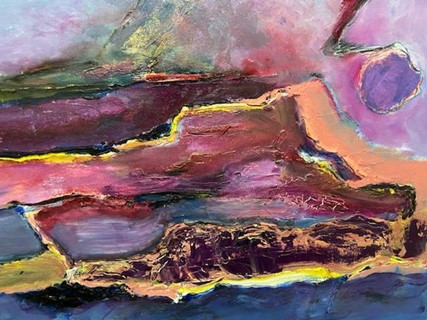
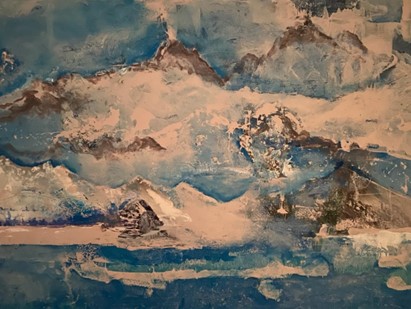
It’s a collection of short poems written to Mike’s paintings. His paintings draw the reader in visually, and the poetry draws the reader in mentally/emotionally.

   – What was the inspiration behind this particular collection of poems?

Mike, don’t kill me. My mother inspired the collection. She recommended writing to Mike’s art. At first, I protested, because I typically write to images that aren’t abstract, like Mike’s. She laughed and said I could write anything I wanted, and nobody would know the difference.

However, when I began the project, I found myself responding to colors and forms, so it was easier to do than I originally thought.

   – Please share your poetry from this book.

They circle

Artist: Mike Armstrong

thinking I taste good,

at first, I think they’re vultures.

A second look reveals teeth.

Ah, they are money vampires.

They tell me they can hook me up,

no, cook me up in style.

They see me as some roadkill

and they’re a spatula.

***

Don’t let the light

Artist: Mike Armstrong

seep through the sutures of your skull,

don’t let it set your hair ablaze.

It’s hard enough to fit

into this dark and dreary world

without everybody noticing your fire.

   – Could you walk us through your creative process when crafting a new poem?

Often, an unrelated object or experience comes to mind as I mull over a prompt or an experience/feeling. For example, I wanted to write to the prompt “bond,” but blueberries popped into my head. So, I wrote a line that included blueberries, and the whole poem fell into place.

I only take a couple of minutes to decide where to start, and I write quickly. I usually give a poem one editorial pass, and then get it out to the world. It’s similar to explosive barfing.

If I find myself struggling with a poem, I put it away. It’s not ready to be born yet.

   – Do you have any rituals or routines that help you get into the right mindset for writing poetry?

I attend to anything that will distract me from writing (such as laundry, hungry dogs, or emails). And then I write. I usually write two poems a day between distractions. The most I ever wrote was seven poems in a day.

   – How do you know when a poem is “finished” and ready to be included in your book?

I call a poem finished when I have no more to write. I read through it once to see if it makes me laugh or if I respond emotionally. Sometimes I think it’s garbage and ask a poet friend to give me his thoughts. I’m usually wrong.

   – Many poets infuse their work with personal experiences or social commentary. Are there any recurring themes or messages in your poetry?

My personal experiences are usually boring. I never have enough understanding to engage in social commentary. I rely on my imagination to lead me into and through a poem. In End of Earth, I couldn’t tell you if there are any recurring anythings. I don’t know how to step outside my poetry and observe it critically, so I let other people analyze what I wrote. I’m moving on to the next poem.

   – How do you balance the personal with the universal in your poems?

I stick to everyday, specific images. If the universal creeps in, yay for me. It wasn’t intentional.

   – Are there any messages you hope readers take away from your poetry book?

I hope readers enjoy the feast Mike and I laid out for them.

   – Who are some poets or writers that have influenced your work?

My top influences are Alice in Wonderland and The Cat in the Hat. I love the rhythm and imaginative storytelling.

   – Are there any other art forms or sources of inspiration that impact your poetry?

I often write to photographs or art.

   – How do you navigate the fine line between drawing inspiration from others’ work and maintaining your own unique voice as a poet?

I read other poets’ work voraciously. I now have an idea or phrase in a poem as a springboard. And delete the poem to save my poor computer from becoming a literary porker.

   – Who do you envision as your target audience for this poetry book?

Readers who enjoy art and writing.

   – What do you hope readers will gain or feel after reading your poems?

Enjoyment

   – How do you handle feedback or criticism of your poetry, both positive and negative?

I say thank you.

   – Can you share a bit about your experience with the publishing process for this book?

Working with Lisa is wonderful. Everything went smoothly.

   – What advice would you give to aspiring poets who are looking to publish their own work?

Carefully consider how much writing time you’re willing to give up to promote your book. And don’t expect to become an overnight sensation.

   – How do you approach marketing and promoting your poetry book to reach a wider audience?

I live in Wyoming, where I have to drive long distances to participate in readings, and local opportunities are few. I rely on social media to get the word out.

   – Are there any upcoming projects or future plans you can share with us?

Lisa is publishing a collaborative book with poetry by Ken Tomaro and me in 2025. I have one more book in the queue, and then I plan to take a breather from book publishing.

   – How do you see your poetry evolving or changing in the future?

No idea. My intuition doesn’t like to share her plans.

   – Where can listeners find your poetry book and connect with you online?

My book will be available on Amazon and Barnes & Noble, and with other booksellers.

You can find me at:

LinkedIn: https://www.linkedin.com/in/nolchafox/ 

Facebook: https://www.facebook.com/nolcha.fox/

I am also the editor for the literary magazine Chewers by Masticadores. Submissions are always open and always free. Please submit!


Thank you to Nolcha Fox for this enlightening interview! You can find links for sales sites at ProlificPulse.com/NolchaFox or go to:

Amazon Barnes & Noble BAM BookShop ProlificPulse