Announcements, Book Announcements, Book Reviews, Celebrations, poetry

ANNOUNCEMENT! “Writing Between the Lines” by Nolcha Fox is Now Released!

https://www.prolificpulse.com/nolchafox

We are pleased to announce the new release of Nolcha Fox’s Poetry Collection, Writing Between the Lines”

Each natural jewel has its own unique brilliance. Catch the fire in a diamond and it’s like no other. As Nolcha catches the fire from other’s poems, these reflections create a whole new light show. As you read through the poems, you may find remnants of life’s experience weaving through. Like the light streams through stained glass windows, there are illuminations, sun dogs of brilliance, fractures melded into brilliant streams of color, of light.
~~~

Nolcha Fox is fearless. She walks the literary tightrope between success and failure with grace and elegance and she never ever disappoints. For my money, she’s simply one of the most remarkable writers to come along in years.

John Yamrus, author of Don’t Shoot the Messenger: Just Give Him a Good Place to Hide

***
Nolcha Fox’s new poetry book, Writing Between the Lines, is a keen collection of poems that begin and end with two lines from another poet’s poem. Although two lines are credited to another poet, the reader is taken into a new story and resolution decorated with vivid imagery and metaphors.

Barbara Leonhard, author of Three-Penny Memories: A Poetic Memoir

***

“Writing Between the Lines” by Nolcha Fox is a collection that surprises at every turn. Written as part of a 30-poems-in-30-days challenge, each piece begins and ends with borrowed lines from other poets, yet what happens in between is unmistakably Fox’s own voice.

The poems move effortlessly between humour and heartbreak. In “Drunk,” night, sleep, and dawn stumble together like a merry band of revellers, while “My Father’s Death” cuts deeply with raw grief and memory. “Dog Days” transforms the sun into a mischievous dog splashing through a creek, while “Keep Things Simple” delivers biting dark wit.

Nolcha Fox excels at capturing the contradictions of human experience, sorrow and absurdity, longing and laughter. Her imagery is sharp, her tone daring, and her honesty uncompromising.

Munmun Samanta, author of Yellow Chrysanthemum

Get your copy today! Click here for the best choices for this prolific collection.

Book Reviews, short story

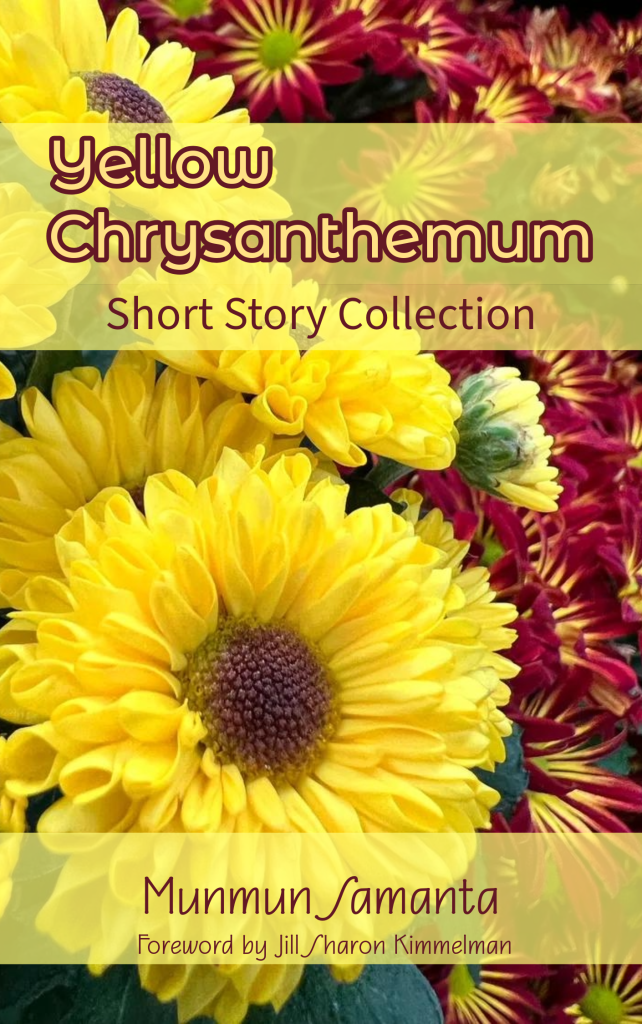
Peter Mladinic’s “The Light of Day,” a review of “Yellow Chrysanthemum”

The Light of Day, a review of Yellow Chrysanthemum by Munmun Samanta. Prolific Pulse LLC. Raleigh, North Carolina. 2025.

In “Sia’s Dream of Dawn” a woman is alone in a garden, thinking, and very attuned to her surroundings. Readers at first think she may be an artist and she’s going to paint the sky. As the story unfolds, readers learn she’s a writer, and it’s as if she’s giving the sky a story, with characters, a plot, a conflict to be developed, heightened, and resolved. And she is. And the sky’s story, like clouds in a river, mirrors the writers. It’s original, poetic, and well worth reading again. Yellow Chrysanthemum as a collection is a story of struggle. Sia “loves this part of the garden. But more than that she loves this confluence of light and shadow.” A struggle to be honest with herself. The collection comprises a struggle for freedom as an artist; for freedom as a wife, daughter, mother, sibling; and for freedom as a person, for equality. “But conventional society never teaches a woman to strike back,” the narrator says in “Written in Blood.”

The stories that depict artists, and scholars are: “Peacock’s Feather,” “Sia’s Dream of Dawn,” “Come Back Somlata,” “Long-forgotten Line,” “A Girl Made of Darkness,” which also involves an individual’s struggle to overcome a society’s prejudice; “Lullaby,” as it invokes the bonding of mother and daughter through song; and “Mad Woman in the Attic,” the story of a woman married to a man who is a successful writer and an emotionally cold, distant husband. His books show empathy for others, but the women in his books reject the woman, just as he does, so she burns his books (his women), and feels at peace.

Stories that involve the struggle of women as members of families are: “Mother India,” “The Caged Bird,” “The Scar,” “Beast of Burden,” “Bright Big Bananas,” “Written in Blood,” and “Uproot.” “Mother India,” the first story in the collection is about hunger and poverty, a mother’s plight to feed herself and her children. It is very visceral; readers feel the hunger in it, and the mother’s desperation. “Uproot,” also about a mother, is contemplative. Should the protagonist stay where she is, or give into her married son’s wish that she leave her home, her job of teaching very young children, and go far away to live with him and his wife? Like “Sia’s Dream …” “Uproot” is a garden story. It begins with Sumita telling the children how a monkey-gardener uprooted trees, to analyze how much water they needed. The children are as delighted with their teacher as she is them, and in the end the story comes back to the garden.

While “Special Dish” has shades of scholastic research, it is primarily a story of the bonding of two women from different classes in society. “A Home of One’s Own,” while it involves family, depicts the plight of women in society at large, a society that says in its morays and traditions that women have no home, the home is the man’s. And in this story, there’s this wonderful sentence: “People say many things, but things are different.” Other stories that involve a woman’s struggle for equality are: “Uma,” “The Kitten and Cleopatra,” and “The Shut Door.” In all these, the plight of one woman is the plight of many.

In “The Shut Door” the narrator says, “It happens sometimes you cannot recognize yourself.” All twenty stories have the unstated adage “be honest with yourself.” Each is an attempt to arrive at some truth. Some stories seem sketched in gray pencils, others in dark blue ink. The light of day is the page on which the story appears. Labels limit. The struggle of the artist, the wife and mother, and the individual all intersect, or seem to, many of them. But in each the author, Munmun Samanta has made a thing of beauty, from her imagination, her vision, and her skill with words. These are stories that ring true; stories of India, of women, of lived lives.

Open her book and see for yourself. You’ll be rewarded. ProlificPulse.com

Peter Mladinic‘s most recent book of poems, Maiden Rock is available from UnCollected Press. An animal rights advocate, he lives in Hobbs, New Mexico, United States.

Maiden Rock: Mladinic, Peter: 9798990558557: Amazon.com: Books

Book Reviews, books

Munmun Samanta’s “Yellow Chrysanthemum: Short Story Collection” Is Available for Purchase!

Set in contemporary India, “Yellow Chrysanthemum” is a stirring collection celebrating the lives of Durga, Uma, Tihar, Somlata, Mridula, and fifteen other women from rural villages to bursting cities. These women are not passive victims but survivors and warriors who have the courage to challenge the status quo of society, which always seeks to silence […]

Munmun Samanta’s “Yellow Chrysanthemum: Short Story Collection” Is Available for Purchase!
Book Reviews

Watches, Cameras, Firearms, Fake IDs: a review of “The Moth” by Scott Archer Jones; Reviewed by Peter Mladinic

Watches, Cameras, Firearms, Fake IDs: a review of The Moth by Scott Archer Jones. Fomite. Burlington, VT. 2025. $15 paper.

The Moth takes readers on a ride to East L.A. and keeps them on the edge of their seats right to the end as its protagonist, Frank, a.k.a., The Moth, a pawn shop proprietor, sinks deeper and deeper into circumstances beyond his control. Part of the tension is that Frank is the sum of his choices, but he can’t control everything. A fusion of person and place, strong character relationships, and an abiding sense of danger make The Moth a memorable thriller in a noir style that calls to mind the fictional turf of Raymond Chandler and John Fante.

     The Moth is character driven. Scott Jones knows that if his readers don’t know they can’t care. One way Jones makes his readers care is by rendering scenes from The Moth’s childhood in the Midwest of the United States. Before he was The Moth, he was Frank, son of a Lithuanian mother and an Irish American father. A central place in Frank’s childhood is the kitchen. It’s in the kitchen that Frank has a scene with his philandering and often absent father that evokes the tension in their relationship, and it’s in the kitchen that Frank learns of the industrial accident that claimed his father’s life. And it’s from the artificial light of the kitchen that Frank and his mother sojourn to the natural light of East L.A., where most of the novel is set. Scott Jones indeed places his readers in that expansive world vastly different from Frank’s claustrophobic roots. It is in East L.A. that he evolves into The Moth. The hospital where Frank’s mother, terminally ill with cancer, lives out her final days; the sidewalks where Frank sells contraband tapes; the food distributing company from which he is fired for giving food to a homeless family; the dark alley where he meets and falls in love with the prostitute Molly; and finally the pawn shop where The Moth works and lives alone in a back apartment are all part of who he is. Similarly other characters in The Moth’s East L.A. neighborhood are products of place. In this place of natural light, the dark of the pawn shop, crowded with items on display and hidden, seems comforting, a refuge, a place where The Moth can be himself.

     The Moth evolves into a part of his East L.A. community. A community of people. Some are seasoned criminals, others have criminal ties and indulge in illegal activities; and still others are people who have little and never enough and are in desperate need of help. Molly, drug-addled and controlled by a pimp, is one such desperate person. Some of the best scenes in the novel occur as she and The Moth bond. Her death at the hands of a psychotic, sadistic john is an irreparable loss. It was with Molly that The Moth had a chance for the life he dreamed of when he moved to L.A. Because there are so many shady, seedy characters in The Moth’s East L.A., the innocents (and Molly is at heart an innocent) are all the more valued. The Moth tries to help Molly live a better life. He tries to help a father living with two children in a car get off the streets, and he tries to shelter a teenage girl from her physically abusive father—all to tragic results. But The Moth’s essential goodness, his generosity and empathy for people in dire need of help comes through in carefully rendered scenes.

     A person steps into the pawn shop and sees lots of things, but what they don’t see are the fake IDs, the array of firearms, and other weaponry The Moth conceals from the eyes of the casual browser. In one scene he sells a high-powered rifle to the son of a criminal kingpin. The son wants that rifle to right a wrong, but the figurative tables turn, and he dies. The kingpin blames The Moth. For The Moth to keep on living, he must at atone for the son’s death by killing four of the kingpin’s enemies. The Moth is in a bind, and danger abides. Danger is integral to the plot, as The Moth knows violent criminals. What he has is of value to some of those criminals, and what he knows is of value to the police, as represented by a woman, an officer whose career is on the rise. She and The Moth met when she was investigating Molly’s murder. She uses The Moth as a snitch, as he knows things the average shopkeeper would never know. Scott Jones lucidly shows their meetings and The Moth’s dealings with people in his shop and in his community.

     The idea of a pawn shop proprietor mixed up in shady dealings is not new, but it plays out beautifully in this novel. Scott Jones makes it believable by giving his readers flesh and blood characters and a well-rounded protagonist. People bring items into a pawn shop and take them out. Or, often those items are taken out by others. In the pawn shop that metaphorically is this novel, through ironic twists and turns, and good storytelling, proprietor-author Scott Jones knows what to put in and what to leave out. The Moth has arrived, an achievement that makes its mark in contemporary literature.

Review Written by Peter Mladinic

About Peter Mladinic

Peter Mladinic’s most recent book of poems, Maiden Rock is available from UnCollected Press. An animal rights advocate, he lives in Hobbs, New Mexico, United States.

Maiden Rock