Poet Chyrel J. Jackson Wins 2026 POTY Book Award for Unsung Canaan Ballads
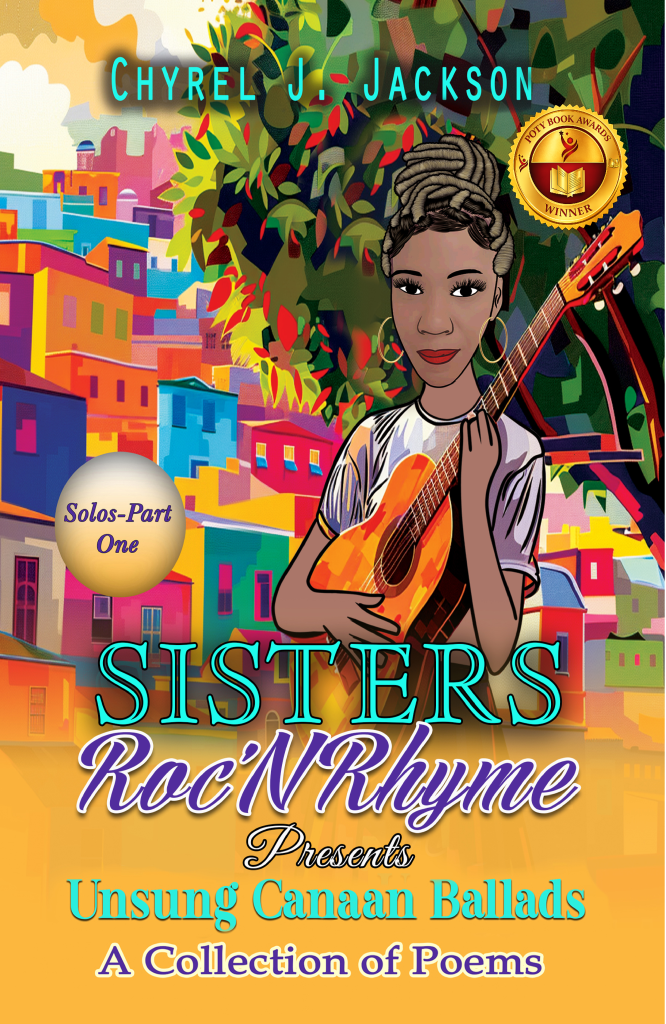
Chicago-area poet and bestselling author Chyrel J. Jackson has been named the 2026 POTY Book Awards Winner in the Non-Fiction–Poetry category for Unsung Canaan Ballads: A Collection of Poems, the first solo release in her Sisters Roc ’N’ Rhyme series.
Poet Chyrel J. Jackson has been selected as a Winner in the 2026 POTY Book Awards, presented by PersonsOfTheYear.com. Her collection,Unsung Canaan Ballads: A Collection of Poems – Sisters Roc ’N’ Rhyme Solos, Part One, took top honors in the Non-Fiction–Poetry category.
The POTY Book Awards recognize outstanding work among each year’s field of entries, honoring books for their quality and accomplishment. In announcing the award, organizers congratulated Jackson on the achievement and encouraged her to celebrate the honor with her readers, publisher, and supporters.
Unsung Canaan Ballads marks Jackson’s first solo collection under the Sisters Roc ’N’ Rhyme banner, the creative partnership she shares with her sister, poet Lyris D. Wallace. Published by Prolific Pulse Press LLC, the book gathers poems rooted in the African American literary tradition that has shaped Jackson’s voice since childhood.
“I’m deeply grateful to the POTY Book Awards for this recognition. These poems carry the voices of people whose stories too often go unsung, and I’m honored that they’ve found their audience.” said Jackson.
Raised in the South Suburbs of Chicago, Jackson writes in the spirit of the literary ancestors she admires. She earned her first literary nomination in 2021, when her poem “Love Unspoken,” published in the Heart Beats Anthology, was nominated for a Pushcart Prize. In 2022 she contributed to the #1 bestselling anthology Not Just Anybody Can Be Dad. With Wallace, she has co-authored SistersRoc’N’Rhyme Presents Poems in the Key of Life, Mirrored Images, and Different Sides of the Same Coin, and the duo’s work appears in numerous anthologies, literary journals, and international magazines. Jackson is also a 2025 poet laureate of the Garden of Neuro and a #1-ranked Amazon bestselling author.
“We could not be more pleased with this outcome. Chyrel J. Jackson is an excellent poet and writer, and we are thrilled for her success. Lisa Tomey-Zonneveld, Prolific Pulse Press LLC.”
Chyrel J. Jackson is an award-winning poet, Pushcart Prize nominee, and #1 bestselling Amazon author from the South Suburbs of Chicago. Together with her sister Lyris D. Wallace, she writes as part of Sisters Roc ’N’ Rhyme, creating written legacies one book at a time. Learn more at sistersrocnrhyme.blogspot.com and linktr.ee/ChyrelJ_Jackson66.
About Prolific Pulse Press LLC
Prolific Pulse Press LLC is an independent publisher of poetry and literary works. Visit www.prolificpulse.com.
Many of us learned the same unspoken rule while growing up: if someone might struggle with suicidal thoughts, tread carefully, change the subject, and do not say the word out loud. They taught us that staying silent is the safest option.
It isn’t. And today — World Suicide Prevention Day — groups emphasise exactly that concept. This year’s theme, set by the International Association for Suicide Prevention, is “Changing the Narrative on Suicide.” The call to action is simple: have the honest conversation instead of the careful silence.
Where I’m coming from
I spent years doing suicide intervention work across every age group — children, teenagers, adults, and older adults. I have walked many clients down the hall of the mental health center to be evaluated by the doctors.
A withdrawn fourteen-year-old and a grieving seventy-year-old can both be at serious risk, and they rarely look alike. I’ve sat with both. What I want to pass on here isn’t a clinical lecture — it’s what actually held up, conversation after conversation, across all of those ages.
The narrative that needs to change
Suicide is not a sudden, singular crisis. Risk builds quietly, shows up differently depending on who’s carrying it, and touches every age bracket. An older adult withdrawing after a loss, a middle-aged parent who’s stopped mentioning the future, a teenager who’s gone quiet online instead of loud — none of these fit the crisis-movie version of what suicide risk looks like, and that mismatch is exactly why people miss it, including in people they love.
The myth worth killing
If I could correct one thing people believe, it’s this: asking someone directly if they’re thinking about suicide does not plant the idea or make it more likely. It’s the opposite. Every study and every hour of practice I’ve had says the same thing: a direct, calm question is protective. You convey to the other person who is exhibiting suicidal ideations that you will remain steady. Silence isolates people. A direct question opens a door.
What you can actually do today
I am no longer a clinician, but I have long since encountered persons contemplating suicide. It’s confusing, at times, to know if their thoughts are legitimate or they are having a rough time, but not suicidal. Often, it is that they need someone to truly listen.
You don’t need a clinical background to matter here. A few things that consistently help:
Ask directly. Not “you’re not thinking of hurting yourself, right?” but a plain, unhurried “Are you having thoughts of suicide?” The directness itself is a kindness.
Listen without rushing to fix it. You don’t need the right response. You need not look away.
Know when to bring in more support. Caring about someone doesn’t mean you have to carry it alone — knowing when to loop in a professional or a crisis line is part of showing up well, not a failure to help enough. You are not there to cure them, but to help them get the help they need.
Follow up again later. Not once. A check-in three days later, and again the week after, tells someone the concern wasn’t a one-time performance.
If you’re the one struggling
If you are experiencing these thoughts now, you don’t need to worry about finding the right words for someone else. In the US, you can call or text 988 anytime. Outside the US, findahelpline.com will point you to a local helpline. Reaching out is not a bigger deal than what you’re carrying; it’s just the next small step.
The point of today
Changing the narrative isn’t a slogan. The difference becomes practical when someone asks a direct question without flinching, contrasting with a person silently suffering to protect others. Any of us can start that conversation. It doesn’t take a professional to have it — it just takes going first.
If you or someone you know is in crisis, call or text 988 (Suicide & Crisis Lifeline) in the US, or visit findahelpline.com for international resources.
When New Hampshire poet William Doreski sat down with Lisa Tomey-Zonneveld of Prolific Pulse Press to talk about his new collection, Orpheus My Orpheus, the conversation ranged from a stubborn high school argument about E.E. Cummings to an early morning writing routine, and from Robert Lowell to a poem about RadioShack laptops that write their own deranged love poetry. It’s a wide-ranging, generous conversation — and it offers a rare window into how a poet’s voice gets built over a lifetime.
A poet almost by accident
Doreski’s origin story starts with resistance, not inspiration. As a high schooler in Connecticut, he was assigned some E.E. Cummings poems by a teacher barely older than his students — and he wasn’t impressed. “This doesn’t seem like poetry to me,” he told his teacher. “Anybody could write this stuff.” His teacher’s response became a turning point: go home and try it yourself.
“I spent several frustrating hours,” Doreski recalls, “learning what Mr. Cummings was doing was held a lot better than I could do.” Cummings never became a favorite, but the exercise cracked something open. From there, Doreski found his way to Wallace Stevens — drawn in partly because Stevens was, like him, a Connecticut poet — and then to Hart Crane, whose Collected Poems was handed to him by a working poet he met in a Springfield, Massachusetts bookstore. Reading about Crane’s death by suicide at 32 was, in Doreski’s words, horrifying — but Crane became an essential influence all the same. Rounding out his early education was Allen Tate, whose Pulitzer- and National Book Award–winning debut left Doreski impressed by a voice he found “very hard to imitate” — a lesson that would shape his own search for a distinctive style.
A career, and a well-timed exit
Doreski went on to teach for 34 years at Keene State College in New Hampshire, with a decade before that as an adjunct at several Boston-area universities, including Boston University, where he studied under the influential critic Helen Vendler. He’s candid about why he chose to retire when he did, at 70: “There comes a point where you may know a lot more than the students, but… their culture has become so different, so far from mine, that I’m really not the right person to be teaching them anymore.” He’d seen colleagues stay too long and become, in his words, “objects of ridicule among the students” — and he wanted to leave on his own terms.
It turned out to be well-timed. Just a few years after Doreski retired, Keene State laid off several tenured English faculty amid enrollment declines tied to New Hampshire’s shifting demographics. “I probably, with my seniority and higher salary, probably would have been a ripe candidate,” he notes.
The discipline of retirement
Retirement didn’t slow Doreski’s writing down — if anything, it gave it more shape. He describes waking early in the morning simply to have quiet, uninterrupted time to read and, some mornings, to write. “It gets sets the right kind of pace for your day,” he says. The flexibility of retirement means he can step away from gardening or painting the house to return to a poem started that morning — “a luxury,” as he puts it, “to be able to pick and choose your time.”
Inside the poems
During the conversation, Doreski reads two poems from the new collection. The title poem, “Orpheus My Orpheus,” restages the Greek myth as a piece of avant-garde 1960s-style theater — complete with a fiberglass fish tank stage, a disembodied singing head placed in a cooler by EMTs, maenads in “fright wigs,” and a narrator accepting a Pulitzer for drama before retreating, Eurydice in hand, toward the underworld. Doreski traces some of its spirit back to a book he’d been reading about the New York avant-garde scene of the 1960s — happenings, underground film, and the kind of theatrical strangeness he was, in his words, “too young to really fully appreciate” at the time.
The second poem he reads, “Computers Go Crazy,” imagines RadioShack display computers spontaneously generating and publishing deranged lyric fragments — and refusing to stop even after being unplugged and smashed on the floor. It’s a playful premise, but it illustrates something Doreski returns to throughout the interview: his belief in verse as a shaped thing, distinct from “broken prose.” Years ago, he says, he stopped writing free verse entirely, worried he was just writing sentences with line breaks. Returning to Wallace Stevens’s example — deceptively simple, but unmistakably verse — helped him find his way back to line, rhythm, and form as meaning-making tools in their own right.
On reading poems aloud — and the people who shaped him
Doreski credits Helen Vendler with instilling in him the practice of reading poems aloud, even alone — a habit he says has taught him more about a poem than silent reading ever could. “A lot of poetry… does not read aloud very well at all,” he observes, even work published in respected magazines.
The conversation also touches on the poets and friends who shaped him — including Robert Lowell, whom Doreski knew personally but has deliberately never written about, wary of adding to the “gush of memoir” that followed Lowell’s death. Of Helen Vendler, he jokes that her ghost would “tell me off” if he tried. It’s a glimpse of how seriously Doreski takes the boundary between friendship and material — a poem, he says, quoting T.S. Eliot’s idea of the “objective correlative,” has to become its own thing, not a sermon or a memoir.
A candid note on where poetry stands today
Later in the conversation, Doreski reflects frankly on the state of the literary world — the shrinking audience for poetry, bookstores where used poetry collections outsell new ones simply because they’re cheaper, and a broader cultural shift away from reading. It’s a wistful, clear-eyed assessment from someone who has spent a lifetime inside that world, delivered without bitterness — just honest observation, and an unmistakable commitment to keep writing anyway.
About the book
Orpheus My Orpheus is a slim, restless collection of seventeen poems in which art is never mere decoration — it’s a disruptive force that exposes the hidden dimensions of experience, and poetry itself becomes a form of survival even when the body fails. Written in fast-swerving accentual verse, the collection moves from the domestic to the mythic to the grotesque with startling emotional agility, echoing poets like Mark Strand and Stephen Dobyns.
Order Orpheus My Orpheus and learn more about William Doreski here 🎥 Watch the full interview on YouTube.
As a teacher, I will always remain a student. In the classroom of life, l wish to work with and educate others. Whether you’re a teacher, student, or just your average person, here are a few of my "TEACHERble" moments.