Book Reviews, books, poetry

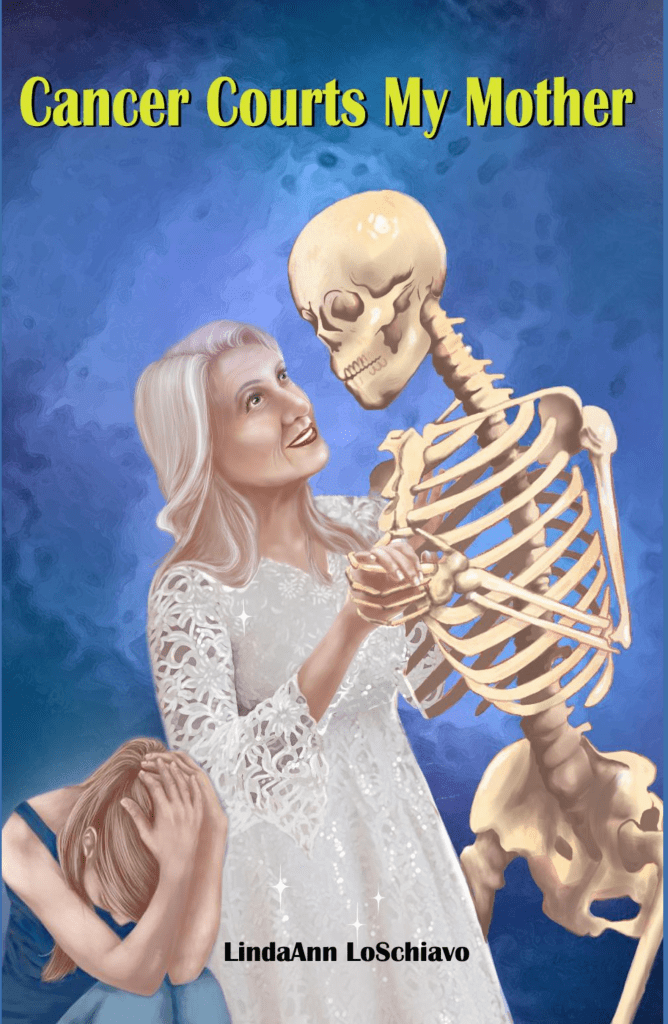
Peter Mladinic’s Book Review of “Cancer Courts My Mother” by LindaAnn LoSchiavo


Home Remedies: a review of Cancer Courts My Mother by LindaAnn LoSchiavo. Prolific Pulse Press. Raleigh, NC. November 2025

It would be hard to find a person whose life, directly or indirectly, has not been touched by cancer. Just as cancer takes many forms, people’s mental, emotional, and physical responses vary. LindaAnn LoSchiavo’s response is this book. Out of ugliness, the frightful fact cancer kills, she has wrought beauty, this sequence of poems. A reader’s appreciation of them may be heightened by taking a look at their metaphorical resonance and their distinction between honesty and artifice; and, ultimately, by considering the voice of the poet, a daughter speaking about her parents.

The book’s title Cancer Courts My Mother suggests an extended metaphor. The tenor, cancer, is a suitor. A suitor is defined as a man who courts a woman.  Although the title suggests otherwise, the woman the suitor courts is the daughter, the poet. In “Arrival” she says, “I know he’s made himself at home, the dark prince …conveying her into his sunless realm.” Yes, death is conveying the mother but it’s daughter who knows. And she is the one being courted, the one who hears the dark prince’s seductive whispers, the one for whom “terminal illness / twirls out of the speech of men.” At the end of “Tick Tick” she says, “Cancer, biding his time, taunts me.” In “Early Visit from the Grim Reaper,” “His baritone commanded me to GO!” In the “Bartering with Cancer,” the octave begins with “When medicine has nothing more to give / There’s only daughters and morphine…” And in the turn, the second half, she says, “I’m stunned.” In “Jaundice,” she says, “my mother wound up with him —Cancer —,” but in the realm of life, cancer courts the daughter, the maker of these poems.

They are interesting for their distinction between fact and fiction, honesty and artifice. Interesting, compelling, haunting. “Diagnosis” begins the sequence. Its abrupt enjambments signal an urgency that inclines the speaker towards artifice.

Transformation’s required, starting with your voice,
Hemorrhaging with euphemisms, lies. You could
Be an actor fed fake dialogue, words almost
A well-rehearsed performance. You could be-
Come an acrobat, clutching the girders of hope. A
Safety net’s missing. The laughter is a ghost’s.

The abiding artifice is the poems.

Even imagination threatened to betray
me, failing to make good on the fancies I’d hope to invent.
But pen and paper became the dependable parents I’d
always longed for. With them, I sketched realities I could
eventually escape to.

That passage is the conclusion of “Mother Magnified,” which is an honest account of the friction between the speaker and her mother, one aspect of this mother and daughter relationship. Yet another realm of reality, that not only counters the artifice “an actor fed fake dialogue” but also the wooing of “the dark prince” is the life of plants.  In “Green Nursemaid” the daughter tends her mother’s plants, “suturing new healthiness into the exhausted potting mixture.” While other flourishes of artifice appear in the forms of mythic “mermaids” and the “prayer candles” of religious ritual, the plants symbolize continual life, and, in “Living through the Dying,” which begins with the imperative “Resuscitate the wilted,” their tenacity and the poet’s.

To consider the voice in the poems is to consider the speaker, a poet facing the grim reality that many of her reading audience have faced or will face: cancer kills. The poet’s mother’s suffering is terminal; then there’s her father’s suffering and her own. Her voice, what is said, and how, reflects the human heart in conflict with itself. Signs that say Fuck Cancer are brandished by people who hate the thing that is killing their love ones. I love, I hate —they suggest, conveying that conflict. The poet’s “realities” she “could escape to” suggests her speaking, and putting pen to paper is cathartic. She is also defiant. In “Early Visit …” the reaper says, “GO! She says “No!” 

Cancer Courts My Mother consists of poems in free verse and in tradition forms. While its rhymes resolve, there is no closure; the poet’s turmoil remains. Cancer took her mother. A mother’s suffering and eventual absence, left a daughter and a spouse/ father to grieve. The poet’s grief is poignantly conveyed throughout this sequence. Towards the end she says, “When my mother died, she took home along with her.”

Order “Cancer Courts My Mother”

Peter Mladinic was born and raised in New Jersey. He graduated from the University of Minnesota in 1973 and earned an MFA in Creative Writing at the University of Arkansas in 1985. Professor emeritus at New Mexico Junior College, where he was a member of the English faculty for thirty years. During that time, he was a board member of the Lea County Museum and president of the Lea County Humane Society. He is the author of several poetry collections.
Announcements, Book Announcements, book launch, Book Reviews, poetry

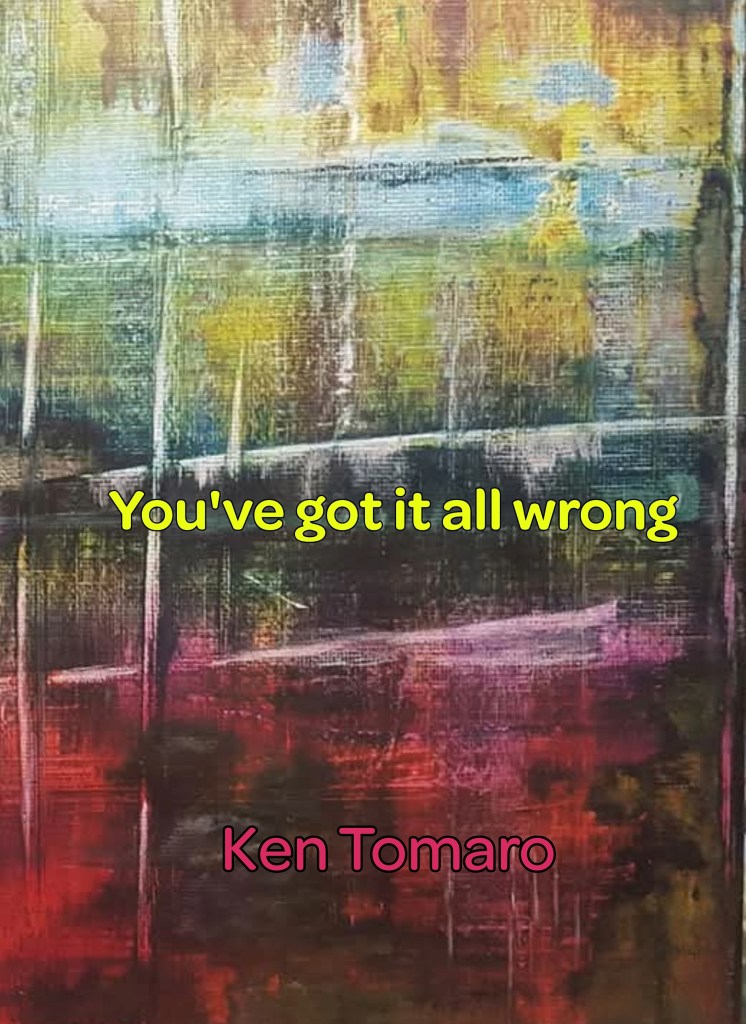
ANNOUNCEMENT! “You’ve got it all wrong” by Ken Tomaro is ready for you!

An Honest Review From Munmun “Sam” Samanta:

“You’ve Got it All Wrong” by Ken Tomaro.

 “I cleaned the apartment today,

changed the lightbulb in the refrigerator

and made stew from the leftover lamb my sister didn’t eat

I’m tired, it’s cold and dark here

and I am afraid of what’s out there

beyond the glass of the balcony door

beyond the neighbor who yells at his wife,

and kids, and brother

I’m afraid I’ll never find

what it is I don’t even know I’m looking for

or maybe I’m afraid

I won’t be able to change those things that need it…”

This is Ken Tomaro, so easy yet so profound.

Ken Tomaro’s collection “You’ve Got it All Wrong” explores nostalgia, loss, and the absurdities of existence through poignant, reflective poems. It is a collection of poetry that resists lyric ornament in favour of blunt realism, irony, and dark humour. Written in a conversational style, these poems traverse memory, absurdity, faith, mortality, and working-class identity.

The first poem, “I remember the distinct aroma,” begins with the scent of Polish doughnuts, using this family memory to reflect on the passing of time, the loss of childhood innocence, and fleeting moments that cannot be reclaimed.

“I was robbed” is a fierce monologue where Tomaro likens life to a thief: it brandishes a gun, steals sanity, dreams, and certainty, yet he refuses to yield.

“Playing God” conjures the fantasy of manipulating fate, depicted through cars on a highway—miniature models in the mind’s grip. “Summer of ‘89” is a lyrical meditation on teenage nights at Lake Erie.

“Life is very much a horror movie” is a standout poem that likens office life to an unending nightmare.

“If I believed in God” and “The big God damn bang” both question religious belief, exposing the flaws Tomaro perceives in the idea of a universe created by an indifferent force. In contrast, “Chickens” injects humour with its absurd image of chickens wandering a city road, disrupting the poet’s brooding thoughts.

“We all carry anger.”

A compassionate poem speaking to grief, persistence, and the will to keep breathing. “Make it stop” is among the darkest, most unflinching poems:

“word of warning –

It’s not a happy ending.”

“Breathworks” is a brief yet powerful poem that reminds us that trauma begins at birth. “Bad genes” is a satiric poem wrapped in humour and rage. Tomaro’s bluntness, “fuck all of you!” is cathartic. “Rosemarie” is a deeply nostalgic and tender poem that evokes memories of childhood winters, fireplaces, and Christmas music from 1976.

“Sometimes a dog’s butthole” leans into shock value, but its humour reveals genuine affection for Cleveland, using the city’s quirks—potholes, pierogies, grey winters—to illustrate imperfect love.

“A glittering shitshow of smash-faced adults” distils Tomaro’s outlook: absurdity, bluntness, and unyielding truth. The poem confronts adolescence, broken towns, and fragmented adulthood.

“Beyond the Glass” is one of the most vulnerable poems by Tomaro. It captures the threads of loneliness, seasonal depression, and the fear of the unknown that linger in the human heart. The “cold and dark” beyond the balcony glass becomes a metaphor for uncertainty and existential dread. “Well, hello” is the closing poem.  It is structured around the word “well,” and ties together themes of health, survival, and cautious hope.

Tomaro writes with honesty and sharp wit, never sugarcoating his words. His poetry speaks to those who want the truth, humour that doesn’t hold back, and a clear-eyed look at life. “You’ve Got It All Wrong” reminds us that being human means living with contradictions and sometimes finding reasons to laugh anyway.

“You’ve Got It All Wrong” isn’t for readers who want romance or flowery language. Tomaro’s poems are stripped down, gritty, and often hit hard. He writes about life’s odd moments, the pull of memory, and the humour that helps us get by. This is poetry about surviving with honesty and wit, not by escaping reality. Fans of Charles Bukowski, Diane Seuss, John Prine, or anyone ready to face life’s absurdities with a grin must grab a copy:

“and it’s time for your annual wellness check/ to make sure you and your doctor/ remember each other’s faces.”

Get your copy today!!

Announcements, Book Announcements, poetry

ANNOUNCEMENT! “You’ve got it all wrong” is available for pre-order

https://youtube.com/shorts/QUO6tn0MFw4?feature=share

Check out the latest web update for Ken Tomaro’s latest Poetry Collection,

“You’ve got it all wrong.” https://www.prolificpulse.com/

Hear what Ken Tomaro has to say: “We don’t all get a fair shake in life, which will become clearer to you after reading this collection of poetry. Life is, among other things, a series of memories, good and bad, of death and grief. Hate and happiness. Kindness and compassion. Sometimes it’s just plain ridiculous and all we can do is laugh or shake our heads in disbelief. But, everything in this life is very real as are these poems. My hope is simply that anyone reading this book finds them relatable and that they evoke some kind of emotion whether it’s joy or discomfort.”

Reviewers have great praise for Tomaro’s work:

The voice in Ken Tomaro’s new chapbook, You’ve got it all wrong is at times despairing, often celebratory, and always restless, hungry for truth, not one absolute, but the many truths beneath the surface of every day. He finds the extraordinary in his life and in the lives of others, and puts it into sharp, elegant lines of poems written by a human being in a beautifully complicated, troubled, imperfect world. His poems raise questions, offer no easy answers, and go straight to the heart. They are particular but also universal. Readers can see themselves and be thankful for the significant fact of being alive. Mostly, these poems take you in, and delight. In “Well, hello,” the chapbook’s final poem, Ken Tomaro says, “wellness is in the eye of the beholder / it’s in a good cup of coffee / a good hand in poker or / laughing out loud when you haven’t in a while.”

Peter Mladinic, author of The Whitestone Bridge and Maiden Rock

Give me a nice day, some really good tequila and a book by Ken Tomaro and I’m good to go.

John Yamrus, author of Don’t Shoot the Messenger: Just Give Him a Good Place to Hide

Ken’s work speaks from the base of his heart directly to the base of yours, leaving the mind to eavesdrop. His words evoke moments, feelings, memories so strongly that the conscious mind can only hang on for the ride and this collection has you nodding in agreement before you can even process what was said. This gift, this curse of his, is neatly packaged up for us to experience in this collection

Jason Artis

Pre-Order your copy for the October 17 release! https://www.prolificpulse.com/

Book Announcements, poetry

Propers to LindaAnn LoSchiavo for these Deeply Expressed Poems

Photo by Emiliano Arano on Pexels.com

I read this blog post from Black Poppy Review and found these poems to be deeply expressive. LindaAnn LoSchiavo is a prolific poet who is publishing her November release “Cancer Courts My Mother” with Prolific Pulse Press LLC

https://blackpoppyreview.blogspot.com/2025/10/my-mothers-ghost-started-dancing.html

Stay tuned for my interview with LoSchiavo.

Announcements, Book Announcements, Book Reviews, Celebrations, poetry

ANNOUNCEMENT! “Writing Between the Lines” by Nolcha Fox is Now Released!

https://www.prolificpulse.com/nolchafox

We are pleased to announce the new release of Nolcha Fox’s Poetry Collection, Writing Between the Lines”

Each natural jewel has its own unique brilliance. Catch the fire in a diamond and it’s like no other. As Nolcha catches the fire from other’s poems, these reflections create a whole new light show. As you read through the poems, you may find remnants of life’s experience weaving through. Like the light streams through stained glass windows, there are illuminations, sun dogs of brilliance, fractures melded into brilliant streams of color, of light.
~~~

Nolcha Fox is fearless. She walks the literary tightrope between success and failure with grace and elegance and she never ever disappoints. For my money, she’s simply one of the most remarkable writers to come along in years.

John Yamrus, author of Don’t Shoot the Messenger: Just Give Him a Good Place to Hide

***
Nolcha Fox’s new poetry book, Writing Between the Lines, is a keen collection of poems that begin and end with two lines from another poet’s poem. Although two lines are credited to another poet, the reader is taken into a new story and resolution decorated with vivid imagery and metaphors.

Barbara Leonhard, author of Three-Penny Memories: A Poetic Memoir

***

“Writing Between the Lines” by Nolcha Fox is a collection that surprises at every turn. Written as part of a 30-poems-in-30-days challenge, each piece begins and ends with borrowed lines from other poets, yet what happens in between is unmistakably Fox’s own voice.

The poems move effortlessly between humour and heartbreak. In “Drunk,” night, sleep, and dawn stumble together like a merry band of revellers, while “My Father’s Death” cuts deeply with raw grief and memory. “Dog Days” transforms the sun into a mischievous dog splashing through a creek, while “Keep Things Simple” delivers biting dark wit.

Nolcha Fox excels at capturing the contradictions of human experience, sorrow and absurdity, longing and laughter. Her imagery is sharp, her tone daring, and her honesty uncompromising.

Munmun Samanta, author of Yellow Chrysanthemum

Get your copy today! Click here for the best choices for this prolific collection.