


Prolific Pulse Press has now released Laura Stamps latest book “Doggie Haiku – A Novella for Dog-Lovers” Since this is the second book of Laura’s that we have published, it’s only fitting that we interview this fun and fascinating writer. Here goes!
1.) Please tell us a bit about yourself and your journey as a poet and writer.
I didn’t start writing until I was 30. By then I was a successful fine artist with paintings and art prints in galleries around the world. But one day I bought a “Writer’s Digest” magazine at my local Waldenbooks. I loved every word in it, especially Judson Jerome’s poetry column. It was his column that inspired me to write my first poem. And what an awful poem it was! I had no idea what I was doing. But I was hooked! I had always been an honors student in high school and college in English literature, but had never considered a career in writing because I am dyslexic. After writing that first poem, I dug out all my college English grammar text books, studied like crazy, and ordered a bunch of books from the “Writer’s Digest Book Club” about how to write poetry, fiction, and nonfiction. I read, studied, wrote every day, submitted to magazines, and eventually overcame my dyslexia. You can imagine how much the 2005 Pulitzer Prize nomination for my poetry book “The Year of the Cat” meant to me, considering the obstacles I’d overcome in order to achieve it. Today, I’ve published over 67 poetry books, short story collections, novels, and novellas with various publishers. Most recently, “The Good Dog” (Prolific Pulse Press, 2023), “Addicted to Dog Magazines” (Impspired, 2023), and “Dog Dazed” (Kittyfeather Press, 2022). In 2025 Prolific Pulse Press will publish my next novella-in-verse, “Postcards to Herself.” Many of my novels and novellas have spent months or years on the Amazon bestsellers lists. My stories and poems have appeared in over 2000 literary magazines and anthologies worldwide. And I’ve won countless awards, as well as receiving 7 Pushcart Prize nominations.
2.) How would you describe your writing style and the themes you explore in your novellas-in-verse?
I write in a stream-of-consciousness style. At first glance this style of writing might seem chaotic. But it’s how the subconscious strings thoughts together, which is why it makes perfect sense in the mind of the reader. And that fascinates me. I love to push it as far as I can, creating experimental forms, and breaking the rules of traditional sentence structure, which is why I enjoy writing novellas-in-verse like “Doggie Haiku.” I’m also attracted to this style of writing because I’m a huge fan of abstract art. Stream-of-consciousness writing is structured in the same way an artist paints an abstract painting. Gertrude Stein is famous for her stream-of-consciousness poems and stories. Virginia Woolf wrote an entire novel in this style (“The Waves”). The themes in my books may vary, but the underlying theme is always positive and empowering. That’s because I’m a child abuse survivor, date rape survivor, attempted kidnapping survivor, and domestic abuse survivor. And I’ve experienced all the side effects that accompany that kind of trauma, like PTSD, anxiety, panic attacks, and depression. I’ve also experienced my share of stalkers and bad-news men in love relationships. That’s why my books, even the humorous ones, are always empowering. I like to highlight the positive and offer hope to my readers. There’s enough darkness in the world. I have no desire to add to it.
3.) Congratulations on your latest poetry book! Can you give us an overview of what readers can expect from it?
“Doggie Haiku” is a novella written entirely in haiku poems. Cindy, the main character, is a shopaholic. She’s also the “Treat Lady.” There’s always a treat in her pocket for the neighborhood dogs. But what she really wants is a dog of her own. One day she sees Hazel at the local shelter. A tiny, frightened, senior Chihuahua. And she can’t resist. However, walking a dog in the snow is not her thing. So she applies for a transfer at her job. Soon Cindy and Hazel are on the move down to the Florida office. To blue skies, sandy beaches, sunshine, and those Southern men (oh, my!). And that’s when the adventures begin!
4.) What was the inspiration behind this particular collection of poems?
I prefer to write poetry in the form of novellas-in-verse, and I’ve published many in the last 36 years. Several with short poems. But never one in haiku. And I’ve never seen a published novel or novella written entirely in haiku. Since I’ve always loved haiku, I thought it would be a fun challenge. And it was! I enjoyed every minute of the process. And I’m very pleased with the result.
5.) Were there any specific challenges or highlights you encountered during the writing process of this book?
Not during the writing process. That was great fun. The challenge occurred during the editing. Every section of this novella had been published months before as separate poems in numerous literary magazines. In order for those sections to make sense as separate poems I had to tweak them a little. However when it came time to edit the novel, each section had to be tweaked again to create the smooth flow of a novel. Plus, there was the syllable count for each poem to consider. Some words have more syllables than you think. Some less. So I ran each haiku poem through a syllable counter to make sure it met the traditional 5/7/5 Haiku syllable structure. Because of this, editing this novella took much longer than usual.
6.) Please share your poetry from this book.
I join a book club
at the library. Novels
for dog-lovers. (Woof!)
But who do I see
next week at the book club? Mark.
(Are you kidding me?)
Mark. The cute guy. The
vet tech. My disaster date.
(How embarrassing!)
“Hi, Cindy,” he says.
“Well, this is awkward.” (You think?
Geez. What a nightmare.)
“Your dog bit my dog,”
I say. “True,” Mark says, “but we
can still be friends, right?”
“I’m not dating you,”
I say. “Your dog hates my dog.”
“Yes,” Mark says. “He does.”
This. This is why I
don’t date. Too stressful. It is.
(I’m no good at this!)
“Just keep Sam away
from Hazel,” I say. “Deal,” he
says, “friends now?” (Maybe…)
7.) Could you walk us through your creative process when crafting a new poem?
I have two offices in my home, and I keep regular business hours (7:00am – 4:00pm). I’m a fulltime writer. My writing day begins every morning at breakfast. I work on poems while I eat breakfast, lunch, and sometimes at dinner. The first draft of a poem is written by hand in a little 3×5 spiral-bound memo pad. I keep one of these pads, the first drafts of poems, and the poem I’m currently working on in a 5.5 x 8.5 zippered notebook. After I finish the first draft of a poem, I type it up on computer and print it out to edit. And that’s how I work until a poem is finished (edit by hand, type up the edits on computer, and print it out to continue editing). Afternoons are for editing. Each poem will go through 40-50 edits over the course of several days. When a poem is finished, I submit it to a magazine and begin working on the next poem. I’m a narrative poet, not a confessional poet, which means every poem I write is part of a novella-in-verse. I rarely take a break after I finish a book. By then I’ve already decided on the story and characters in my next book, and I’m anxious to begin.
8.) Who are some poets or writers that have influenced your work?
All my favorite writers are experimental. I love Anne Carson’s poetry books, especially “Autobiography of Red,” and “Beauty of the Husband”. Every book of hers is written and structured in a different style or form. She is amazing! And, of course, there’s Donald Barthelme. He was such an experimental goof and always cracks me up. The short stories of Ann Beattie and the flash fiction stories of Joyce Carol Oates were also early influences, and I still enjoy them. However, I would have to say Carson and Barthelme are my favorites. Always innovative. Always entertaining.
9.) Are there any other art forms or sources of inspiration that impact your poetry?
I’m a huge fan of abstract art, and it has always been an inspiration for my writing, because it’s a form of art that appeals to the subconscious. I like to structure my novels-in-verse in the same way as an abstract painting. Stories that touch the reader on a subconscious level.
10.) Who do you envision as your target audience for this book?
Dog-lovers and dog owners, as well as anyone who has had a dog, grew up with dogs, or would like to adopt a dog someday. Shopaholics (of course!). Any reader who loves a fast-moving, hysterically funny story. Readers who have survived dating disasters (haven’t we all?). Sometimes you just want to take a break from dating and the opposite sex. Especially when hanging out with your dog is less stressful and more fun. If any of this sounds like you, you’re going to love Cindy!
11.) What do you hope readers will gain or feel after reading your novellas-in-verse?
My goal in all my novels and novellas is to give my readers a fast, entertaining read they can’t put down until they finish it. One that makes them smile and laugh all the way through. A story that lifts their spirits and leaves them with a positive feeling. If that happens, I’ve done my job.
12.) Are there any upcoming projects or future plans you can share with us?
Yes, my next novella-in-verse will be coming out in 2025. It’s called “Postcards to Herself,” and it’s about a woman who writes and mails postcards to herself every week. However, what she has to say in these postcards is NOT what you would expect! It’s another humorous novella with one of my wacky women characters, who also happens to be a dog owner.
13.) Where can readers find your book and connect with you online?
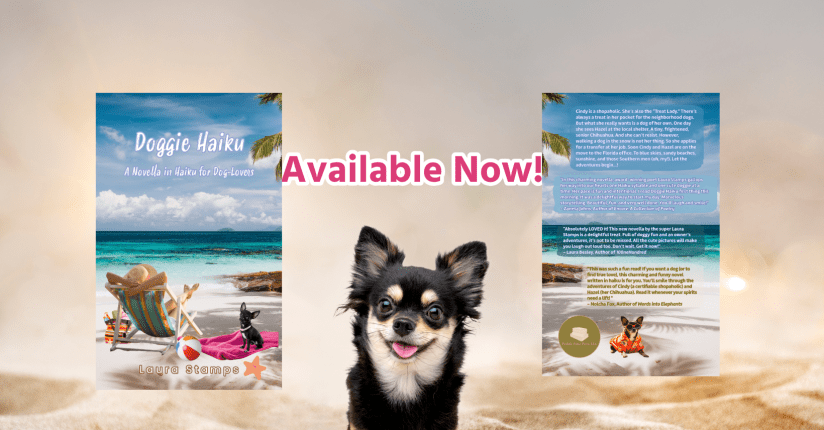
If you live in the U.S., you can order a signed copy of “Doggie Haiku” directly from me. Just email laurastamps18@yahoo.com for ordering information. You can also find me on Facebook (Laura Stamps) and WordPress (www.dogdazed7.wordpress.com) and my website (www.LauraStampsFiction.blogspot.com). “Doggie Haiku” will also be available on Amazon Barnes & Noble Books A Million BookShop and other online stores.





 Prolific Pulse Blog