Thank you to Peter Mladinic for this excellent review of Ken Tomaro's latest collection. [Sensitive Content Warning]
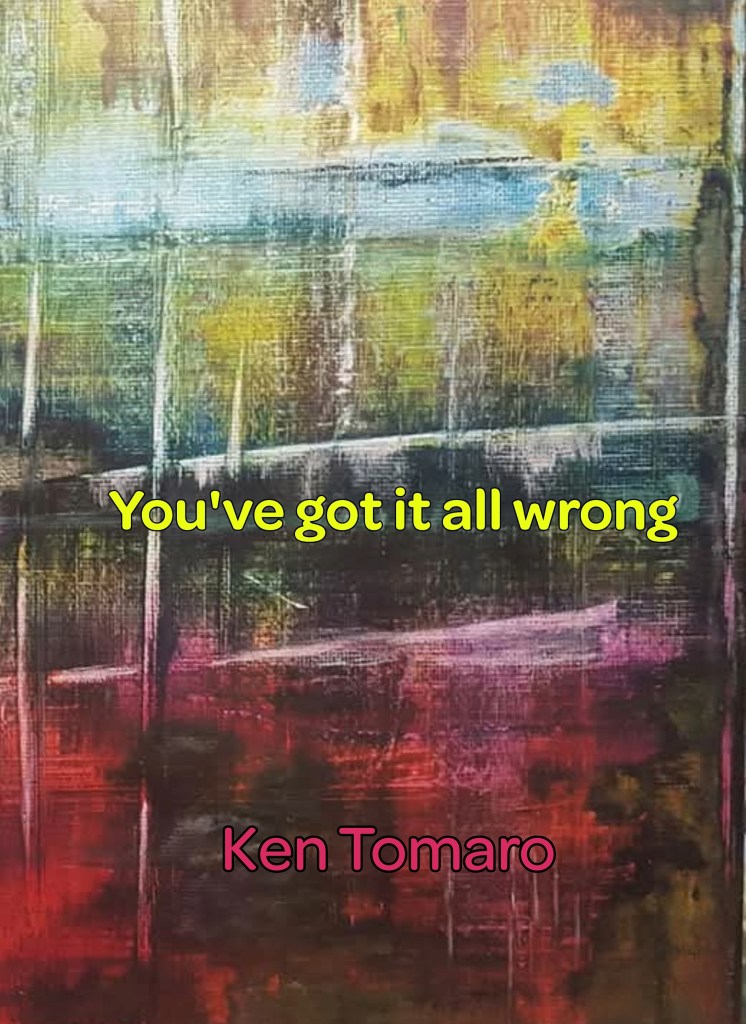
The House of Representatives: a review of You’ve got it all wrong, by Ken Tomaro. Prolific Pulse Press. Raleigh, NC. 2025. $12.95 paper.
Reviewed by Peter Mladinic
Just as there are representatives in politics, poetry too has its representatives, one difference being: there’s no party line to the imagination. Ken Tomaro, in the state of Ohio, is reminiscent of two poets in the neighboring state of Pennsylvania, John Yamrus and Dan Flore III. Like them, he eschews capitalization and standard punctuation, and like them, his comments are blunt, succinct, and direct. Yet all there are distinct voices. Ken Tomaro, like the hero in Frank Capra’s film Mr. Smith Goes to Washington, speaks for all of us. Three things worth noting in Tomaro’s poems are his imagery: his syntax, particularly his interpolated interjections, and his use of the first-person plural we.
Tomaro’s images are exacting, “on the mark, in that they are essential to the whole poem. In “I remember the distinct aroma” as the title indicates, the olfactory takes precedence. The speaker, in a coffee shop smelled an aroma reminiscent of “Polish donuts…from childhood.” The coffee shop workers “couldn’t tell me which pastry it was because I couldn’t describe it.” At the end, his question “but it goes deeper than that, doesn’t it?” is like the donut image at the start, absolutely essential to an appreciation of this imagist poem about memory. “Make it stop” relies on a tactile image. The speaker is irked or annoyed by people violating his personal space.
they were standing 3 feet from my desk talking about their kids, comparing all the sports they were in all the after-school activities which coach does his job, which one needs to retire blocking the isle so I couldn’t escape if I wanted to
This tactile image leads to a comment on society that is both poignant and funny. His pain is his readers’ pleasure as he says, “death is 5 feet away from me in the living room every night.” "Cash,” paper money, in “I can’t give you that” is what the speaker wants for Christmas. It leads him to say, “I can’t give her her old life back / I can’t give her a new set of legs / I can’t give her a million dollars.” This poem is similar to, yet opposite from “Playing God.” In that poem he looks out a window, “down on the traffic / speeding down the highways.” Rather than the person painfully aware of his limitations in “I can’t give you that,” here, in “Playing God” he pretends the cars are little race cars, “toys / running on an electric track / and I am …deciding how fast or slow they go.” The interpolated interjection is an element of syntax Tomaro uses to achieve compactness in his poems. It is particularly effective in “Summer of ‘89, where he puts one complete comment inside another.
the cement blocks we walked along were perfect squares but now, after years of Lake Erie slapping against them made them worn down and smooth there were little pockets along the surface
“Lake Erie slapping against them made them warm and smooth” the complete comment within the other complete comment “The cement blocks …were perfect squares / but now …there were little pockets along the surface “layers the texture of those blocks, adds to these things readers can touch. In “Chickens,” the speaker, running errands, sees something out of the ordinary, “two chickens pecking away at a pile of leaves …in suburbia.” He says, “I laugh for a moment at the absurdity of what I’ve seen / this is truly absurd; I can’t be the only one who thinks so.”
The comment within the comment— “this is truly absurd” accents his surprise at seeing “chickens where chickens shouldn’t be.” Other poems in which interpolated interjections play a vital part are “Reminiscence” and “Bad genes. In “A glittering shitshow of smash-faced adults” the interpolated interjection acts as a bridge of time linking adulthood to childhood:
I’m sitting in the office listening to John Prine pining for that good old country life feeling all weepy and shit he knew the deal he knew how it was and there I was a 14-year-old boy with a half-assed mustache surrounded by a town full of smashed-faced kids
The interjections “he knew the deal / he knew how it was” are followed by “I was,” and a memory of childhood.
Like the hero in Frank Capra’s Mr. Smith Goes to Washington, Ken Tomaro speaks for we, the people. One of his talents is that his deeply personal voice speaks for all of us. Like us, the speaker is an imperfect person living in an imperfect world. If he could he’d tell God that “this masterpiece he created / is just a pile of mud and sticks / slapped together haphazardly.” The title of the book comes from the first line of “We all carry anger.” With his direct address, the speaker conveys empathy. “I think you’ve got it all wrong / but I can see your grief from losing something.” Farther along, “I know you had a plan / and maybe it didn’t go as planned.” And finally, (profoundly), “you continue to do all these things / you say you can’t do /without even realizing you’re doing them.” This book does not lack for humor. “The big God damned bang” gives a unique spin to Adam and Eve’s fall from grace:
This is for you and only you. Go forth and explore, take in all the beauty and the glory. Go wherever you want, do whatever you want. Think and feel however you want. Just don’t touch that fucking apple, is all I’m saying. Give me a fucking break, man. Don’t invite me into your house for a party and tell me eat, drink, be merry, just don’t sit on the couch in the family room. It’s an antique, my grandmother’s, in pristine condition…
This irreverently funny passage conveys an exasperation people must feel at one time or another when thinking about Adam and Eve’s being cast out of paradise, to toil and sweat and grow old and die.
This passage of satire depicts the human condition of transience and mortality. Ken Tomaro’s topic is the human condition. The quotable passages in his poems are many. He is poignant, funny, irreverent, inquisitive, and contemplative. With an attentively attuned ear and a sharp eye for beauty, he makes the subjective objective, the local universal. He says things his way, as he simultaneously instructs and entertains. At the end of the book, he addresses his readers. “Here’s wishing you well and safe travels.” He means it. And his book is deserving of many readers. ... Peter Mladinic was born and raised in New Jersey. He graduated from the University of Minnesota in 1973 and earned an MFA in Creative Writing at the University of Arkansas in 1985. Professor emeritus at New Mexico Junior College, where he was a member of the English faculty for thirty years. During that time, he was a board member of the Lea County Museum and president of the Lea County Humane Society. He is the author of seven books of poems; his most recent book, Maiden Rock, is available from Uncollected Press (2024). An animal rights advocate, he lives in Hobbs, New Mexico, USA.
and made stew from the leftover lamb my sister didn’t eat
I’m tired, it’s cold and dark here
and I am afraid of what’s out there
beyond the glass of the balcony door
beyond the neighbor who yells at his wife,
and kids, and brother
I’m afraid I’ll never find
what it is I don’t even know I’m looking for
or maybe I’m afraid
I won’t be able to change those things that need it…”
This is Ken Tomaro, so easy yet so profound.
Ken Tomaro’s collection “You’ve Got it All Wrong” explores nostalgia, loss, and the absurdities of existence through poignant, reflective poems. It is a collection of poetry that resists lyric ornament in favour of blunt realism, irony, and dark humour. Written in a conversational style, these poems traverse memory, absurdity, faith, mortality, and working-class identity.
The first poem, “I remember the distinct aroma,” begins with the scent of Polish doughnuts, using this family memory to reflect on the passing of time, the loss of childhood innocence, and fleeting moments that cannot be reclaimed.
“I was robbed” is a fierce monologue where Tomaro likens life to a thief: it brandishes a gun, steals sanity, dreams, and certainty, yet he refuses to yield.
“Playing God” conjures the fantasy of manipulating fate, depicted through cars on a highway—miniature models in the mind’s grip. “Summer of ‘89” is a lyrical meditation on teenage nights at Lake Erie.
“Life is very much a horror movie” is a standout poem that likens office life to an unending nightmare.
“If I believed in God” and “The big God damn bang” both question religious belief, exposing the flaws Tomaro perceives in the idea of a universe created by an indifferent force. In contrast, “Chickens” injects humour with its absurd image of chickens wandering a city road, disrupting the poet’s brooding thoughts.
“We all carry anger.”
A compassionate poem speaking to grief, persistence, and the will to keep breathing. “Make it stop” is among the darkest, most unflinching poems:
“word of warning –
It’s not a happy ending.”
“Breathworks” is a brief yet powerful poem that reminds us that trauma begins at birth. “Bad genes” is a satiric poem wrapped in humour and rage. Tomaro’s bluntness, “fuck all of you!” is cathartic. “Rosemarie” is a deeply nostalgic and tender poem that evokes memories of childhood winters, fireplaces, and Christmas music from 1976.
“Sometimes a dog’s butthole” leans into shock value, but its humour reveals genuine affection for Cleveland, using the city’s quirks—potholes, pierogies, grey winters—to illustrate imperfect love.
“A glittering shitshow of smash-faced adults” distils Tomaro’s outlook: absurdity, bluntness, and unyielding truth. The poem confronts adolescence, broken towns, and fragmented adulthood.
“Beyond the Glass” is one of the most vulnerable poems by Tomaro. It captures the threads of loneliness, seasonal depression, and the fear of the unknown that linger in the human heart. The “cold and dark” beyond the balcony glass becomes a metaphor for uncertainty and existential dread. “Well, hello” is the closing poem. It is structured around the word “well,” and ties together themes of health, survival, and cautious hope.
Tomaro writes with honesty and sharp wit, never sugarcoating his words. His poetry speaks to those who want the truth, humour that doesn’t hold back, and a clear-eyed look at life. “You’ve Got It All Wrong” reminds us that being human means living with contradictions and sometimes finding reasons to laugh anyway.
“You’ve Got It All Wrong” isn’t for readers who want romance or flowery language. Tomaro’s poems are stripped down, gritty, and often hit hard. He writes about life’s odd moments, the pull of memory, and the humour that helps us get by. This is poetry about surviving with honesty and wit, not by escaping reality. Fans of Charles Bukowski, Diane Seuss, John Prine, or anyone ready to face life’s absurdities with a grin must grab a copy:
“and it’s time for your annual wellness check/ to make sure you and your doctor/ remember each other’s faces.”
Hear what Ken Tomaro has to say: “We don’t all get a fair shake in life, which will become clearer to you after reading this collection of poetry. Life is, among other things, a series of memories, good and bad, of death and grief. Hate and happiness. Kindness and compassion. Sometimes it’s just plain ridiculous and all we can do is laugh or shake our heads in disbelief. But, everything in this life is very real as are these poems. My hope is simply that anyone reading this book finds them relatable and that they evoke some kind of emotion whether it’s joy or discomfort.”
Reviewers have great praise for Tomaro’s work:
The voice in Ken Tomaro’s new chapbook, You’ve got it all wrong is at times despairing, often celebratory, and always restless, hungry for truth, not one absolute, but the many truths beneath the surface of every day. He finds the extraordinary in his life and in the lives of others, and puts it into sharp, elegant lines of poems written by a human being in a beautifully complicated, troubled, imperfect world. His poems raise questions, offer no easy answers, and go straight to the heart. They are particular but also universal. Readers can see themselves and be thankful for the significant fact of being alive. Mostly, these poems take you in, and delight. In “Well, hello,” the chapbook’s final poem, Ken Tomaro says, “wellness is in the eye of the beholder / it’s in a good cup of coffee / a good hand in poker or / laughing out loud when you haven’t in a while.”
Peter Mladinic, author of The Whitestone Bridge and Maiden Rock
Give me a nice day, some really good tequila and a book by Ken Tomaro and I’m good to go.
John Yamrus, author of Don’t Shoot the Messenger: Just Give Him a Good Place to Hide
Ken’s work speaks from the base of his heart directly to the base of yours, leaving the mind to eavesdrop. His words evoke moments, feelings, memories so strongly that the conscious mind can only hang on for the ride and this collection has you nodding in agreement before you can even process what was said. This gift, this curse of his, is neatly packaged up for us to experience in this collection
This Poetry Collection is available for purchase through online stores. Born from a shared love of dark humor and playful wordplay, Seesaw is a delightful balancing act of wit, whimsy, and poetic mischief. Ken Tomaro and Nolcha Fox first crossed creative paths in the Thursday Night Poets group, where their mutual knack for quirky, offbeat humor sparked an unexpected collaboration. What began as playful exchanges-plucking words and phrases from each other’s poems to craft something new-quickly evolved into a collection that swings between the light and the dark, the serious and the absurd. Seesaw is poetry at its most spontaneous and fun, a reminder that even in life’s heavier moments, there’s always room to laugh, twist the narrative, and dance on the edge of meaning. Dive into this collection and let the playful push and pull of their voices keep you balanced right in the middle of the seesaw.
About the Authors
Ken Tomaro Never until recently did he consider writing poetry. Not when he slid from the womb. Not when he felt the first tingle of teen hormones. Not after he got married, divorced, moved to another city, lost a couple jobs, moved back. It just sort of happened. Ken Tomaro, self-proclaimed poet laureate of the Cleveland sewer system, has been writing poetry for a few short years. He’s not famous, rich, recognized or read in schools across America. He has been published in several literary journals, done a couple podcasts, started the YouTube channel, Screaming Down the Poetic Highway KenTomaro.com
Nolcha Fox’s poems have been curated in print and online journals. Her poetry books are available on Amazon and Dancing Girl Press. Nominee for 2023, 2024, and 2025 Best of The Net. Nominee for 2023 and 2024 Pushcart Prize. Editor of Chewers by Masticadores. Co-Poetry Editor of LatinosUSA. Websites: https://bit.ly/3bT9tYu and https://nolchafox2.wixsite.com/nolcha… Facebook: / nolcha.fox
As a teacher, I will always remain a student. In the classroom of life, l wish to work with and educate others. Whether you’re a teacher, student, or just your average person, here are a few of my "TEACHERble" moments.
Hi! my name is Sebastian (You can call me Seb!) ...welcome to my Blog. I'm a photographer from Worcester, Worcestershire, England. Thanks for dropping by! I hope you enjoy my work.



 Prolific Pulse Blog