Thank you to Peter Mladinic for this excellent review of Ken Tomaro's latest collection. [Sensitive Content Warning]
The House of Representatives: a review of You’ve got it all wrong, by Ken Tomaro. Prolific Pulse Press. Raleigh, NC. 2025. $12.95 paper.
Reviewed by Peter Mladinic
Just as there are representatives in politics, poetry too has its representatives, one difference being: there’s no party line to the imagination. Ken Tomaro, in the state of Ohio, is reminiscent of two poets in the neighboring state of Pennsylvania, John Yamrus and Dan Flore III. Like them, he eschews capitalization and standard punctuation, and like them, his comments are blunt, succinct, and direct. Yet all there are distinct voices. Ken Tomaro, like the hero in Frank Capra’s film Mr. Smith Goes to Washington, speaks for all of us. Three things worth noting in Tomaro’s poems are his imagery: his syntax, particularly his interpolated interjections, and his use of the first-person plural we.
Tomaro’s images are exacting, “on the mark, in that they are essential to the whole poem. In “I remember the distinct aroma” as the title indicates, the olfactory takes precedence. The speaker, in a coffee shop smelled an aroma reminiscent of “Polish donuts…from childhood.” The coffee shop workers “couldn’t tell me which pastry it was because I couldn’t describe it.” At the end, his question “but it goes deeper than that, doesn’t it?” is like the donut image at the start, absolutely essential to an appreciation of this imagist poem about memory. “Make it stop” relies on a tactile image. The speaker is irked or annoyed by people violating his personal space.
they were standing 3 feet from my desk talking about their kids, comparing all the sports they were in all the after-school activities which coach does his job, which one needs to retire blocking the isle so I couldn’t escape if I wanted to
This tactile image leads to a comment on society that is both poignant and funny. His pain is his readers’ pleasure as he says, “death is 5 feet away from me in the living room every night.” "Cash,” paper money, in “I can’t give you that” is what the speaker wants for Christmas. It leads him to say, “I can’t give her her old life back / I can’t give her a new set of legs / I can’t give her a million dollars.” This poem is similar to, yet opposite from “Playing God.” In that poem he looks out a window, “down on the traffic / speeding down the highways.” Rather than the person painfully aware of his limitations in “I can’t give you that,” here, in “Playing God” he pretends the cars are little race cars, “toys / running on an electric track / and I am …deciding how fast or slow they go.” The interpolated interjection is an element of syntax Tomaro uses to achieve compactness in his poems. It is particularly effective in “Summer of ‘89, where he puts one complete comment inside another.
the cement blocks we walked along were perfect squares but now, after years of Lake Erie slapping against them made them worn down and smooth there were little pockets along the surface
“Lake Erie slapping against them made them warm and smooth” the complete comment within the other complete comment “The cement blocks …were perfect squares / but now …there were little pockets along the surface “layers the texture of those blocks, adds to these things readers can touch. In “Chickens,” the speaker, running errands, sees something out of the ordinary, “two chickens pecking away at a pile of leaves …in suburbia.” He says, “I laugh for a moment at the absurdity of what I’ve seen / this is truly absurd; I can’t be the only one who thinks so.”
The comment within the comment— “this is truly absurd” accents his surprise at seeing “chickens where chickens shouldn’t be.” Other poems in which interpolated interjections play a vital part are “Reminiscence” and “Bad genes. In “A glittering shitshow of smash-faced adults” the interpolated interjection acts as a bridge of time linking adulthood to childhood:
I’m sitting in the office listening to John Prine pining for that good old country life feeling all weepy and shit he knew the deal he knew how it was and there I was a 14-year-old boy with a half-assed mustache surrounded by a town full of smashed-faced kids
The interjections “he knew the deal / he knew how it was” are followed by “I was,” and a memory of childhood.
Like the hero in Frank Capra’s Mr. Smith Goes to Washington, Ken Tomaro speaks for we, the people. One of his talents is that his deeply personal voice speaks for all of us. Like us, the speaker is an imperfect person living in an imperfect world. If he could he’d tell God that “this masterpiece he created / is just a pile of mud and sticks / slapped together haphazardly.” The title of the book comes from the first line of “We all carry anger.” With his direct address, the speaker conveys empathy. “I think you’ve got it all wrong / but I can see your grief from losing something.” Farther along, “I know you had a plan / and maybe it didn’t go as planned.” And finally, (profoundly), “you continue to do all these things / you say you can’t do /without even realizing you’re doing them.” This book does not lack for humor. “The big God damned bang” gives a unique spin to Adam and Eve’s fall from grace:
This is for you and only you. Go forth and explore, take in all the beauty and the glory. Go wherever you want, do whatever you want. Think and feel however you want. Just don’t touch that fucking apple, is all I’m saying. Give me a fucking break, man. Don’t invite me into your house for a party and tell me eat, drink, be merry, just don’t sit on the couch in the family room. It’s an antique, my grandmother’s, in pristine condition…
This irreverently funny passage conveys an exasperation people must feel at one time or another when thinking about Adam and Eve’s being cast out of paradise, to toil and sweat and grow old and die.
This passage of satire depicts the human condition of transience and mortality. Ken Tomaro’s topic is the human condition. The quotable passages in his poems are many. He is poignant, funny, irreverent, inquisitive, and contemplative. With an attentively attuned ear and a sharp eye for beauty, he makes the subjective objective, the local universal. He says things his way, as he simultaneously instructs and entertains. At the end of the book, he addresses his readers. “Here’s wishing you well and safe travels.” He means it. And his book is deserving of many readers. ... Peter Mladinic was born and raised in New Jersey. He graduated from the University of Minnesota in 1973 and earned an MFA in Creative Writing at the University of Arkansas in 1985. Professor emeritus at New Mexico Junior College, where he was a member of the English faculty for thirty years. During that time, he was a board member of the Lea County Museum and president of the Lea County Humane Society. He is the author of seven books of poems; his most recent book, Maiden Rock, is available from Uncollected Press (2024). An animal rights advocate, he lives in Hobbs, New Mexico, USA.
The Light of Day, a review of Yellow Chrysanthemum by Munmun Samanta. Prolific Pulse LLC. Raleigh, North Carolina. 2025.
In “Sia’s Dream of Dawn” a woman is alone in a garden, thinking, and very attuned to her surroundings. Readers at first think she may be an artist and she’s going to paint the sky. As the story unfolds, readers learn she’s a writer, and it’s as if she’s giving the sky a story, with characters, a plot, a conflict to be developed, heightened, and resolved. And she is. And the sky’s story, like clouds in a river, mirrors the writers. It’s original, poetic, and well worth reading again. Yellow Chrysanthemum as a collection is a story of struggle. Sia “loves this part of the garden. But more than that she loves this confluence of light and shadow.” A struggle to be honest with herself. The collection comprises a struggle for freedom as an artist; for freedom as a wife, daughter, mother, sibling; and for freedom as a person, for equality. “But conventional society never teaches a woman to strike back,” the narrator says in “Written in Blood.”
The stories that depict artists, and scholars are: “Peacock’s Feather,” “Sia’s Dream of Dawn,” “Come Back Somlata,” “Long-forgotten Line,” “A Girl Made of Darkness,” which also involves an individual’s struggle to overcome a society’s prejudice; “Lullaby,” as it invokes the bonding of mother and daughter through song; and “Mad Woman in the Attic,” the story of a woman married to a man who is a successful writer and an emotionally cold, distant husband. His books show empathy for others, but the women in his books reject the woman, just as he does, so she burns his books (his women), and feels at peace.
Stories that involve the struggle of women as members of families are: “Mother India,” “The Caged Bird,” “The Scar,” “Beast of Burden,” “Bright Big Bananas,” “Written in Blood,” and “Uproot.” “Mother India,” the first story in the collection is about hunger and poverty, a mother’s plight to feed herself and her children. It is very visceral; readers feel the hunger in it, and the mother’s desperation. “Uproot,” also about a mother, is contemplative. Should the protagonist stay where she is, or give into her married son’s wish that she leave her home, her job of teaching very young children, and go far away to live with him and his wife? Like “Sia’s Dream …” “Uproot” is a garden story. It begins with Sumita telling the children how a monkey-gardener uprooted trees, to analyze how much water they needed. The children are as delighted with their teacher as she is them, and in the end the story comes back to the garden.
While “Special Dish” has shades of scholastic research, it is primarily a story of the bonding of two women from different classes in society. “A Home of One’s Own,” while it involves family, depicts the plight of women in society at large, a society that says in its morays and traditions that women have no home, the home is the man’s. And in this story, there’s this wonderful sentence: “People say many things, but things are different.” Other stories that involve a woman’s struggle for equality are: “Uma,” “The Kitten and Cleopatra,” and “The Shut Door.” In all these, the plight of one woman is the plight of many.
In “The Shut Door” the narrator says, “It happens sometimes you cannot recognize yourself.” All twenty stories have the unstated adage “be honest with yourself.” Each is an attempt to arrive at some truth. Some stories seem sketched in gray pencils, others in dark blue ink. The light of day is the page on which the story appears. Labels limit. The struggle of the artist, the wife and mother, and the individual all intersect, or seem to, many of them. But in each the author, Munmun Samanta has made a thing of beauty, from her imagination, her vision, and her skill with words. These are stories that ring true; stories of India, of women, of lived lives.
Open her book and see for yourself. You’ll be rewarded. ProlificPulse.com
Peter Mladinic‘s most recent book of poems, Maiden Rock is available from UnCollected Press. An animal rights advocate, he lives in Hobbs, New Mexico, United States.
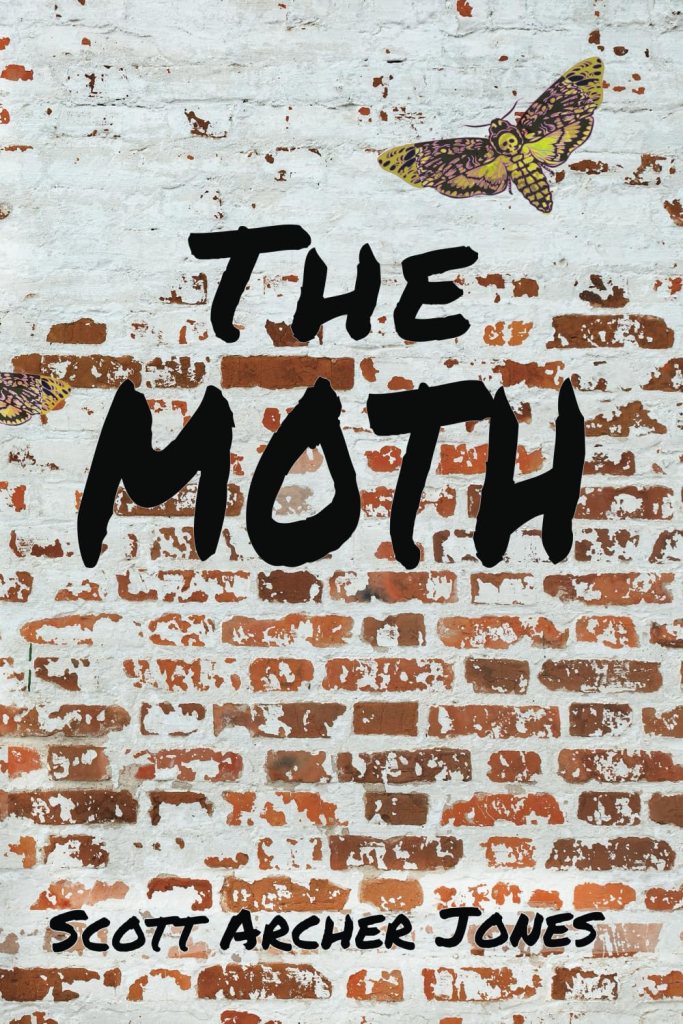
Watches, Cameras, Firearms, Fake IDs: a review of The Moth by Scott Archer Jones. Fomite. Burlington, VT. 2025. $15 paper.
The Moth takes readers on a ride to East L.A. and keeps them on the edge of their seats right to the end as its protagonist, Frank, a.k.a., The Moth, a pawn shop proprietor, sinks deeper and deeper into circumstances beyond his control. Part of the tension is that Frank is the sum of his choices, but he can’t control everything. A fusion of person and place, strong character relationships, and an abiding sense of danger make The Moth a memorable thriller in a noir style that calls to mind the fictional turf of Raymond Chandler and John Fante.
The Moth is character driven. Scott Jones knows that if his readers don’t know they can’t care. One way Jones makes his readers care is by rendering scenes from The Moth’s childhood in the Midwest of the United States. Before he was The Moth, he was Frank, son of a Lithuanian mother and an Irish American father. A central place in Frank’s childhood is the kitchen. It’s in the kitchen that Frank has a scene with his philandering and often absent father that evokes the tension in their relationship, and it’s in the kitchen that Frank learns of the industrial accident that claimed his father’s life. And it’s from the artificial light of the kitchen that Frank and his mother sojourn to the natural light of East L.A., where most of the novel is set. Scott Jones indeed places his readers in that expansive world vastly different from Frank’s claustrophobic roots. It is in East L.A. that he evolves into The Moth. The hospital where Frank’s mother, terminally ill with cancer, lives out her final days; the sidewalks where Frank sells contraband tapes; the food distributing company from which he is fired for giving food to a homeless family; the dark alley where he meets and falls in love with the prostitute Molly; and finally the pawn shop where The Moth works and lives alone in a back apartment are all part of who he is. Similarly other characters in The Moth’s East L.A. neighborhood are products of place. In this place of natural light, the dark of the pawn shop, crowded with items on display and hidden, seems comforting, a refuge, a place where The Moth can be himself.
The Moth evolves into a part of his East L.A. community. A community of people. Some are seasoned criminals, others have criminal ties and indulge in illegal activities; and still others are people who have little and never enough and are in desperate need of help. Molly, drug-addled and controlled by a pimp, is one such desperate person. Some of the best scenes in the novel occur as she and The Moth bond. Her death at the hands of a psychotic, sadistic john is an irreparable loss. It was with Molly that The Moth had a chance for the life he dreamed of when he moved to L.A. Because there are so many shady, seedy characters in The Moth’s East L.A., the innocents (and Molly is at heart an innocent) are all the more valued. The Moth tries to help Molly live a better life. He tries to help a father living with two children in a car get off the streets, and he tries to shelter a teenage girl from her physically abusive father—all to tragic results. But The Moth’s essential goodness, his generosity and empathy for people in dire need of help comes through in carefully rendered scenes.
A person steps into the pawn shop and sees lots of things, but what they don’t see are the fake IDs, the array of firearms, and other weaponry The Moth conceals from the eyes of the casual browser. In one scene he sells a high-powered rifle to the son of a criminal kingpin. The son wants that rifle to right a wrong, but the figurative tables turn, and he dies. The kingpin blames The Moth. For The Moth to keep on living, he must at atone for the son’s death by killing four of the kingpin’s enemies. The Moth is in a bind, and danger abides. Danger is integral to the plot, as The Moth knows violent criminals. What he has is of value to some of those criminals, and what he knows is of value to the police, as represented by a woman, an officer whose career is on the rise. She and The Moth met when she was investigating Molly’s murder. She uses The Moth as a snitch, as he knows things the average shopkeeper would never know. Scott Jones lucidly shows their meetings and The Moth’s dealings with people in his shop and in his community.
The idea of a pawn shop proprietor mixed up in shady dealings is not new, but it plays out beautifully in this novel. Scott Jones makes it believable by giving his readers flesh and blood characters and a well-rounded protagonist. People bring items into a pawn shop and take them out. Or, often those items are taken out by others. In the pawn shop that metaphorically is this novel, through ironic twists and turns, and good storytelling, proprietor-author Scott Jones knows what to put in and what to leave out. The Moth has arrived, an achievement that makes its mark in contemporary literature.
Review Written by Peter Mladinic
About Peter Mladinic
Peter Mladinic’s most recent book of poems, Maiden Rock is available from UnCollected Press. An animal rights advocate, he lives in Hobbs, New Mexico, United States.
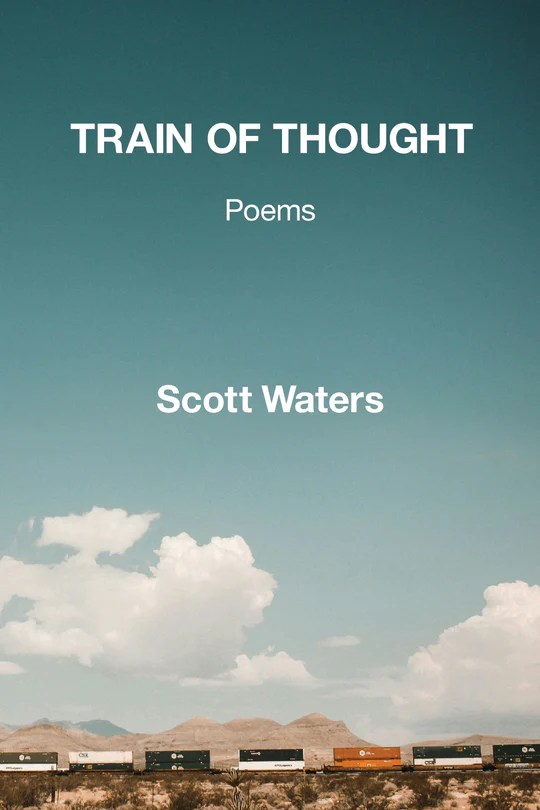
So the Day Doesn’t Escape Too Soon, a review of Train of Thought by Scott Waters. Kelsay Books. American Fork, Utah. 2025. $17.00 paper
In a documentary film on the great director Yasajiro Ozu, Wim Wenders has some wonderful commentary on trains in Ozu’s films. Trains in Ozu are symbols of passage, and a similar symbolism is going on in the poems of Scott Waters. As in Ozu, Waters’ trains are often commuter trains, taking people from their homes to work or to business in a city. Trains appear in various contexts in most of these poems, that concern themselves, and their readers with, like a train, going forward, and the persistence of nature, art, and humanity.
Nature thrives among the ruins. The vital coexists with the decadent. In “When I Took This Job,” the book’s opening poem, “the lulling rumble / of the train car” is juxtaposed with “three ducks shot like arrows / over a Cabernet pond.” The lulling rhythm varies with the quick, smooth flight, as seen from a window. In another poem, hills are likened to horses. In “Small,” “the morning news” is enveloped by a finch’s descent “through the bright pond of air” and “a spray of white petals / against your windshield.” In “Awakening on the 5:05,” the democracy of “a lavender stream in the woods” is accented, how it is there for all, to sustain animal life and evoke tranquility in humans, regardless of their socio-economic strata. It is there for all, as are the “oak, hickory, dogwood” trees in “Parallel Tracks,” the “mountain stream” in “Leaving the Cove,” and the “blackbirds” that rise “from marshes” in “I Took a Train to Fresno.” The human, the machine, and nature converge in “Shredding the Clouds,” a poem about ascent.
Three seagulls
circle above
a commuter train
parking lot
This passage is followed by an image of a raven’s descent onto a parking lot, perhaps to pick up a scrap of food left there. And then, another ascent “a small white plane,” in appearance like a gull, “chops through a / grey scarf of clouds.”
What is art? Perhaps, anything the artist can get away with. The idea that the subject chooses the artist is alive and well in “About the Floor,” with its tone of wry humor. The commuting speaker contemplates nature “cumulus piled / on western hills,” and human-made “beams as thick / as battering rams,” and ends up writing (memorably) about “the filthy / train / floor.” In “Body of Work” he describes in an array of arresting images a painting that has a quilt-like collage. “God’s Diorama” is three-dimensional, like a Joseph Cornell box. Beauty in art underlies “Puffs,” “glory / is an / English train.” The train, like a work of art, “startles you / when it arrives.” The role of the imagination in art underlies “Waking the Phoenix” as a train moves through hills, the “hills roll on,” the sun, like a new-born bird, “learns to fly” and finally is “soaring now,” a metaphor for humans being alive enough to imagine. Art mirrors life. In “Switch,” the speaker says “I …
pull out a pen
and the train, the mole,
the hills, the clouds,
the fog
are all at once embraced
by arms
of light.
The poet Philip Larkin said “What will survive of us is love.” In Train of Thought the best of humanity is exemplified in the care people give to places, things, and each other. Their “best” is continual, starting from “the / loved one / at / the door” in “Castaway Mind,” and ending with the “dark forces” in “Let Us Now Praise Breakfast in the Sun,” a poem that, despite those dark forces, is celebratory. Life is precious because people are mortal, the speaker suggests: “I am 57 / beard more grey/ than it was last week.” With a grey beard and a cognizance of death he says of his company’s CEO, a man who “died in his sleep … He will never face/ another Monday.” In “One Thing” a scent of perfume triggers a romantic memory, and in “A Bit of Flannel” the image of a shirt on a clothesline triggers a memory of familial love. In “Better Home and Garden” the speaker’s empathy for whoever lives in a “Tent by the railroad tracks” abides. A man rummages (“among the flung garbage/ of his campsite”)
as she hangs laundry
among the overgrown weeds
of a yard that belongs
to an unsent postcard
of a home.
Any review of Train of Thought would be remiss without the mention of “Mumbly Old Men.” With its precise showing and telling, it contrasts reality and virtual reality, accenting differences between then and now. One of the best in this collection of very good poems, it deserves to be in an anthology of the best of contemporary poetry. It engages all the five senses, and in a few words says a whole lot, not only about the speaker but about anyone living within the touch of a keypad. Fortunately, for readers, other poems in this book have the import of “Mumbly Old Men,” a poem with something to say that readers are unlikely to forget.
About Peter Mladinic
Peter Mladinic lives in Hobbs, New Mexico. He was born and raised in New Jersey and has lived in the Midwest and in the South. He enlisted in the United States Navy and served for four years. He received an MFA in Creative Writing from the University of Arkansas in 1985, and taught English for thirty years at New Mexico Junior College in Hobbs. He has edited two books: Love, Death, and the Plains; and Ethnic Lea: Southeast New Mexico Stories, which are available from the Lea County Museum Press, as are three volumes of poetry: Lost in Lea, Dressed for Winter, and Falling Awake in Lovington. His most recent book, Knives on a Table was published by Better Than Starbucks Publications in 2021. He is a past board member of the Lea County Museum and a former president of the Lea County Humane Society. An animal advocate, he supports numerous animal rescue groups. Two of his main concerns are to bring an end to the euthanizing of animals in shelters and to help get animals in shelters adopted into caring homes.
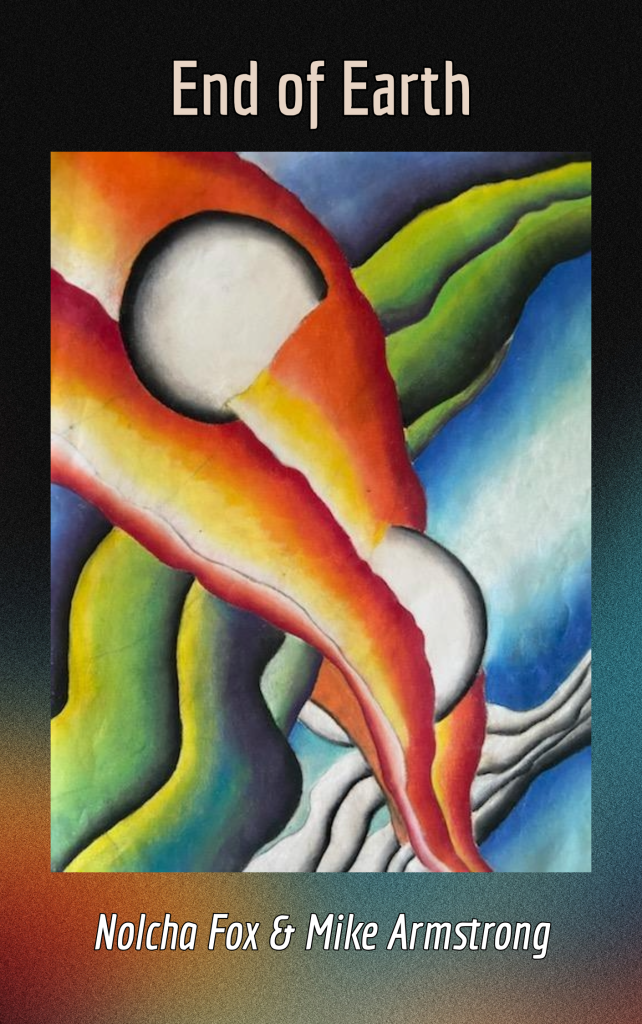
The Stars Will Remember, a review of End of Earth by Nolcha Fox, art by Mike Armstrong. Prolific Pulse Press, Raleigh, NC. 2024. $15.95 paper, $4.99 Kindle.
Perhaps in a future ions away, the stars will remember life on earth, the life of planets, animals, and humans, which is precisely what Nolcha Fox is writing about in End of Earth, a document of that life in poetic lines about people, places, and things in her past and present. Her poems, each of them, are complimented by Mike Armstrong’s paintings, that are vivid, abstract, and evoke impressions suited to the particular mood of each poem. In her point of view, sensibilities, and brevity, Fox is our contemporary Emily Dickinson, and very much herself, her own person. Three devices that make her utterances poems in End of Earth are metaphors, personification, and repetition.
Greed is the subject of “They Circle.” Hucksters, charlatans, thieves who misrepresent themselves, preying upon the vulnerable, are “money vampires.” Fox sets up a scene of roadkill and vultures. Outrageously, the roadkill, a dead possum? is speaking. With three words “a second look” Fox shifts the scene, from outdoors to indoors, and a person, perhaps by a computer, and perhaps indoors. Part of the poem’s economy lies in this ambiguity. The speaker could be indoors, or in an outdoors market, or even in a mall. Then she smoothly goes back to the roadkill. Form and content meld. Just as vultures circle in the sky, imagery takes the reader back to the beginning. And then also, there’s the “cook” and “spatula” kitchen diction, adding another dimension, evoking the density of texture needed to make a poem about greed that is powerful in that less says more. Fox indeed knows her way around a metaphor.
The sun is personified as feminine, as in the adage “when the fat lady sings,” in “The sun throws,” again with great economy. So, in the middle the euphony of “singing snow into icicles” signals a shift in imagery. In eight lines, a roof, a mountain, and a stage all fit wonderfully into this poem, with its structure of personification, a poetic device Fox uses satirically in “Gardening.” The wonder of “Gardening” is that the statement it makes is not only for today, but for times past. The human characteristic of stupidity is given to plant life. It’s a thing people cultivate, thus the garden itself becomes society, a broader and abstract entity, as in social media. The gardener “tells her friends stupidity” is a good thing, that it will provide nourishment and health, like a squash. The colloquial “buy” followed by the agricultural “stalk” conclude this poem in which the speaker means the opposite of what she says, and the import of what she says is achieved by personification: an attribute of human nature manifests itself in the form of a plant.
Fox employs repetition with variation well in “Pieces and Parts.” “No one sees…No one takes…When each one walks…,” a poem in which a “thingamabob” coexists with a “coffin” and the self interacts with the other. The tone in “Pieces and Parts” is defiant, the speaker defies nothing less than…death, (which is perhaps why Emily Dickinson wrote poems). In Fox’s “If I Can’t Overcome” the tone is resolved. Its structure of repetition, “let me be…let me be…let me be…let me breathe…let me welcome” lends to its elegance.
…let me be the stillness
that seeps into the clouds
before the rain.
Let me be the silence
that soothes the branches
just before the wind
announces snow…
Just as Mike Armstrong creates lines, angles, circles, squares, and other shapes that move through a visual pattern, Nolcha Fox creates lines that move through a verbal pattern. Reading her poems and coming back to each yields appreciation as well as pleasure. Whether light-hearted or dead serious, she is always exacting. She runs a gamut of human emotions and experience in poems that stand not just for today but for times past and times to come.
About Peter Mladinic:
Peter Mladinic lives in Hobbs, New Mexico. He was born and raised in New Jersey and has lived in the Midwest and in the South. He enlisted in the United States Navy and served for four years. He received an MFA in Creative Writing from the University of Arkansas in 1985, and taught English for thirty years at New Mexico Junior College in Hobbs. He has edited two books: Love, Death, and the Plains; and Ethnic Lea: Southeast New Mexico Stories, which are available from the Lea County Museum Press, as are his three volumes of poetry: Lost in Lea, Dressed for Winter, and his most recent book, co-authored with Charles Behlen, Falling Awake in Lovington. He is a past board member of the Lea County Museum and a former president of the Lea County Humane Society. An animal activist, he supports numerous animal rescue groups. Two of his main concerns are to bring an end to the euthanizing of animals in shelters and to help get animals in shelters adopted into caring homes. In his spare time, he enjoys yoga, listening to music, reading, and spending time with his six dogs. Recently, his poems have been published in numerous online journals in the US, Canada, England, Ireland, and Australia
As a teacher, I will always remain a student. In the classroom of life, l wish to work with and educate others. Whether you’re a teacher, student, or just your average person, here are a few of my "TEACHERble" moments.
Hi! my name is Sebastian (You can call me Seb!) ...welcome to my Blog. I'm a photographer from Worcester, Worcestershire, England. Thanks for dropping by! I hope you enjoy my work.




 Prolific Pulse Blog