To Submit to this unique publication, go to this LINK

To Submit to this unique publication, go to this LINK
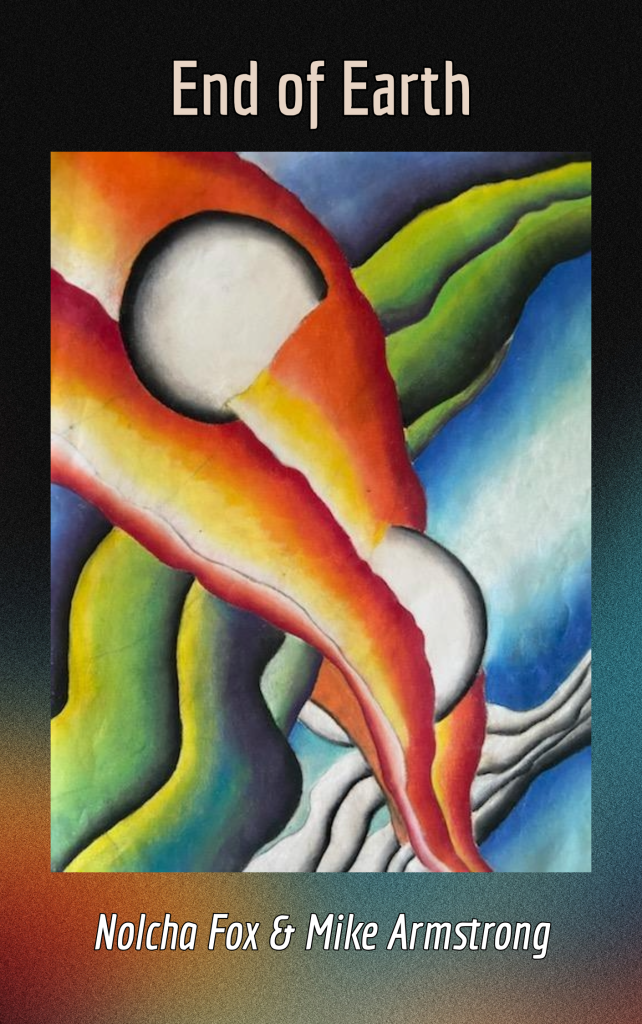
Poet Nolcha Fox and Artist Mike Armstrong have known each other for over 30 years. It is only natural that this would result in an amazing collaboration. “End of Earth – A Collaboration of Poetry and Painting” is the result. The rich, colorful, expression of art by Armstrong encouraged Fox’s poetic muse to create these thought-provoking poems. Such a collaboration is like no other and, well, you must see this for yourself. It is a little book with a big WOW factor. This would make a lovely gift for art and poetry lovers.
What do others have to say?
End of Earth, a Collaboration of Poetry and Painting, by Nolcha Fox and Mike Armstrong is ekphrastic art at its finest, a seamless coming together of vibrant brushstrokes and memorable lines in poem after poem. From “They circle” we have “Ah, they are money vampires. / They tell me they can hook me up, / no, cook me up in style.” The wit, music, and metaphors that comprise Nolcha Fox’s style are alive and well in End of Earth; it contains some of her best recent work. She is our contemporary Emily Dickinson, but also an original, fulfilling the potential of her poetic self in this new book.
Peter Mladinic, author of House Sitting, and The Homesick Mortician
Without a doubt, Nolcha Fox is the most interesting, inventive writer of poetry on the scene today.
John Yamrus, author of Present Tense
And now, January 25-31 there’s a .99 Kindle Exclusive Deal! https://a.co/d/i1Fpf50
Irony won’t be wasted! As January 25 is National Florida Day, let’s honor Mike Armstrong, the Artist of this team. He is in Sunny Florida!

Recently, Mike Armstrong, the artist for End of Earth, responded to my many interview questions.
– Please tell us a bit about yourself and your journey as an artist. – What inspired you to start creating art? How would you describe your artistic approach, style, and the themes you often explore in your artistic creations?
Long ago, I was born in Beautiful Birmingham Alabama. Fortunately, I received early Art instruction. I threw my first pot in the 3rd grade. It was a mess. I have taught Sculpture since.
Not being the ‘greatest’ High School student, I was released, by some of my teachers, to go to the Art room where I never made less than an A.
At the University of Alabama, I majored in Painting/Ceramics. Also studied Art and Art history at Santa Monica College and U.C.L.A.
I’m right brained and left-handed
Your Poetry and Art Book:
– Congratulations on your latest poetry and art collaboration! Can you give us an overview of what readers can expect from it?
I hope that our readers will explore its depth and lightheartedness. In other words, I hope that they get it.
Rotate book cover to the left and see something different. NOT to be strange, rotate pages 22 and 24 left-I see you. Be afraid–
Creative Process:
– Could you walk us through your creative process when creating a new painting? – Do you have any rituals or routines that help you get into the right mindset for painting? – How do you know when a painting is “finished?”
The creative process requires both mental and physical energy. I have recently moved my studio from the commercial Brevard Art Guild, where painting and associating with other artists was a plus, to my home studio which is convenient.
My non-representational work starts with adding a shape and a color to a usually blank canvas. Analyze, repeat. Finishing can be problematic-could take a week (record), or never. Yes, I have a lot of unfinished work.
– Many poets infuse their work with personal experiences or social commentary. Are there any recurring themes or messages in your art? – Are there any messages you hope readers take away from your art?
Although I do not aim for realism, I must be influenced by water. I grew up with a creek in my back yard and now live on the ocean. Also, many years of camping in the beautiful mountains of northern California are strongly remembered.
Named paintings are “Mountains” and “More Mountains.”
I often utilize a straight line, perhaps it represents sea line or–back to earth.
My work is spontaneous and has no intentional outcome. It is both mindless, reactive, and sometimes stressful.
– Who are some artists who have influenced your work? – Are there any other art forms or sources of inspiration that impact your art? – How do you navigate the fine line between drawing inspiration from others’ work and maintaining your own unique voice as an artist?
I am a fan of Willem De Kooning.
I was very much influenced by High School teacher, Deliska Skinner who guided and tolerated me for 3 hours, 5 days a week. Angelic.
Alvin Sella often frightened his students into hard work at the University of Alabama. With me, he was kind and gentle. Check him out.
Santa Monica College provided me with years of world travel and museums. A great Art department.
While at U.C.L.A., I would have to leave the all-night sessions in the photo lab only because the janitor was coming to work, and I had his parking space. Don’t think that I was supposed to be there–
Audience and Reception:
– Who do you envision as your target audience for this book? – What do you hope readers will gain or feel after viewing this collaboration? – How do you handle feedback or criticism of your art, both positive and negative?
When being reviewed, I listen for sincerity. It’s great when a viewer sees something that I have not, yet, considered.
– Any final words of encouragement or wisdom for aspiring artists reading this
interview?
For encouragement?? Yes, I’ll take all you can give. Oh yes, practice, practice.
Thank you, Mike Armstrong, for your interesting responses. I feel like I know you a little better.
Have you picked up your copy of End of Earth?


The Stars Will Remember, a review of End of Earth by Nolcha Fox, art by Mike Armstrong. Prolific Pulse Press, Raleigh, NC. 2024. $15.95 paper, $4.99 Kindle.
Perhaps in a future ions away, the stars will remember life on earth, the life of planets, animals, and humans, which is precisely what Nolcha Fox is writing about in End of Earth, a document of that life in poetic lines about people, places, and things in her past and present. Her poems, each of them, are complimented by Mike Armstrong’s paintings, that are vivid, abstract, and evoke impressions suited to the particular mood of each poem. In her point of view, sensibilities, and brevity, Fox is our contemporary Emily Dickinson, and very much herself, her own person. Three devices that make her utterances poems in End of Earth are metaphors, personification, and repetition.
Greed is the subject of “They Circle.” Hucksters, charlatans, thieves who misrepresent themselves, preying upon the vulnerable, are “money vampires.” Fox sets up a scene of roadkill and vultures. Outrageously, the roadkill, a dead possum? is speaking. With three words “a second look” Fox shifts the scene, from outdoors to indoors, and a person, perhaps by a computer, and perhaps indoors. Part of the poem’s economy lies in this ambiguity. The speaker could be indoors, or in an outdoors market, or even in a mall. Then she smoothly goes back to the roadkill. Form and content meld. Just as vultures circle in the sky, imagery takes the reader back to the beginning. And then also, there’s the “cook” and “spatula” kitchen diction, adding another dimension, evoking the density of texture needed to make a poem about greed that is powerful in that less says more. Fox indeed knows her way around a metaphor.
The sun is personified as feminine, as in the adage “when the fat lady sings,” in “The sun throws,” again with great economy. So, in the middle the euphony of “singing snow into icicles” signals a shift in imagery. In eight lines, a roof, a mountain, and a stage all fit wonderfully into this poem, with its structure of personification, a poetic device Fox uses satirically in “Gardening.” The wonder of “Gardening” is that the statement it makes is not only for today, but for times past. The human characteristic of stupidity is given to plant life. It’s a thing people cultivate, thus the garden itself becomes society, a broader and abstract entity, as in social media. The gardener “tells her friends stupidity” is a good thing, that it will provide nourishment and health, like a squash. The colloquial “buy” followed by the agricultural “stalk” conclude this poem in which the speaker means the opposite of what she says, and the import of what she says is achieved by personification: an attribute of human nature manifests itself in the form of a plant.
Fox employs repetition with variation well in “Pieces and Parts.” “No one sees…No one takes…When each one walks…,” a poem in which a “thingamabob” coexists with a “coffin” and the self interacts with the other. The tone in “Pieces and Parts” is defiant, the speaker defies nothing less than…death, (which is perhaps why Emily Dickinson wrote poems). In Fox’s “If I Can’t Overcome” the tone is resolved. Its structure of repetition, “let me be…let me be…let me be…let me breathe…let me welcome” lends to its elegance.
…let me be the stillness
that seeps into the clouds
before the rain.
Let me be the silence
that soothes the branches
just before the wind
announces snow…
Just as Mike Armstrong creates lines, angles, circles, squares, and other shapes that move through a visual pattern, Nolcha Fox creates lines that move through a verbal pattern. Reading her poems and coming back to each yields appreciation as well as pleasure. Whether light-hearted or dead serious, she is always exacting. She runs a gamut of human emotions and experience in poems that stand not just for today but for times past and times to come.
About Peter Mladinic:
Peter Mladinic lives in Hobbs, New Mexico. He was born and raised in New Jersey and has lived in the Midwest and in the South. He enlisted in the United States Navy and served for four years. He received an MFA in Creative Writing from the University of Arkansas in 1985, and taught English for thirty years at New Mexico Junior College in Hobbs. He has edited two books: Love, Death, and the Plains; and Ethnic Lea: Southeast New Mexico Stories, which are available from the Lea County Museum Press, as are his three volumes of poetry: Lost in Lea, Dressed for Winter, and his most recent book, co-authored with Charles Behlen, Falling Awake in Lovington. He is a past board member of the Lea County Museum and a former president of the Lea County Humane Society. An animal activist, he supports numerous animal rescue groups. Two of his main concerns are to bring an end to the euthanizing of animals in shelters and to help get animals in shelters adopted into caring homes. In his spare time, he enjoys yoga, listening to music, reading, and spending time with his six dogs. Recently, his poems have been published in numerous online journals in the US, Canada, England, Ireland, and Australia

You’ve already learned of the new release of “End of Earth” but in case you missed it… it’s right HERE
This is the first of Two interviews. This first interview is with Nolcha Fox, the Poetry Contributor of the poetry and art collection by Nolcha Fox and Mike Armstrong.
Let’s learn about Nolcha Fox:
– Please tell us a bit about yourself and your journey as a poet and writer,
I started writing as a toddler, using poop on the walls. I also tried to write on myself using my mother’s red lipstick. She told me it took a little while before the red tint disappeared from my face and hair.
When I was a little older, I returned to walls with crayons. I must have been potty-trained.
I expanded my writing to the margins of pages, a little embarrassing to my father, who borrowed the book. That may have been when I fell in love with reading, too.
In school, I expanded my skills through writing assignments. I had a wonderful teacher who encouraged us to write in the style of different authors. I wrote in the style of Charles Dickens for a bit. Poor Dickens.
I journaled in my early 20s and 30s. My journals included some awful poetry. So awful, I eventually tossed a small library of journals into a dumpster and never looked back.
My poetry was awful because I didn’t write like myself. I didn’t trust my intuition to guide me.
Plus, the angst in my poems was over the top. Hormones will do that.
Finally, I stumbled into technical writing. What an education in learning how to write! Much of my career was a black hole that squashed my creative writing. After 8+ hours working at a computer, my eyes were too tired to stare at another screen.
I didn’t seriously write until I retired. I had to wait for my hormones to move to a tropical island before I could truly write instead of emote.
– What inspired you to start writing poetry?
A dear poet friend of mine suggested poetry when the pain of daily migraines made it next to impossible for me to write any short fiction.
My first poem was published, and I thought, hey, I can do this!
– How would you describe your writing style and the themes you often explore in your poetry?
I write about whatever comes to mind. When I start a poem, I have no idea where it will end. I went through a period of writing about grief after my mother died last year. Otherwise, my themes are all over the place.
Most of my poetry is short (10 lines or less), unless I’m working with a form, such as a pantoum.
– Congratulations on your latest poetry book! Can you give us an overview of what readers can expect from it?
It’s a collection of short poems written to Mike’s paintings. His paintings draw the reader in visually, and the poetry draws the reader in mentally/emotionally.
– What was the inspiration behind this particular collection of poems?
Mike, don’t kill me. My mother inspired the collection. She recommended writing to Mike’s art. At first, I protested, because I typically write to images that aren’t abstract, like Mike’s. She laughed and said I could write anything I wanted, and nobody would know the difference.
However, when I began the project, I found myself responding to colors and forms, so it was easier to do than I originally thought.
– Please share your poetry from this book.
They circle

thinking I taste good,
at first, I think they’re vultures.
A second look reveals teeth.
Ah, they are money vampires.
They tell me they can hook me up,
no, cook me up in style.
They see me as some roadkill
and they’re a spatula.
***
Don’t let the light

seep through the sutures of your skull,
don’t let it set your hair ablaze.
It’s hard enough to fit
into this dark and dreary world
without everybody noticing your fire.
– Could you walk us through your creative process when crafting a new poem?
Often, an unrelated object or experience comes to mind as I mull over a prompt or an experience/feeling. For example, I wanted to write to the prompt “bond,” but blueberries popped into my head. So, I wrote a line that included blueberries, and the whole poem fell into place.
I only take a couple of minutes to decide where to start, and I write quickly. I usually give a poem one editorial pass, and then get it out to the world. It’s similar to explosive barfing.
If I find myself struggling with a poem, I put it away. It’s not ready to be born yet.
– Do you have any rituals or routines that help you get into the right mindset for writing poetry?
I attend to anything that will distract me from writing (such as laundry, hungry dogs, or emails). And then I write. I usually write two poems a day between distractions. The most I ever wrote was seven poems in a day.
– How do you know when a poem is “finished” and ready to be included in your book?
I call a poem finished when I have no more to write. I read through it once to see if it makes me laugh or if I respond emotionally. Sometimes I think it’s garbage and ask a poet friend to give me his thoughts. I’m usually wrong.
– Many poets infuse their work with personal experiences or social commentary. Are there any recurring themes or messages in your poetry?
My personal experiences are usually boring. I never have enough understanding to engage in social commentary. I rely on my imagination to lead me into and through a poem. In End of Earth, I couldn’t tell you if there are any recurring anythings. I don’t know how to step outside my poetry and observe it critically, so I let other people analyze what I wrote. I’m moving on to the next poem.
– How do you balance the personal with the universal in your poems?
I stick to everyday, specific images. If the universal creeps in, yay for me. It wasn’t intentional.
– Are there any messages you hope readers take away from your poetry book?
I hope readers enjoy the feast Mike and I laid out for them.
– Who are some poets or writers that have influenced your work?
My top influences are Alice in Wonderland and The Cat in the Hat. I love the rhythm and imaginative storytelling.
– Are there any other art forms or sources of inspiration that impact your poetry?
I often write to photographs or art.
– How do you navigate the fine line between drawing inspiration from others’ work and maintaining your own unique voice as a poet?
I read other poets’ work voraciously. I now have an idea or phrase in a poem as a springboard. And delete the poem to save my poor computer from becoming a literary porker.
– Who do you envision as your target audience for this poetry book?
Readers who enjoy art and writing.
– What do you hope readers will gain or feel after reading your poems?
Enjoyment
– How do you handle feedback or criticism of your poetry, both positive and negative?
I say thank you.
– Can you share a bit about your experience with the publishing process for this book?
Working with Lisa is wonderful. Everything went smoothly.
– What advice would you give to aspiring poets who are looking to publish their own work?
Carefully consider how much writing time you’re willing to give up to promote your book. And don’t expect to become an overnight sensation.
– How do you approach marketing and promoting your poetry book to reach a wider audience?
I live in Wyoming, where I have to drive long distances to participate in readings, and local opportunities are few. I rely on social media to get the word out.
– Are there any upcoming projects or future plans you can share with us?
Lisa is publishing a collaborative book with poetry by Ken Tomaro and me in 2025. I have one more book in the queue, and then I plan to take a breather from book publishing.
– How do you see your poetry evolving or changing in the future?
No idea. My intuition doesn’t like to share her plans.
– Where can listeners find your poetry book and connect with you online?
My book will be available on Amazon and Barnes & Noble, and with other booksellers.
You can find me at:
LinkedIn: https://www.linkedin.com/in/nolchafox/
Facebook: https://www.facebook.com/nolcha.fox/
I am also the editor for the literary magazine Chewers by Masticadores. Submissions are always open and always free. Please submit!

Thank you to Nolcha Fox for this enlightening interview! You can find links for sales sites at ProlificPulse.com/NolchaFox or go to:
Poetry, Flash Fiction, Stories, Musings, Photos
The Truth is Stranger than Fiction
Empowering a World of Readers, One Book at a Time
A Magazine Where Words and Books Meet the World
A personal blog sharing heartfelt poetry inspired by nature, beauty, and soulful reflection.
Unravelling thoughts. One word. One poem at a time.
"you will find pieces of me wherever you wander"
Daydreaming and then, maybe, writing a poem about it. And that's my life.
Just Another Trans Writer Guy
she strives to do it all
As a teacher, I will always remain a student. In the classroom of life, l wish to work with and educate others. Whether you’re a teacher, student, or just your average person, here are a few of my "TEACHERble" moments.
Beautiful & Damned!
Life on the go ❤️
Dive into a collection of memories, musings and emotions delicately concocted into stories and introspective articles
Hi! my name is Sebastian (You can call me Seb!) ...welcome to my Blog. I'm a photographer from Worcester, Worcestershire, England. Thanks for dropping by! I hope you enjoy my work.
From Health to Happiness – The Complete Dog Guide
Writing shouldn't be pretentious. Here's a bunch of free stuff for you!
paintings and bullshit