
This was such an honor to be asked to present at this event. Have a look:
If you would like to be a part of this group, including opportunities to participate in these events, please go to this link and check it out: The Fertile Brains

This was such an honor to be asked to present at this event. Have a look:
If you would like to be a part of this group, including opportunities to participate in these events, please go to this link and check it out: The Fertile Brains
It’s that time of year to announce our 2025 Call for Submissions. This year’s theme and anthology title is: “Social Possibilities – Poetic Voices of Hope” and we hope to see your submissions. We are open, RIGHT NOW until February 28, 2025
To read the Call for Submissions in it’s entirety and to access the entry form, go to:
ProlificPulse.com and scroll down to the delicious details.
We are pleased to announce that Zan V. Johns will be co-editing the anthology.
We’ll be checking the inbox!
Thank You!
P.S. Did you know that Cadence placed as a finalist for the 2024 American Writing Awards? Let’s see what happens with this one!
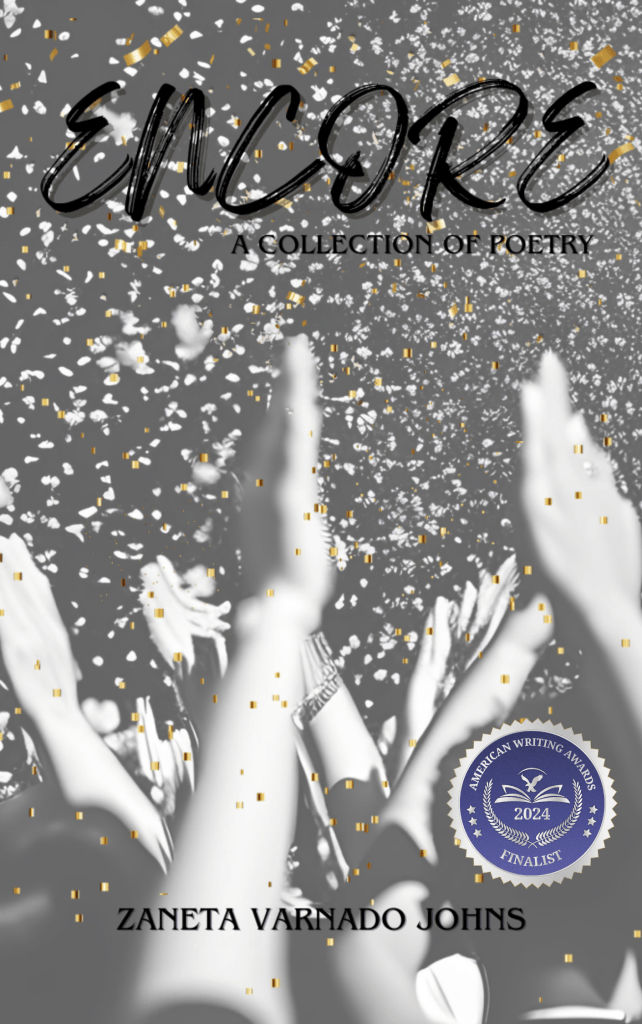
Check out the new addition to Encore! Zaneta Varnado Johns entered her latest poetry collection, “Encore” in the American Writing Awards and received the Finalist Badge!
Finalist: 2024 American Writing Awards
Internationally recognized poet and author Zaneta Varnado Johns is back, fueled by passion, purpose, and steady acclaim. She is spiritually grounded, filled with love, appreciation and awe. In response to the loud applause garnered by her two previous poetry collections, Johns presents Encore: A Collection of Poetry. Featuring ninety-nine select poems, Encore is a gift from the author’s heart. In the book’s Dedication, Johns states, “For every relative, friend, poet, and organizational leader who pushed, prodded, nudged, and encouraged me: this one’s for you. I titled this book to acknowledge your applause. I heard it. I loved it. I responded. This is your encore-from my heart to yours.” Some poems, previously featured globally in anthologies, make an encore appearance in this collection.
Take your seat and prepare to be enchanted by Encore’s stellar performance. Encore begins with romantic musings and essences sparked by the poet’s life and thoughtful interpretations of the lives of others. Poetic threads are woven through lyrics inspired by favored locales. From Hawaii to Boston’s Cape Cod, Colorado to Greece, Johns writes as she marvels at her surroundings and experiences. Her compassion for people is beautifully expressed either as poetic observations or unique tributes found in the chapter titled, “In Awe.” The heartwarming “Joy in Her Swing” celebrates the resilience of five-year-old Azaria whose mother and grandmother passed away within three years of each other, entrusting her care to her grandmother’s devoted selfless childhood friend. Johns’ prose poem, “She Speaks for Me,” is a masterpiece showcasing renowned African and African American women poets who persuade her writing.
Johns has a lot to say about the human condition. Some poems are concise while others are grouped in the chapters titled “Rants and Spiels” or “Keynotes.” She passionately addresses hunger, gun violence, women’s empowerment, and prejudice, among other contemporary issues. Anyone with a heart will be stirred by “Hunger, a Global Tragedy” and “It Has to Stop,” two poignant poems illuminating the realities of hunger and the poet’s gut-wrenching reaction to yet another senseless school shooting. Johns is a personal figure in “Not Eclipsed” and “Life as a Breeze,” expressions concerning skin color and prejudice.
Johns imparts the spirit of Hawaii’s aloha in Encore’s message. “My Walk Along the Ocean” and “Blessed Life” are examples of poems reflecting tranquil moments of immense gratitude. Encore’s expressions are accompanied by complementary images and quotes-the poet’s signature accent found in her two previous collections. With Encore, Zaneta Varnado Johns leaves an indelible mark with every word and artistic rendering.
Congratulations to Zan!
You can check it out on ProlificPulse.com It’s front-page news!!
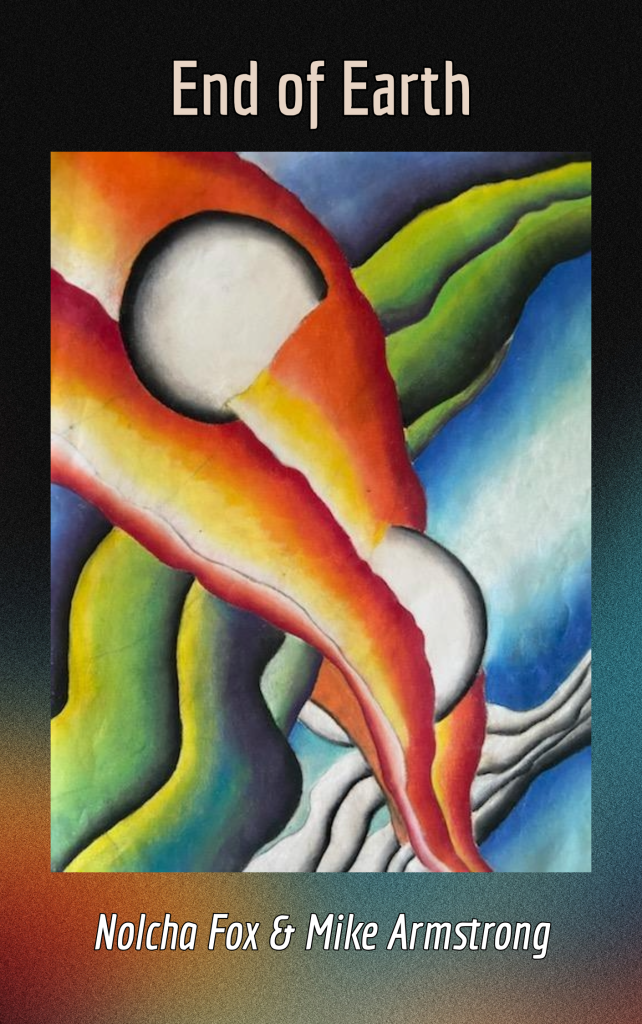
The Stars Will Remember, a review of End of Earth by Nolcha Fox, art by Mike Armstrong. Prolific Pulse Press, Raleigh, NC. 2024. $15.95 paper, $4.99 Kindle.
Perhaps in a future ions away, the stars will remember life on earth, the life of planets, animals, and humans, which is precisely what Nolcha Fox is writing about in End of Earth, a document of that life in poetic lines about people, places, and things in her past and present. Her poems, each of them, are complimented by Mike Armstrong’s paintings, that are vivid, abstract, and evoke impressions suited to the particular mood of each poem. In her point of view, sensibilities, and brevity, Fox is our contemporary Emily Dickinson, and very much herself, her own person. Three devices that make her utterances poems in End of Earth are metaphors, personification, and repetition.
Greed is the subject of “They Circle.” Hucksters, charlatans, thieves who misrepresent themselves, preying upon the vulnerable, are “money vampires.” Fox sets up a scene of roadkill and vultures. Outrageously, the roadkill, a dead possum? is speaking. With three words “a second look” Fox shifts the scene, from outdoors to indoors, and a person, perhaps by a computer, and perhaps indoors. Part of the poem’s economy lies in this ambiguity. The speaker could be indoors, or in an outdoors market, or even in a mall. Then she smoothly goes back to the roadkill. Form and content meld. Just as vultures circle in the sky, imagery takes the reader back to the beginning. And then also, there’s the “cook” and “spatula” kitchen diction, adding another dimension, evoking the density of texture needed to make a poem about greed that is powerful in that less says more. Fox indeed knows her way around a metaphor.
The sun is personified as feminine, as in the adage “when the fat lady sings,” in “The sun throws,” again with great economy. So, in the middle the euphony of “singing snow into icicles” signals a shift in imagery. In eight lines, a roof, a mountain, and a stage all fit wonderfully into this poem, with its structure of personification, a poetic device Fox uses satirically in “Gardening.” The wonder of “Gardening” is that the statement it makes is not only for today, but for times past. The human characteristic of stupidity is given to plant life. It’s a thing people cultivate, thus the garden itself becomes society, a broader and abstract entity, as in social media. The gardener “tells her friends stupidity” is a good thing, that it will provide nourishment and health, like a squash. The colloquial “buy” followed by the agricultural “stalk” conclude this poem in which the speaker means the opposite of what she says, and the import of what she says is achieved by personification: an attribute of human nature manifests itself in the form of a plant.
Fox employs repetition with variation well in “Pieces and Parts.” “No one sees…No one takes…When each one walks…,” a poem in which a “thingamabob” coexists with a “coffin” and the self interacts with the other. The tone in “Pieces and Parts” is defiant, the speaker defies nothing less than…death, (which is perhaps why Emily Dickinson wrote poems). In Fox’s “If I Can’t Overcome” the tone is resolved. Its structure of repetition, “let me be…let me be…let me be…let me breathe…let me welcome” lends to its elegance.
…let me be the stillness
that seeps into the clouds
before the rain.
Let me be the silence
that soothes the branches
just before the wind
announces snow…
Just as Mike Armstrong creates lines, angles, circles, squares, and other shapes that move through a visual pattern, Nolcha Fox creates lines that move through a verbal pattern. Reading her poems and coming back to each yields appreciation as well as pleasure. Whether light-hearted or dead serious, she is always exacting. She runs a gamut of human emotions and experience in poems that stand not just for today but for times past and times to come.
About Peter Mladinic:
Peter Mladinic lives in Hobbs, New Mexico. He was born and raised in New Jersey and has lived in the Midwest and in the South. He enlisted in the United States Navy and served for four years. He received an MFA in Creative Writing from the University of Arkansas in 1985, and taught English for thirty years at New Mexico Junior College in Hobbs. He has edited two books: Love, Death, and the Plains; and Ethnic Lea: Southeast New Mexico Stories, which are available from the Lea County Museum Press, as are his three volumes of poetry: Lost in Lea, Dressed for Winter, and his most recent book, co-authored with Charles Behlen, Falling Awake in Lovington. He is a past board member of the Lea County Museum and a former president of the Lea County Humane Society. An animal activist, he supports numerous animal rescue groups. Two of his main concerns are to bring an end to the euthanizing of animals in shelters and to help get animals in shelters adopted into caring homes. In his spare time, he enjoys yoga, listening to music, reading, and spending time with his six dogs. Recently, his poems have been published in numerous online journals in the US, Canada, England, Ireland, and Australia
Welcome to my Reading Nook. A little corner of the web dedicated to the bookworms out there like me. So if you like what you see then follow me :)
Международен конкурс за хайку "Мая Любенова"
Romance, mystery, suspense, & small town humor...
Poetry, Flash Fiction, Stories, Musings, Photos
The Truth is Stranger than Fiction
Empowering a World of Readers, One Book at a Time
A Magazine Where Words and Books Meet the World
A personal blog sharing heartfelt poetry inspired by nature, beauty, and soulful reflection.
Unravelling thoughts. One word. One poem at a time.
"I am a wildflower, free"
Daydreaming and then, maybe, writing a poem about it. And that's my life.
Just Another Trans Writer Guy
she strives to do it all
As a teacher, I will always remain a student. In the classroom of life, l wish to work with and educate others. Whether you’re a teacher, student, or just your average person, here are a few of my "TEACHERble" moments.
Beautiful & Damned!
Life on the go ❤️
Dive into a collection of memories, musings and emotions delicately concocted into stories and introspective articles
Hi! my name is Sebastian (You can call me Seb!) ...welcome to my Blog. I'm a photographer from Worcester, Worcestershire, England. Thanks for dropping by! I hope you enjoy my work.
 Prolific Pulse Blog