

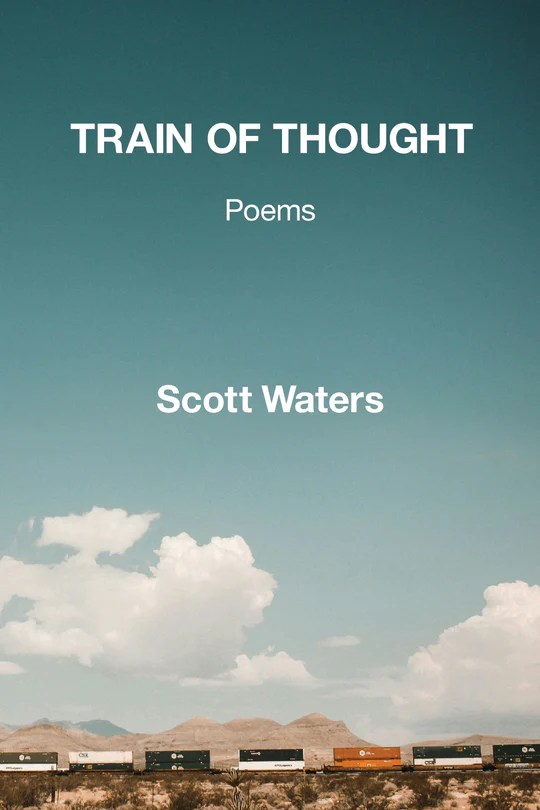
So the Day Doesn’t Escape Too Soon, a review of Train of Thought by Scott Waters. Kelsay Books. American Fork, Utah. 2025. $17.00 paper
In a documentary film on the great director Yasajiro Ozu, Wim Wenders has some wonderful commentary on trains in Ozu’s films. Trains in Ozu are symbols of passage, and a similar symbolism is going on in the poems of Scott Waters. As in Ozu, Waters’ trains are often commuter trains, taking people from their homes to work or to business in a city. Trains appear in various contexts in most of these poems, that concern themselves, and their readers with, like a train, going forward, and the persistence of nature, art, and humanity.
Nature thrives among the ruins. The vital coexists with the decadent. In “When I Took This Job,” the book’s opening poem, “the lulling rumble / of the train car” is juxtaposed with “three ducks shot like arrows / over a Cabernet pond.” The lulling rhythm varies with the quick, smooth flight, as seen from a window. In another poem, hills are likened to horses. In “Small,” “the morning news” is enveloped by a finch’s descent “through the bright pond of air” and “a spray of white petals / against your windshield.” In “Awakening on the 5:05,” the democracy of “a lavender stream in the woods” is accented, how it is there for all, to sustain animal life and evoke tranquility in humans, regardless of their socio-economic strata. It is there for all, as are the “oak, hickory, dogwood” trees in “Parallel Tracks,” the “mountain stream” in “Leaving the Cove,” and the “blackbirds” that rise “from marshes” in “I Took a Train to Fresno.” The human, the machine, and nature converge in “Shredding the Clouds,” a poem about ascent.
Three seagulls
circle above
a commuter train
parking lot
This passage is followed by an image of a raven’s descent onto a parking lot, perhaps to pick up a scrap of food left there. And then, another ascent “a small white plane,” in appearance like a gull, “chops through a / grey scarf of clouds.”
What is art? Perhaps, anything the artist can get away with. The idea that the subject chooses the artist is alive and well in “About the Floor,” with its tone of wry humor. The commuting speaker contemplates nature “cumulus piled / on western hills,” and human-made “beams as thick / as battering rams,” and ends up writing (memorably) about “the filthy / train / floor.” In “Body of Work” he describes in an array of arresting images a painting that has a quilt-like collage. “God’s Diorama” is three-dimensional, like a Joseph Cornell box. Beauty in art underlies “Puffs,” “glory / is an / English train.” The train, like a work of art, “startles you / when it arrives.” The role of the imagination in art underlies “Waking the Phoenix” as a train moves through hills, the “hills roll on,” the sun, like a new-born bird, “learns to fly” and finally is “soaring now,” a metaphor for humans being alive enough to imagine. Art mirrors life. In “Switch,” the speaker says “I …
pull out a pen
and the train, the mole,
the hills, the clouds,
the fog
are all at once embraced
by arms
of light.
The poet Philip Larkin said “What will survive of us is love.” In Train of Thought the best of humanity is exemplified in the care people give to places, things, and each other. Their “best” is continual, starting from “the / loved one / at / the door” in “Castaway Mind,” and ending with the “dark forces” in “Let Us Now Praise Breakfast in the Sun,” a poem that, despite those dark forces, is celebratory. Life is precious because people are mortal, the speaker suggests: “I am 57 / beard more grey/ than it was last week.” With a grey beard and a cognizance of death he says of his company’s CEO, a man who “died in his sleep … He will never face/ another Monday.” In “One Thing” a scent of perfume triggers a romantic memory, and in “A Bit of Flannel” the image of a shirt on a clothesline triggers a memory of familial love. In “Better Home and Garden” the speaker’s empathy for whoever lives in a “Tent by the railroad tracks” abides. A man rummages (“among the flung garbage/ of his campsite”)
as she hangs laundry
among the overgrown weeds
of a yard that belongs
to an unsent postcard
of a home.
Any review of Train of Thought would be remiss without the mention of “Mumbly Old Men.” With its precise showing and telling, it contrasts reality and virtual reality, accenting differences between then and now. One of the best in this collection of very good poems, it deserves to be in an anthology of the best of contemporary poetry. It engages all the five senses, and in a few words says a whole lot, not only about the speaker but about anyone living within the touch of a keypad. Fortunately, for readers, other poems in this book have the import of “Mumbly Old Men,” a poem with something to say that readers are unlikely to forget.
About Peter Mladinic
Peter Mladinic lives in Hobbs, New Mexico. He was born and raised in New Jersey and has lived in the Midwest and in the South. He enlisted in the United States Navy and served for four years. He received an MFA in Creative Writing from the University of Arkansas in 1985, and taught English for thirty years at New Mexico Junior College in Hobbs. He has edited two books: Love, Death, and the Plains; and Ethnic Lea: Southeast New Mexico Stories, which are available from the Lea County Museum Press, as are three volumes of poetry: Lost in Lea, Dressed for Winter, and Falling Awake in Lovington. His most recent book, Knives on a Table was published by Better Than Starbucks Publications in 2021. He is a past board member of the Lea County Museum and a former president of the Lea County Humane Society. An animal advocate, he supports numerous animal rescue groups. Two of his main concerns are to bring an end to the euthanizing of animals in shelters and to help get animals in shelters adopted into caring homes.
 Prolific Pulse Blog