
/https://samslibrary.com/end-of-earth-by-nolcha-fox-and-mike-armstrong/

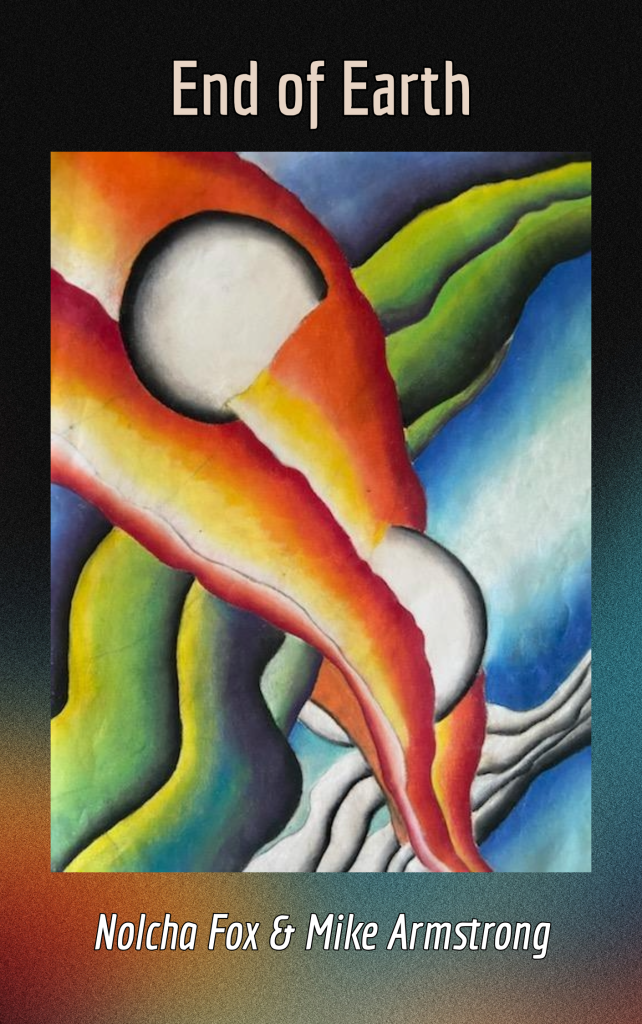
The Stars Will Remember, a review of End of Earth by Nolcha Fox, art by Mike Armstrong. Prolific Pulse Press, Raleigh, NC. 2024. $15.95 paper, $4.99 Kindle.
Perhaps in a future ions away, the stars will remember life on earth, the life of planets, animals, and humans, which is precisely what Nolcha Fox is writing about in End of Earth, a document of that life in poetic lines about people, places, and things in her past and present. Her poems, each of them, are complimented by Mike Armstrong’s paintings, that are vivid, abstract, and evoke impressions suited to the particular mood of each poem. In her point of view, sensibilities, and brevity, Fox is our contemporary Emily Dickinson, and very much herself, her own person. Three devices that make her utterances poems in End of Earth are metaphors, personification, and repetition.
Greed is the subject of “They Circle.” Hucksters, charlatans, thieves who misrepresent themselves, preying upon the vulnerable, are “money vampires.” Fox sets up a scene of roadkill and vultures. Outrageously, the roadkill, a dead possum? is speaking. With three words “a second look” Fox shifts the scene, from outdoors to indoors, and a person, perhaps by a computer, and perhaps indoors. Part of the poem’s economy lies in this ambiguity. The speaker could be indoors, or in an outdoors market, or even in a mall. Then she smoothly goes back to the roadkill. Form and content meld. Just as vultures circle in the sky, imagery takes the reader back to the beginning. And then also, there’s the “cook” and “spatula” kitchen diction, adding another dimension, evoking the density of texture needed to make a poem about greed that is powerful in that less says more. Fox indeed knows her way around a metaphor.
The sun is personified as feminine, as in the adage “when the fat lady sings,” in “The sun throws,” again with great economy. So, in the middle the euphony of “singing snow into icicles” signals a shift in imagery. In eight lines, a roof, a mountain, and a stage all fit wonderfully into this poem, with its structure of personification, a poetic device Fox uses satirically in “Gardening.” The wonder of “Gardening” is that the statement it makes is not only for today, but for times past. The human characteristic of stupidity is given to plant life. It’s a thing people cultivate, thus the garden itself becomes society, a broader and abstract entity, as in social media. The gardener “tells her friends stupidity” is a good thing, that it will provide nourishment and health, like a squash. The colloquial “buy” followed by the agricultural “stalk” conclude this poem in which the speaker means the opposite of what she says, and the import of what she says is achieved by personification: an attribute of human nature manifests itself in the form of a plant.
Fox employs repetition with variation well in “Pieces and Parts.” “No one sees…No one takes…When each one walks…,” a poem in which a “thingamabob” coexists with a “coffin” and the self interacts with the other. The tone in “Pieces and Parts” is defiant, the speaker defies nothing less than…death, (which is perhaps why Emily Dickinson wrote poems). In Fox’s “If I Can’t Overcome” the tone is resolved. Its structure of repetition, “let me be…let me be…let me be…let me breathe…let me welcome” lends to its elegance.
…let me be the stillness
that seeps into the clouds
before the rain.
Let me be the silence
that soothes the branches
just before the wind
announces snow…
Just as Mike Armstrong creates lines, angles, circles, squares, and other shapes that move through a visual pattern, Nolcha Fox creates lines that move through a verbal pattern. Reading her poems and coming back to each yields appreciation as well as pleasure. Whether light-hearted or dead serious, she is always exacting. She runs a gamut of human emotions and experience in poems that stand not just for today but for times past and times to come.
About Peter Mladinic:
Peter Mladinic lives in Hobbs, New Mexico. He was born and raised in New Jersey and has lived in the Midwest and in the South. He enlisted in the United States Navy and served for four years. He received an MFA in Creative Writing from the University of Arkansas in 1985, and taught English for thirty years at New Mexico Junior College in Hobbs. He has edited two books: Love, Death, and the Plains; and Ethnic Lea: Southeast New Mexico Stories, which are available from the Lea County Museum Press, as are his three volumes of poetry: Lost in Lea, Dressed for Winter, and his most recent book, co-authored with Charles Behlen, Falling Awake in Lovington. He is a past board member of the Lea County Museum and a former president of the Lea County Humane Society. An animal activist, he supports numerous animal rescue groups. Two of his main concerns are to bring an end to the euthanizing of animals in shelters and to help get animals in shelters adopted into caring homes. In his spare time, he enjoys yoga, listening to music, reading, and spending time with his six dogs. Recently, his poems have been published in numerous online journals in the US, Canada, England, Ireland, and Australia

Words into Elephants is a work of imagination. For its brevity and exactitude the book it comes closest to is Richard Brautigan’s The Pill Versus the Springhill Mine Disaster. Both books’ personal point of view reflects the human condition. For Fox meaning lies in metaphor, in manipulation of sound and rhythm, and in ironies that convey poignancy and humor.
Most of these poems have metaphors. Metaphors seem an integral part of the poet’s thinking. Her collection begins with “A broken promise.” The promise is given the tangibility of a plastic thing, for example a model plane or car a person has built. Once broken, “No glue can put it/ back together.” The recipient of the broken promise takes “Its shards” into a dark alley and dumps them in a trash barrel, under the debris of “good intentions.” This extended metaphor implies betrayal, disappointment, and perhaps regret on the part of the person who broke the promise. “I have big dreams” suggests self-worth. The speaker is a pearl in a seashell, safe and hidden from “sharks.” But she will “upgrade/to a pickup truck and camper shell,” figuratively come out of her shell, to travel, and “see the world.” Fox makes this imaginative transition with no waste of words, to suggest where there is life there is hope. In “Morning is a river” he, crossing that river, stumbles “on stones/ of a life of almost/ but not quite.” A comment on human aspirations. The sand on the riverbed contains “metal findings/ enough to build a cage/ without a door.” Perhaps “he” has worked his way into a trap of his own making.
The sense is in the sound. Fox uses full rhymes for resolutions, slant rhymes for partial resolutions, and in “Borderline” repetition with variation, “sense, no sense, “nonsense” to evoke ideas. “Colors Are Running” ends with the internal rhyme of “car” and cigar.” “Coordinated,” with its humor, has a structure of alliterative c sounds. “Fragments” is enveloped by the slant rhymes of the first line’s “through” and the last line’s “gloom.” And in the middle of “My muse” the end rhymes “her” and “bender” lend a comic, colloquial tone to this poem about the muse.
Just as metaphors come natural to Fox, so does irony; it has to do with her world view. She does not shy from the dark side, nor does she hesitate to find humor in it, when humor is appropriately called for. A dark humor is at work in “a swerve.” The speaker has crashed her car into a guardrail, avoiding a deer in the road. She observes her flat tire. The first thing she thinks of is not to call for help, but how that tire reminds her of a cake she baked, perhaps earlier that day. Another poem that jars expectations with its irony, to humorous effect is “Dogs and buttered toast aren’t cats.” Noting subtle differences between these animals, the speaker calls the cat “a dirty dog.” This is a very exacting and skillful poem, one of many. Irony has a poignant effect in “I stuffed my anger,” a poem that beings with “a glass marble” and ends with “a flower;” and “Sad seagull,” with verbs “shatter” and “pierce.” The speaker says the seagull doesn’t want to leave and doesn’t want to stay and calls on the seagull to “Fly me on your back/ across the ocean.” In her evocation she speaks not only for herself but for humankind. Lastly, irony is used powerfully and poignantly in the final poem, “Your cigar is missing,” which suggests familiarity with the dead man she addresses (Your cigar is missing from your grave) and words of caution to the dead woman buried beside him. “Let her find out…when she can’t get away.” This is a dark, ironic poem that taps into memory and emotions of the human condition.
Elephants into Words is a book of compact poems that “hit the mark” again and again. They evoke the whole gambit of emotions, their ultimate topic, what it means to be alive. They are the word creations of a poet who writes to know and discovers as she writes. That is all to the delight of her readers. Each poem is a brief adventure in language, an imaginative flight grounded in the reality the world we share.
Words into Elephants – Nolcha Fox
Thank you to Peter Mladinic for this excellent review.
Learn more about Peter Mladinic and his latest poetry collection.
Welcome to my Reading Nook. A little corner of the web dedicated to the bookworms out there like me. So if you like what you see then follow me :)
Международен конкурс за хайку "Мая Любенова"
Romance, mystery, suspense, & small town humor...
Poetry, Flash Fiction, Stories, Musings, Photos
The Truth is Stranger than Fiction
Empowering a World of Readers, One Book at a Time
A Magazine Where Words and Books Meet the World
A personal blog sharing heartfelt poetry inspired by nature, beauty, and soulful reflection.
Unravelling thoughts. One word. One poem at a time.
"I am a wildflower, free"
Daydreaming and then, maybe, writing a poem about it. And that's my life.
Just Another Trans Writer Guy
she strives to do it all
As a teacher, I will always remain a student. In the classroom of life, l wish to work with and educate others. Whether you’re a teacher, student, or just your average person, here are a few of my "TEACHERble" moments.
Beautiful & Damned!
Life on the go ❤️
Dive into a collection of memories, musings and emotions delicately concocted into stories and introspective articles
Hi! my name is Sebastian (You can call me Seb!) ...welcome to my Blog. I'm a photographer from Worcester, Worcestershire, England. Thanks for dropping by! I hope you enjoy my work.
 Prolific Pulse Blog