

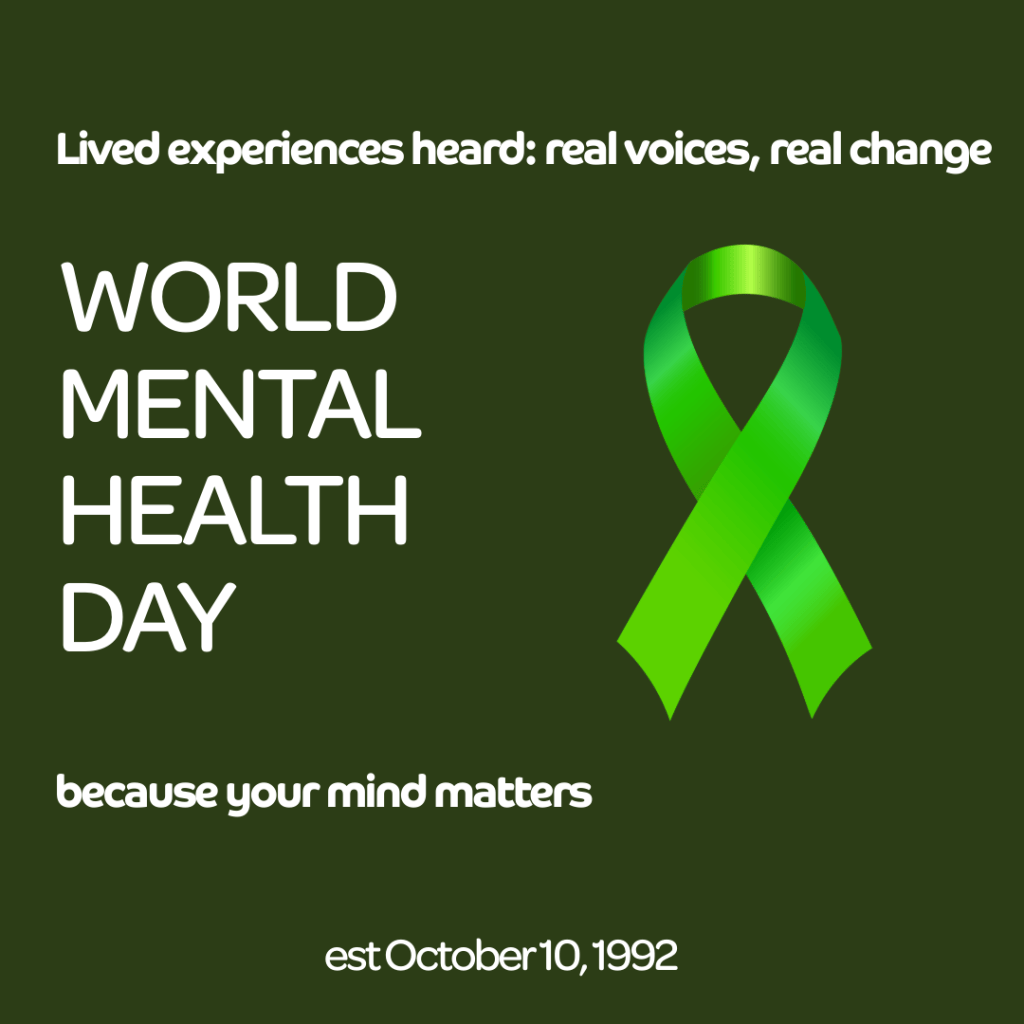
Today, October 10, 2026, is World Mental Health Day, and this year’s theme is “Lived Experiences Heard: Real Voices, Real Change.” Below are some questions to reflect on and simple activities to help families, friends and groups listen to one another.
What Is World Mental Health Day?
World Mental Health Day was first observed in 1992 at the initiative of Richard Hunter, then Deputy Secretary General of the World Federation for Mental Health. It is marked every year on October 10, with a new theme each year to focus attention on a different part of mental health.
The 2026 Theme: “Lived Experiences Heard: Real Voices, Real Change”
How does this year’s theme affect you and me? I believe it is about all of us, and our personal need to stay mentally healthy or to find the path to get there. People who have lived through mental health challenges know things that no textbook can teach, and when their voices are truly heard, real change follows.
Mental health is a personal and a long-lasting concern with people I have cared for and about for much of my life. As a social worker and advocate for mental health I believe that lack of services, accessibility to services, and the stigma associated with mental health are major factors. If we don’t address these, we risk more distancing leading to poor care.
5 Questions to Reflect On
1. Do you recall a time when you felt truly understood? What did the other person do that fostered this feeling? Often it is simple things, like listening without interrupting or not rushing to fix the problem.
2. What unique insights do clinicians, researchers and people with lived experience each hold that others might miss? Each group sees mental health from a different angle, and the best care brings all three together.
3. How has openness from public figures shifted attitudes about mental health? Think of social influencers, celebrities, athletes and others in all areas of life who have spoken honestly about their struggles.
4. What risks do people take when they share their stories, and how can we protect them? For example, workplace environments and attitudes, stigma about mental health, and the pain of reliving difficult experiences.
5. What changes have you seen that made a real difference? If you have heard stories from others or experienced improvements yourself, such as legal changes, funding or better access to services, what made those changes possible? What factors played into them?

Activities for Putting Mental Health into Practice
1. The two-minute listening circle
In a family, circle of friends, church group, or simply around a table over nachos, each person has two uninterrupted minutes to share. Listeners respond to what they heard before anyone offers ideas or advice.
2. Redesign a local service
Pick a real service, such as a school counseling program, and redesign one feature with people who have experienced or observed its gaps. Perhaps there are accessibility issues in your community that the group can help resolve. Factors to consider include stigma, language barriers and cost.
3. Rethink everyday language
Recognize slang terms related to mental health and discuss how they shape perceptions of people with lived experience. What are some better expressions to use instead?
4. Share one helpful habit
Have each person name one thing that helps when talking with someone who has lived experience, such as asking open questions, being patient with silence, or simply saying “thank you for telling me.”
Frequently Asked Questions
When is World Mental Health Day?
World Mental Health Day is observed every year on October 10.
What is the World Mental Health Day 2026 theme?
The 2026 theme is “Lived Experiences Heard: Real Voices, Real Change,” announced by the World Federation for Mental Health.
Who started World Mental Health Day?
World Mental Health Day was started in 1992 by the World Federation for Mental Health, at the initiative of its Deputy Secretary General, Richard Hunter.
Where to Find Help
Always and forever, please know that there is help.
- In the U.S., call or text 988 to reach the 988 Suicide & Crisis Lifeline, available 24/7.
- Outside the U.S., see Suicide Hotlines and Prevention Resources Around the World from Psychology Today.
- If you or someone else is in immediate danger, call your local emergency number.
Lisa Tomey-Zonneveld is a never-retired social worker who is currently an artist, write, and publisher in Raleigh, North Caroline.

