

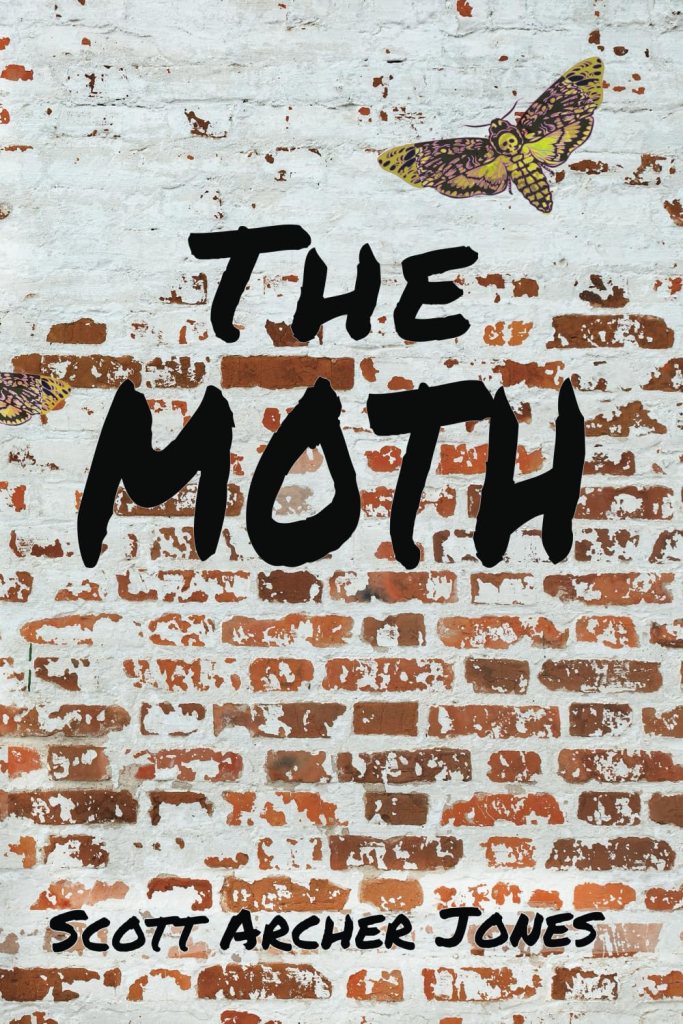
Watches, Cameras, Firearms, Fake IDs: a review of The Moth by Scott Archer Jones. Fomite. Burlington, VT. 2025. $15 paper.
The Moth takes readers on a ride to East L.A. and keeps them on the edge of their seats right to the end as its protagonist, Frank, a.k.a., The Moth, a pawn shop proprietor, sinks deeper and deeper into circumstances beyond his control. Part of the tension is that Frank is the sum of his choices, but he can’t control everything. A fusion of person and place, strong character relationships, and an abiding sense of danger make The Moth a memorable thriller in a noir style that calls to mind the fictional turf of Raymond Chandler and John Fante.
The Moth is character driven. Scott Jones knows that if his readers don’t know they can’t care. One way Jones makes his readers care is by rendering scenes from The Moth’s childhood in the Midwest of the United States. Before he was The Moth, he was Frank, son of a Lithuanian mother and an Irish American father. A central place in Frank’s childhood is the kitchen. It’s in the kitchen that Frank has a scene with his philandering and often absent father that evokes the tension in their relationship, and it’s in the kitchen that Frank learns of the industrial accident that claimed his father’s life. And it’s from the artificial light of the kitchen that Frank and his mother sojourn to the natural light of East L.A., where most of the novel is set. Scott Jones indeed places his readers in that expansive world vastly different from Frank’s claustrophobic roots. It is in East L.A. that he evolves into The Moth. The hospital where Frank’s mother, terminally ill with cancer, lives out her final days; the sidewalks where Frank sells contraband tapes; the food distributing company from which he is fired for giving food to a homeless family; the dark alley where he meets and falls in love with the prostitute Molly; and finally the pawn shop where The Moth works and lives alone in a back apartment are all part of who he is. Similarly other characters in The Moth’s East L.A. neighborhood are products of place. In this place of natural light, the dark of the pawn shop, crowded with items on display and hidden, seems comforting, a refuge, a place where The Moth can be himself.
The Moth evolves into a part of his East L.A. community. A community of people. Some are seasoned criminals, others have criminal ties and indulge in illegal activities; and still others are people who have little and never enough and are in desperate need of help. Molly, drug-addled and controlled by a pimp, is one such desperate person. Some of the best scenes in the novel occur as she and The Moth bond. Her death at the hands of a psychotic, sadistic john is an irreparable loss. It was with Molly that The Moth had a chance for the life he dreamed of when he moved to L.A. Because there are so many shady, seedy characters in The Moth’s East L.A., the innocents (and Molly is at heart an innocent) are all the more valued. The Moth tries to help Molly live a better life. He tries to help a father living with two children in a car get off the streets, and he tries to shelter a teenage girl from her physically abusive father—all to tragic results. But The Moth’s essential goodness, his generosity and empathy for people in dire need of help comes through in carefully rendered scenes.
A person steps into the pawn shop and sees lots of things, but what they don’t see are the fake IDs, the array of firearms, and other weaponry The Moth conceals from the eyes of the casual browser. In one scene he sells a high-powered rifle to the son of a criminal kingpin. The son wants that rifle to right a wrong, but the figurative tables turn, and he dies. The kingpin blames The Moth. For The Moth to keep on living, he must at atone for the son’s death by killing four of the kingpin’s enemies. The Moth is in a bind, and danger abides. Danger is integral to the plot, as The Moth knows violent criminals. What he has is of value to some of those criminals, and what he knows is of value to the police, as represented by a woman, an officer whose career is on the rise. She and The Moth met when she was investigating Molly’s murder. She uses The Moth as a snitch, as he knows things the average shopkeeper would never know. Scott Jones lucidly shows their meetings and The Moth’s dealings with people in his shop and in his community.
The idea of a pawn shop proprietor mixed up in shady dealings is not new, but it plays out beautifully in this novel. Scott Jones makes it believable by giving his readers flesh and blood characters and a well-rounded protagonist. People bring items into a pawn shop and take them out. Or, often those items are taken out by others. In the pawn shop that metaphorically is this novel, through ironic twists and turns, and good storytelling, proprietor-author Scott Jones knows what to put in and what to leave out. The Moth has arrived, an achievement that makes its mark in contemporary literature.
Review Written by Peter Mladinic
About Peter Mladinic
Peter Mladinic’s most recent book of poems, Maiden Rock is available from UnCollected Press. An animal rights advocate, he lives in Hobbs, New Mexico, United States.
 Prolific Pulse Blog