

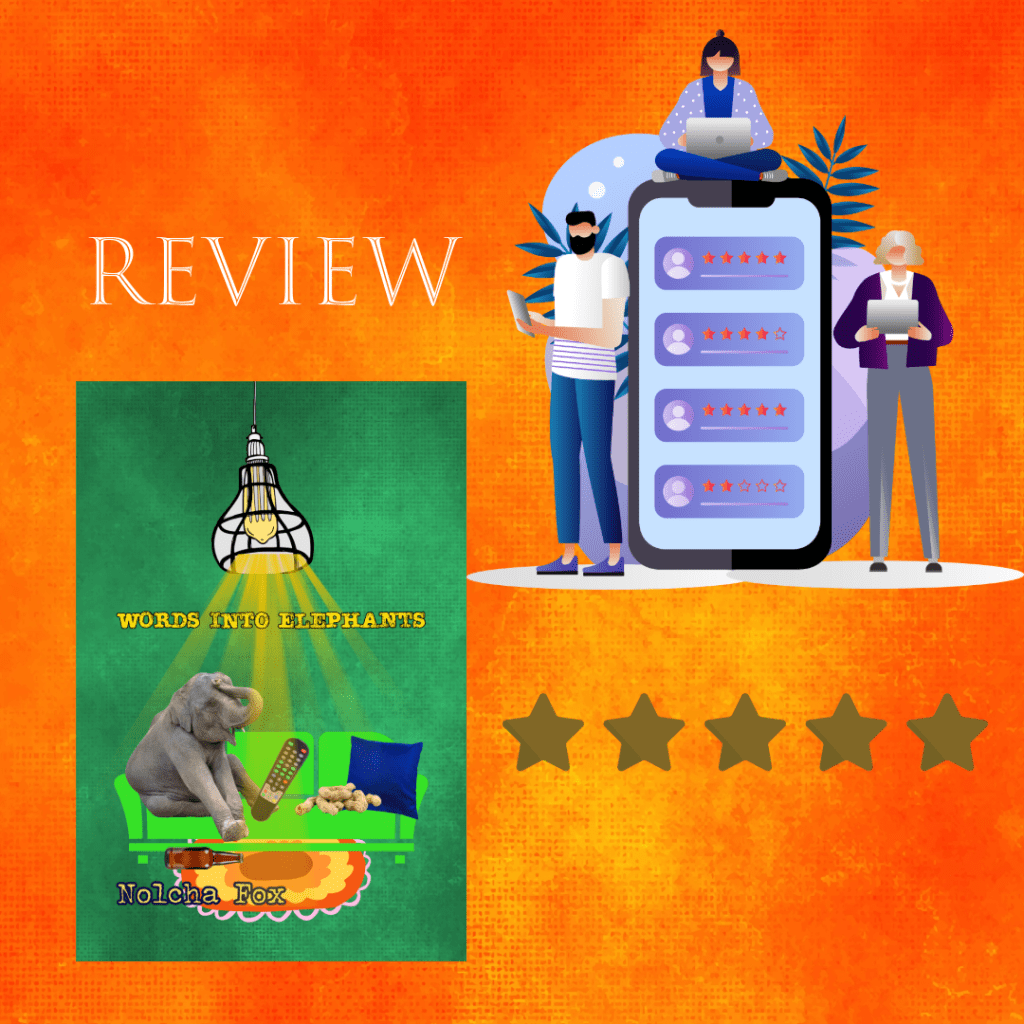
Words into Elephants is a work of imagination. For its brevity and exactitude the book it comes closest to is Richard Brautigan’s The Pill Versus the Springhill Mine Disaster. Both books’ personal point of view reflects the human condition. For Fox meaning lies in metaphor, in manipulation of sound and rhythm, and in ironies that convey poignancy and humor.
Most of these poems have metaphors. Metaphors seem an integral part of the poet’s thinking. Her collection begins with “A broken promise.” The promise is given the tangibility of a plastic thing, for example a model plane or car a person has built. Once broken, “No glue can put it/ back together.” The recipient of the broken promise takes “Its shards” into a dark alley and dumps them in a trash barrel, under the debris of “good intentions.” This extended metaphor implies betrayal, disappointment, and perhaps regret on the part of the person who broke the promise. “I have big dreams” suggests self-worth. The speaker is a pearl in a seashell, safe and hidden from “sharks.” But she will “upgrade/to a pickup truck and camper shell,” figuratively come out of her shell, to travel, and “see the world.” Fox makes this imaginative transition with no waste of words, to suggest where there is life there is hope. In “Morning is a river” he, crossing that river, stumbles “on stones/ of a life of almost/ but not quite.” A comment on human aspirations. The sand on the riverbed contains “metal findings/ enough to build a cage/ without a door.” Perhaps “he” has worked his way into a trap of his own making.
The sense is in the sound. Fox uses full rhymes for resolutions, slant rhymes for partial resolutions, and in “Borderline” repetition with variation, “sense, no sense, “nonsense” to evoke ideas. “Colors Are Running” ends with the internal rhyme of “car” and cigar.” “Coordinated,” with its humor, has a structure of alliterative c sounds. “Fragments” is enveloped by the slant rhymes of the first line’s “through” and the last line’s “gloom.” And in the middle of “My muse” the end rhymes “her” and “bender” lend a comic, colloquial tone to this poem about the muse.
Just as metaphors come natural to Fox, so does irony; it has to do with her world view. She does not shy from the dark side, nor does she hesitate to find humor in it, when humor is appropriately called for. A dark humor is at work in “a swerve.” The speaker has crashed her car into a guardrail, avoiding a deer in the road. She observes her flat tire. The first thing she thinks of is not to call for help, but how that tire reminds her of a cake she baked, perhaps earlier that day. Another poem that jars expectations with its irony, to humorous effect is “Dogs and buttered toast aren’t cats.” Noting subtle differences between these animals, the speaker calls the cat “a dirty dog.” This is a very exacting and skillful poem, one of many. Irony has a poignant effect in “I stuffed my anger,” a poem that beings with “a glass marble” and ends with “a flower;” and “Sad seagull,” with verbs “shatter” and “pierce.” The speaker says the seagull doesn’t want to leave and doesn’t want to stay and calls on the seagull to “Fly me on your back/ across the ocean.” In her evocation she speaks not only for herself but for humankind. Lastly, irony is used powerfully and poignantly in the final poem, “Your cigar is missing,” which suggests familiarity with the dead man she addresses (Your cigar is missing from your grave) and words of caution to the dead woman buried beside him. “Let her find out…when she can’t get away.” This is a dark, ironic poem that taps into memory and emotions of the human condition.
Elephants into Words is a book of compact poems that “hit the mark” again and again. They evoke the whole gambit of emotions, their ultimate topic, what it means to be alive. They are the word creations of a poet who writes to know and discovers as she writes. That is all to the delight of her readers. Each poem is a brief adventure in language, an imaginative flight grounded in the reality the world we share.
Words into Elephants – Nolcha Fox
Thank you to Peter Mladinic for this excellent review.
Learn more about Peter Mladinic and his latest poetry collection.
 Prolific Pulse Blog